Hi Becky- your radish is beautifully rendered and the leaves are really well done! The one leaf I would revisit is the one in the middle. I would not expect to see such a strong highlight on the right side of the leaf and the wide, white veins are distracting. They don’t jive with all the other veins which are so well done! Food for thought – it is always good to practice reflected highlights, but in this case I would not use one. Reflected highlights are commonly found on objects that are laying on a surface or there are multiples of a subject, like a bunch of grapes, etc.. Obviously when a subject is laying on a surface you would have a reflected highlight and a cast shadow. If you prefer to keep the reflected highlight it needs to be toned down a little so it is not so white and loosen the top edge. It needs to blend into the dark toning above it to convey it’s reflective glow.
Nice Becky! Aren’t radishes fun? Way to go tackling leaves. You are off to a great start. You are paying good attention to the way those leaves bend and curl, and I immediately recognized them as radish leaves. I think if you darken up that right side of that front leaf, and narrow up and darken those thick light veins on that same leaf, it will help a lot. I agree with Doug about the reflected highlight. Although you can get some reflected light bouncing off the ground or other objects around a subject that isn’t lying directly on a surface, it wouldn’t be as strong of a reflected highlight as it would be if it were lying on something like a white table. So, it can often look more natural if we tone those reflected highlights down or even leave them out when rendering a subject that isn’t lying on a table. Hope that makes sense!

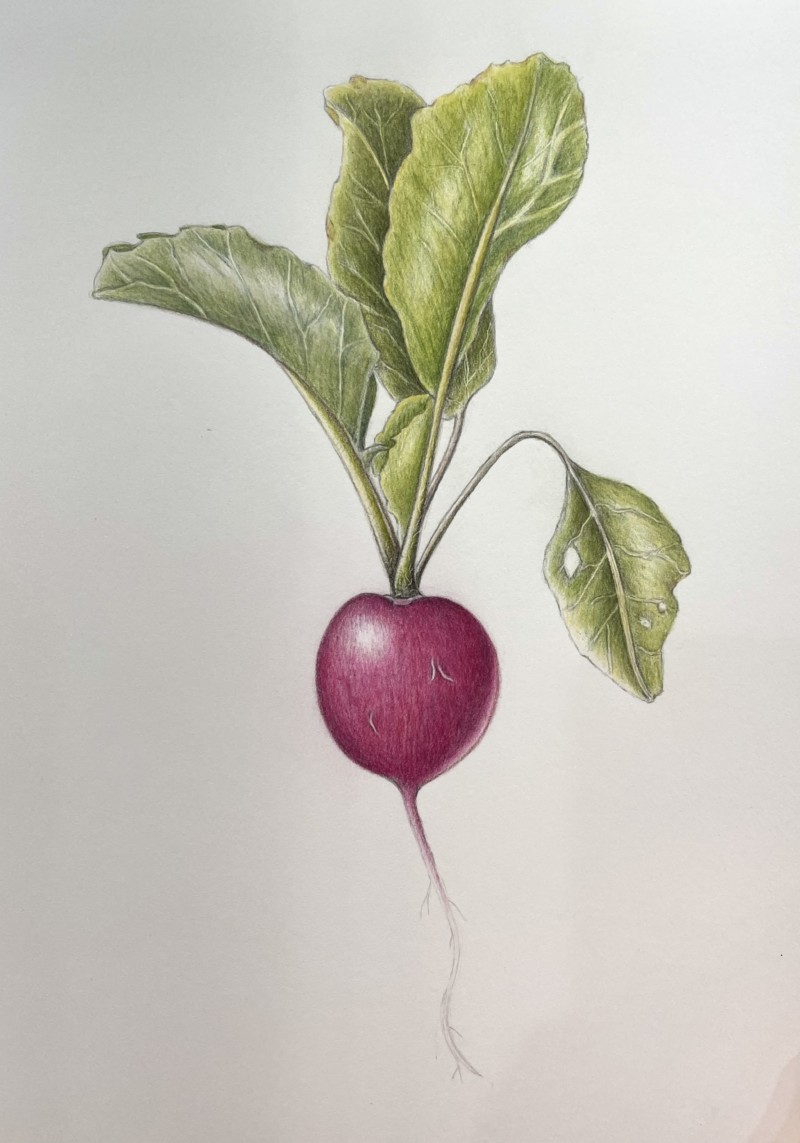
Radish from our market. Leaves are a huge step for me!
Hi Becky- your radish is beautifully rendered and the leaves are really well done! The one leaf I would revisit is the one in the middle. I would not expect to see such a strong highlight on the right side of the leaf and the wide, white veins are distracting. They don’t jive with all the other veins which are so well done! Food for thought – it is always good to practice reflected highlights, but in this case I would not use one. Reflected highlights are commonly found on objects that are laying on a surface or there are multiples of a subject, like a bunch of grapes, etc.. Obviously when a subject is laying on a surface you would have a reflected highlight and a cast shadow. If you prefer to keep the reflected highlight it needs to be toned down a little so it is not so white and loosen the top edge. It needs to blend into the dark toning above it to convey it’s reflective glow.
Nice Becky! Aren’t radishes fun? Way to go tackling leaves. You are off to a great start. You are paying good attention to the way those leaves bend and curl, and I immediately recognized them as radish leaves. I think if you darken up that right side of that front leaf, and narrow up and darken those thick light veins on that same leaf, it will help a lot. I agree with Doug about the reflected highlight. Although you can get some reflected light bouncing off the ground or other objects around a subject that isn’t lying directly on a surface, it wouldn’t be as strong of a reflected highlight as it would be if it were lying on something like a white table. So, it can often look more natural if we tone those reflected highlights down or even leave them out when rendering a subject that isn’t lying on a table. Hope that makes sense!