One of the problems I didn’t quite know how to address was showing cast shadow when a cylinder wasn’t directly in contact with the cylinder below it. The vertical cylinder on the far right doesn’t touch the top horizontal cylinder; the bottom horizontal cylinder doesn’t touch the vertical cylinder on the left. I tried to show the cast shadows at these intersections as being lighter and less distinct than they would have been if the cylinders were directly in contact. I don’t think that was too successful. This was a really valuable (although difficult) exercise.
Hi Constance, The fact that you are observing and trying to work out the cast shadows is evidence of really good observational skills. I have seen many students just add a cast shadow in a way that doesn’t address that the shadow falls on a curved surface or that the shadow would be different if the cylinder is not in direct contact with the cylinder below it. Good job! My suggestion is to think of the light source. And why there is a shadow in the first place, ie. absence of light. I see you have the correct ideal that the shadow would be lighter when the cylinder is not touching, as light is getting underneath. The darkest point in a drawing is almost alway right where the object sits on a surface. That is where there is the least amount of light.

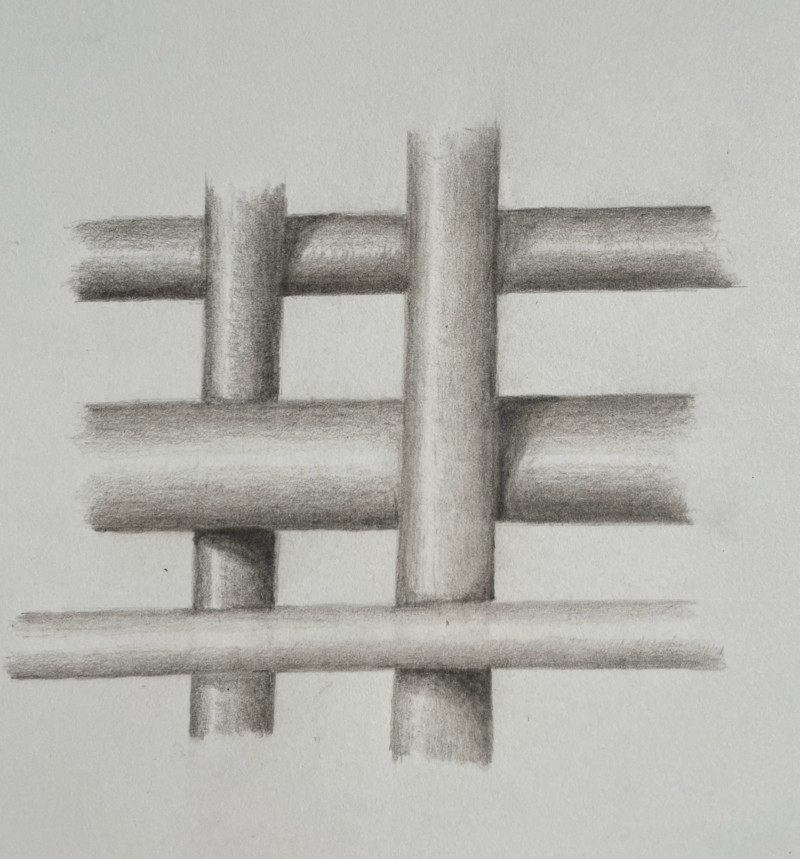
One of the problems I didn’t quite know how to address was showing cast shadow when a cylinder wasn’t directly in contact with the cylinder below it. The vertical cylinder on the far right doesn’t touch the top horizontal cylinder; the bottom horizontal cylinder doesn’t touch the vertical cylinder on the left. I tried to show the cast shadows at these intersections as being lighter and less distinct than they would have been if the cylinders were directly in contact. I don’t think that was too successful. This was a really valuable (although difficult) exercise.
Hi Constance, The fact that you are observing and trying to work out the cast shadows is evidence of really good observational skills. I have seen many students just add a cast shadow in a way that doesn’t address that the shadow falls on a curved surface or that the shadow would be different if the cylinder is not in direct contact with the cylinder below it. Good job! My suggestion is to think of the light source. And why there is a shadow in the first place, ie. absence of light. I see you have the correct ideal that the shadow would be lighter when the cylinder is not touching, as light is getting underneath. The darkest point in a drawing is almost alway right where the object sits on a surface. That is where there is the least amount of light.
I second Katy’s comments on your willingness and keenness to observe. 🙂 That’s the funnest part for me.