BLOOM 2026
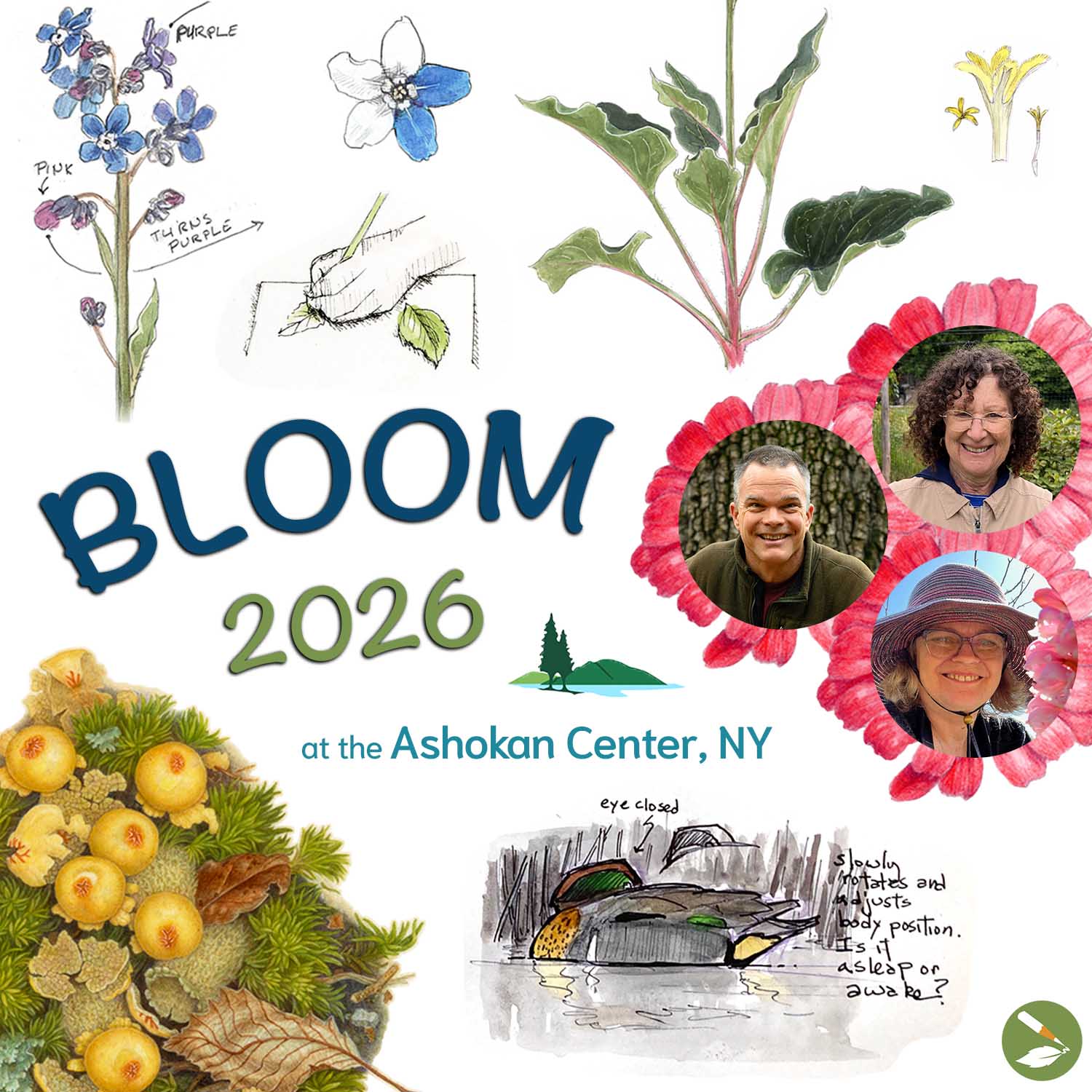
BLOOM: Botanical Learning Outdoors Observational Meetup
A Botanical Art & Nature Journaling Retreat Rooted in Curiosity, Creativity, and Community
FIND FULL RETREAT DETAILS HERE
BLOOM: Botanical Learning Outdoors Observational Meetup
A Botanical Art & Nature Journaling Retreat Rooted in Curiosity, Creativity, and Community
Instructors: John Muir Laws, Wendy Hollender, & Carol Woodin
*When: Friday, August 7 – Sunday, August 9, 2026
Where: The Ashokan Center, Olivebridge, NY
Who’s invited?: Nature enthusiasts and curious folks of ALL artistic skill levels, aspiring to advanced
*If you can’t make it for the full weekend, DAY PASSES are now available for Saturday and Sunday!
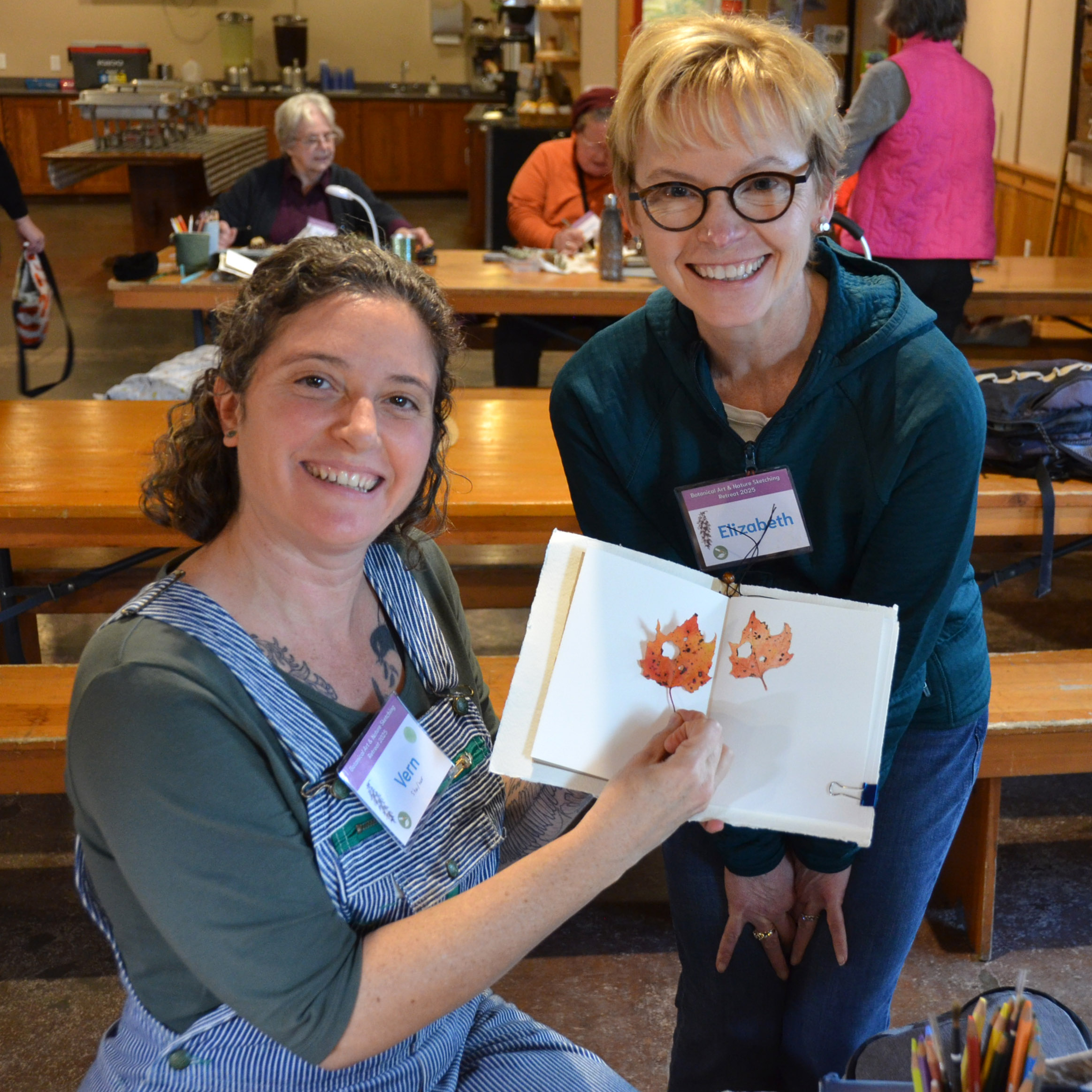
Have you ever stopped to admire a fascinating flower? Paused to pick up a lovely leaf, perhaps? Or been distracted by a brilliant bird or bug? If the answer is yes, you don’t want to miss this unforgettable weekend at the historic Ashokan Center in New York’s Catskill Mountains.
BLOOM encourages us to explore, appreciate, and wonder about all the living things sharing this extraordinary earth with us. Learn from professional botanical artists and leaders of the nature journaling movement, not just in structured classes, but also in casual conversation over meals, in sketching side by side, and in touring the landscape together.

BLOOM is…
🌼where observation deepens, skills expand, and strangers become sketching companions.
🌼an invitation to grow, rooted in the idea that creativity flourishes best when it’s shared
🌼where botanical illustrations and nature journals come to life through shared curiosity, open eyes, and the joy of learning together.
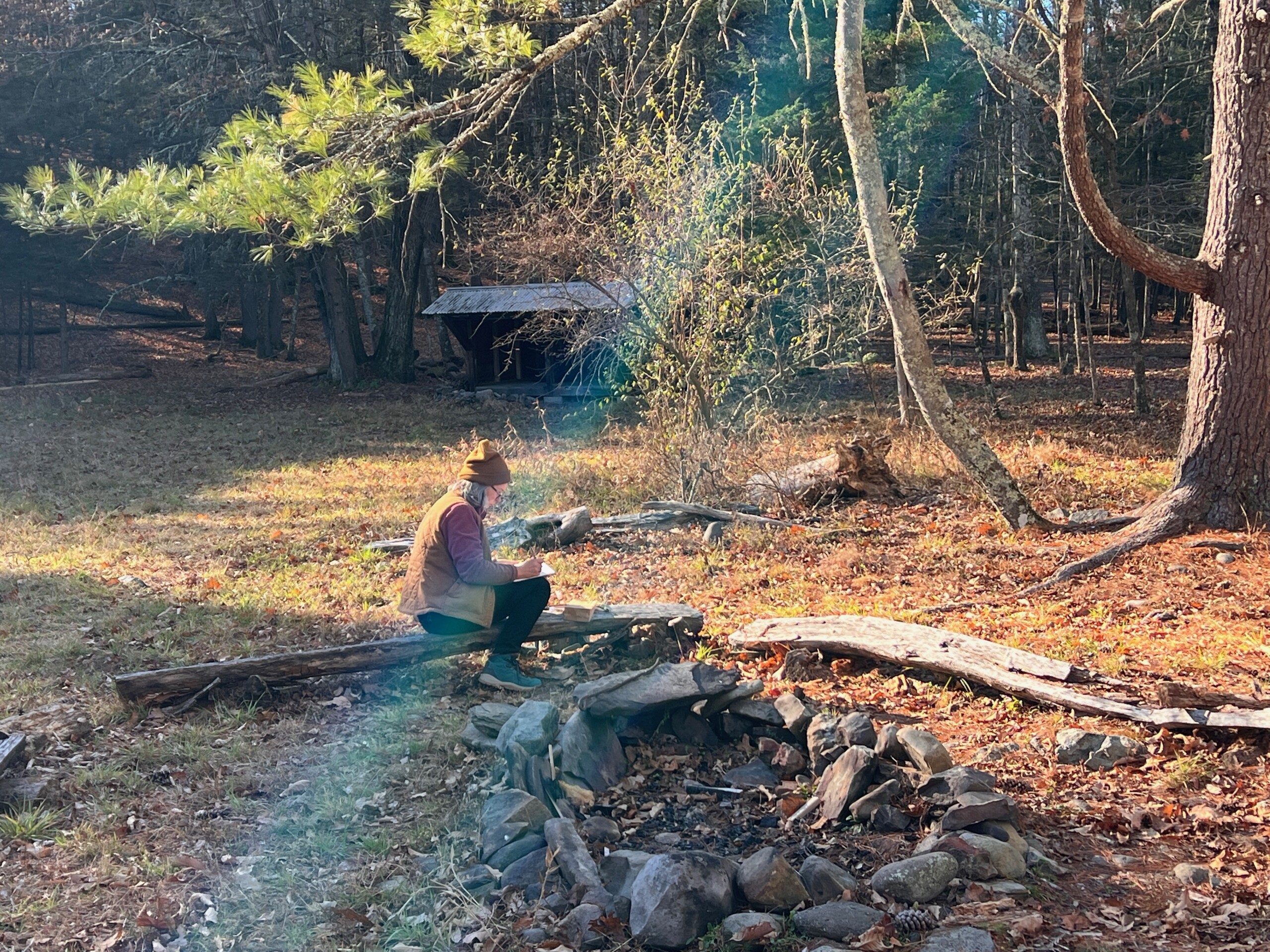
What Awaits You
🌿 Learn from Renowned Instructors
Join incredible artists and talented teachers, John Muir Laws, Wendy Hollender, and Carol Woodin, for a mix of large-screen presentations and demonstrations and drawing sessions with one-on-one instructor attention. Find out more about them and see samples of their work by scrolling down to the section, Meet the Instructors.
🎨 Hands-On Botanical Art & Nature Sketching Workshops
Whether you’re a beginner or a seasoned artist, we’ll explore and practice new skills in observational drawing, watercolor techniques, nature journaling, and botanical illustration on vellum.
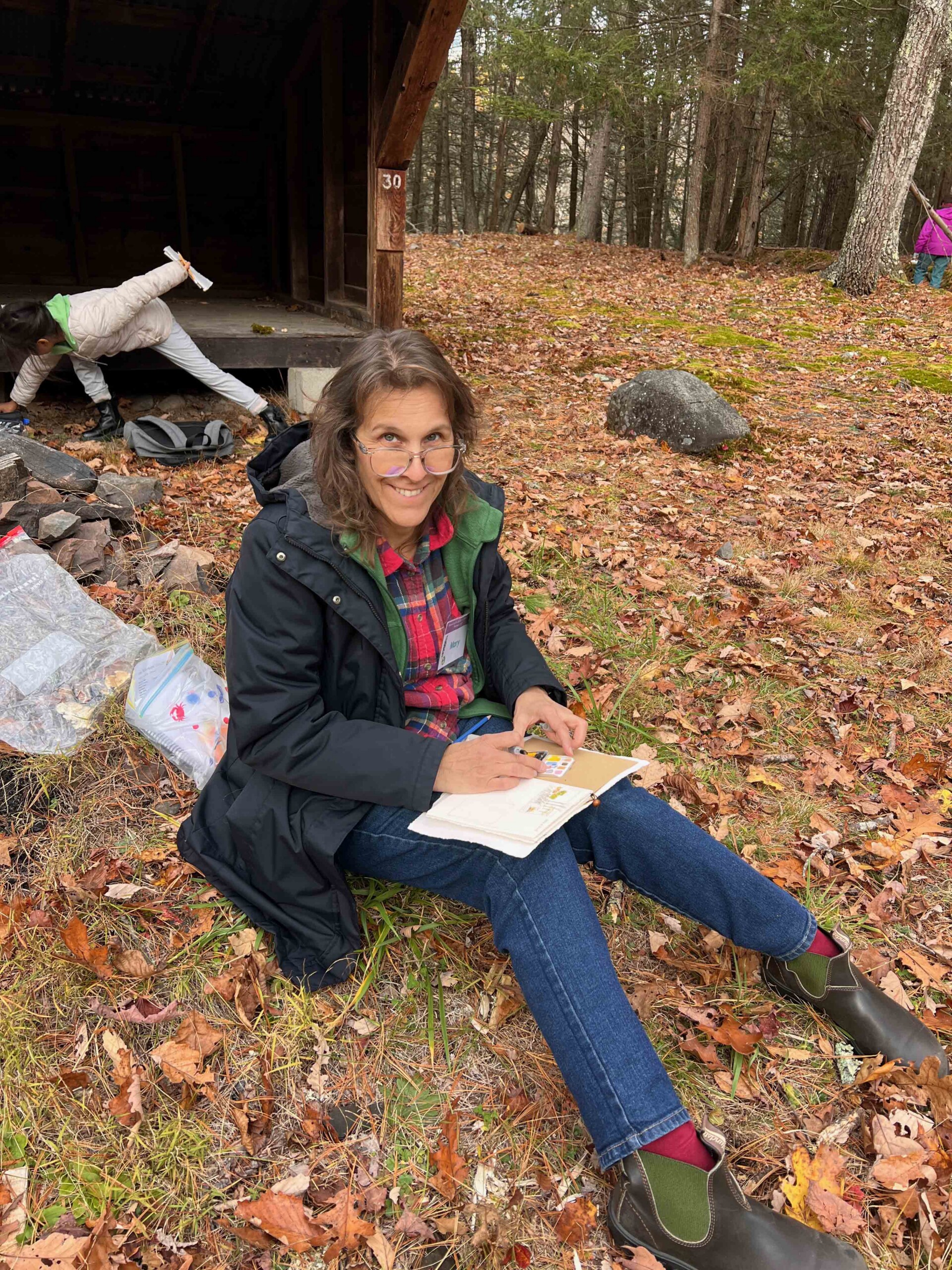
🍂 Nature “Snorkeling”
Stroll scenic trails, notice all the living things around you, and rediscover just how incredible nature is. Sketch birds and summer plants, gather flowers by family, take deep breaths among the trees, and so much more.
🖌 Personalized Learning & Creative Freedom
Select a schedule that inspires you most! You choose your sessions, so you can focus on what excites you. It’s a rare opportunity to just have fun in a relaxed learning environment without worrying about grades, attendance, or traditional school rules. You do you!
🏕 Relax, Recharge & Reconnect
Surrounded by fellow passionate artists, this retreat offers a welcoming, friendly atmosphere where you can create, share, and find inspiration in both nature and community.
What You’ll Take Home
✨ Confidence in nature journaling & observational drawing
✨ A deeper understanding of botanical art techniques
✨ A renewed love for art, nature, and creative exploration
✨ Lasting friendships and newfound artistic inspiration
Whether you’re looking to refine your craft, explore the beauty of the natural world, or simply step away from everyday life to draw, relax, and reconnect, this retreat is for you and those you love.
Full Weekend Bonuses
You’re welcome to join us for Saturday or Sunday only, but if you attend for the full weekend, we will provide you with the following:
•Sketchbook with lessons to reference and a cover to customize (The Laws Sketchbook for Nature Journaling)
•Pencil: Prismacolor Col-erase Non-photo Blue Pencil
•Water Brush: Pentel Arts Aquash Round, Large (18mm), Fine Point Water Brush
Note: If you only signed up for one day, these items will not be provided.
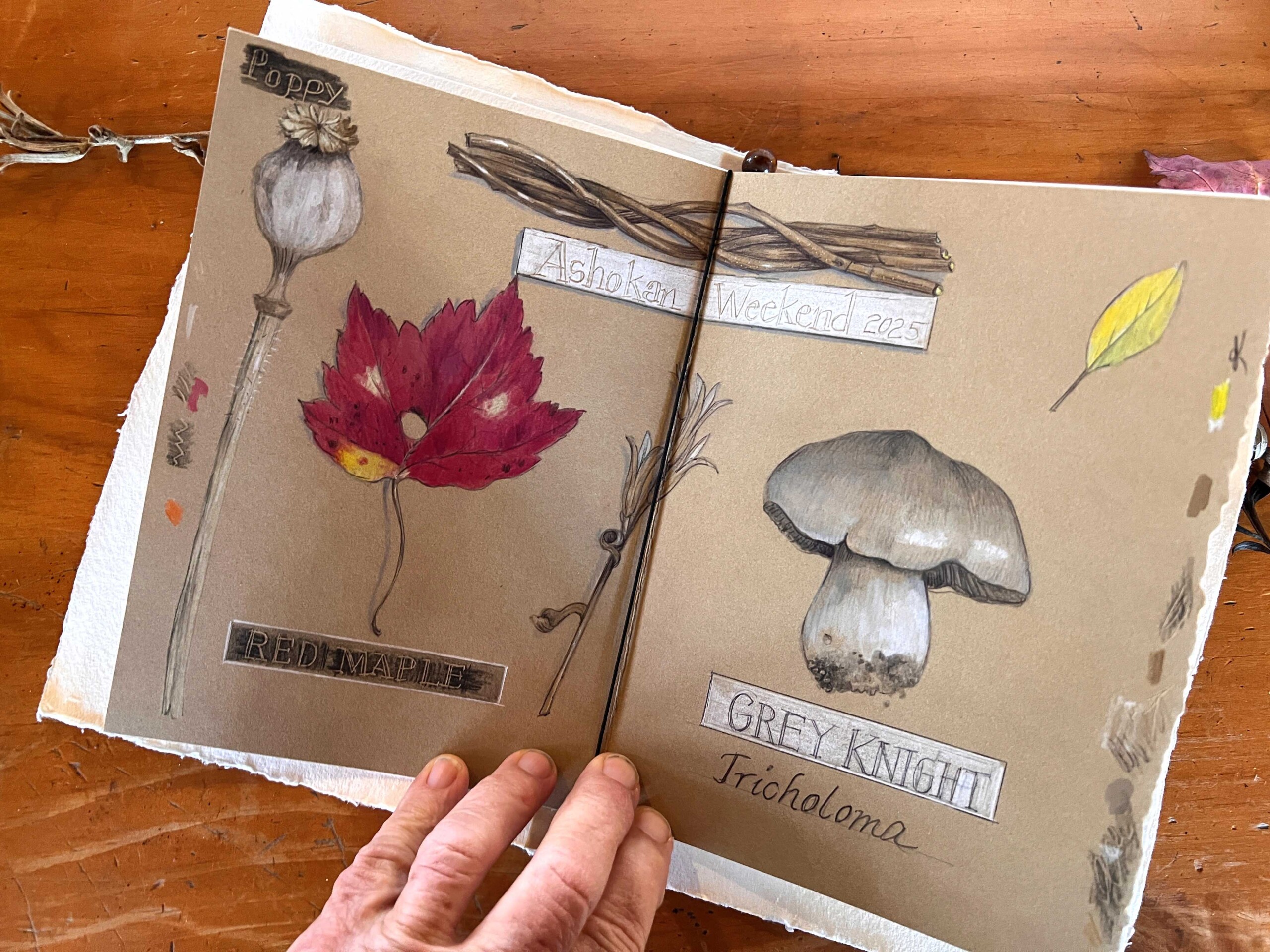
Enjoy Different Types of Sessions
Each day, you get to choose which sessions you attend, so you can do everything you’d like to do (and nothing you don’t!). No need to sign up for specific sessions; just show up when and where you want.
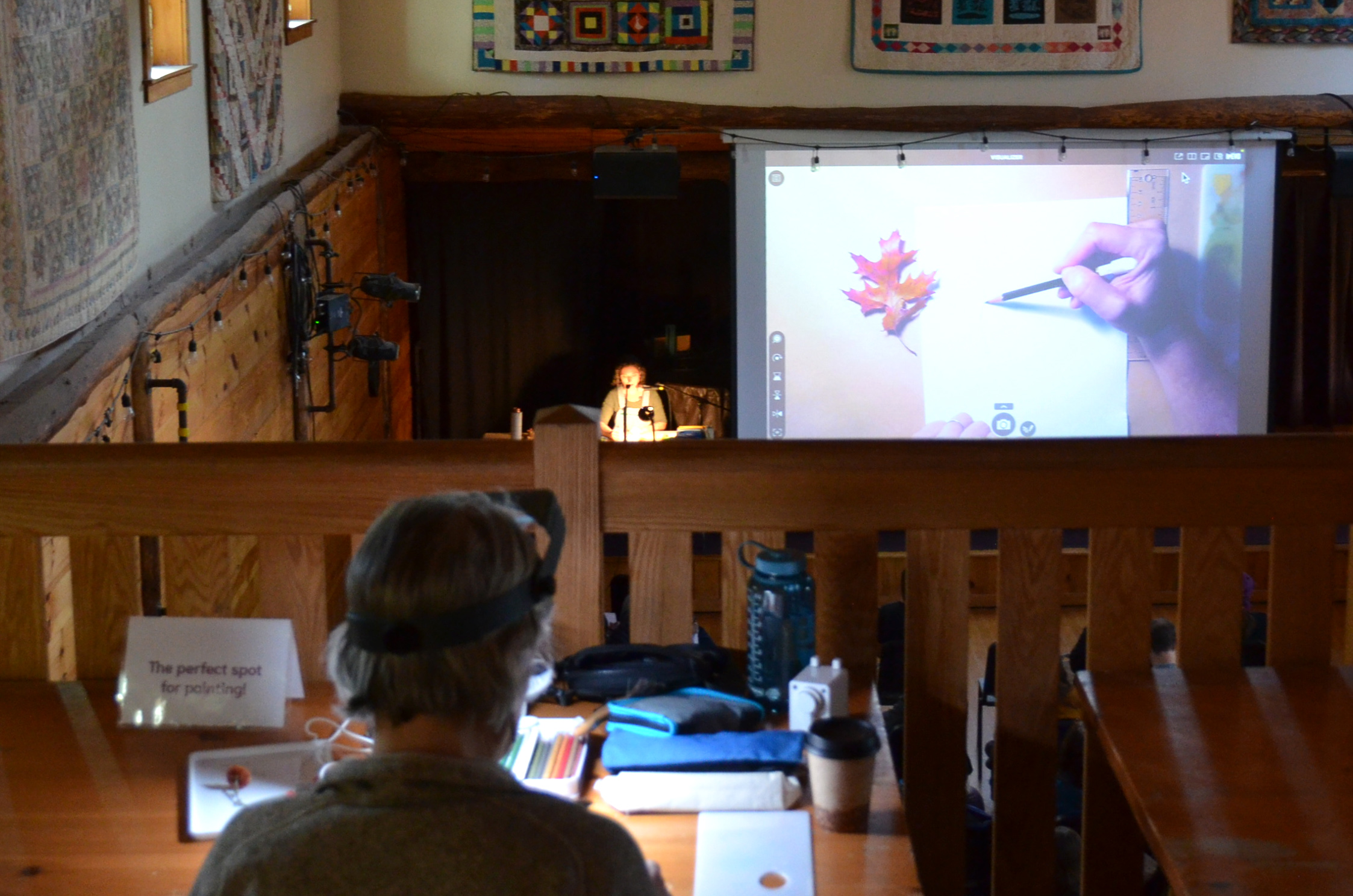
Watch live instructor drawing demonstrations projected on the big screen, so you won’t miss any details. Explore the historic Ashokan Center’s gorgeous grounds on guided hikes or adventure on your own. Take supplies on your walks to draw outside, or bring your foraged finds back inside to your drawing table.
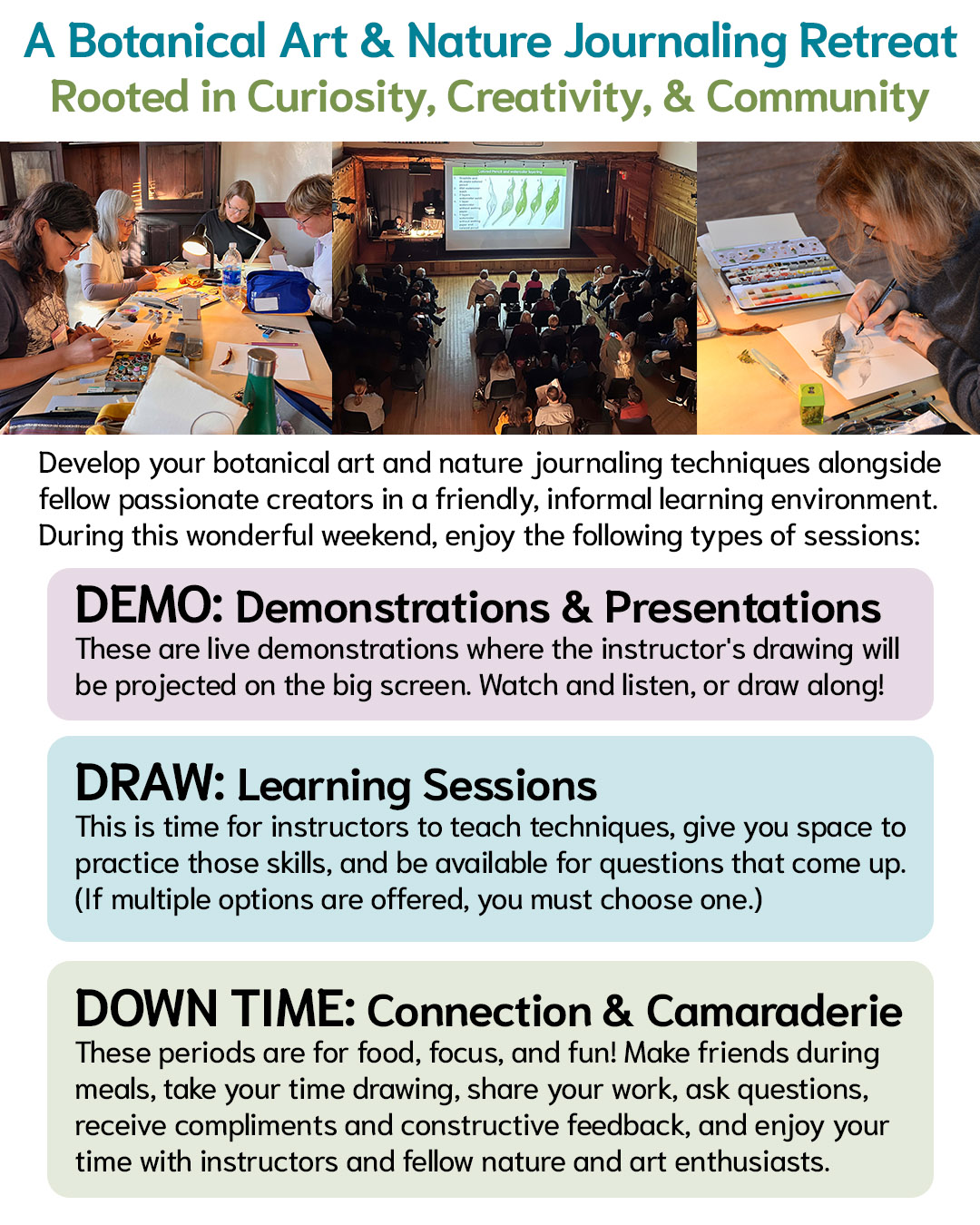
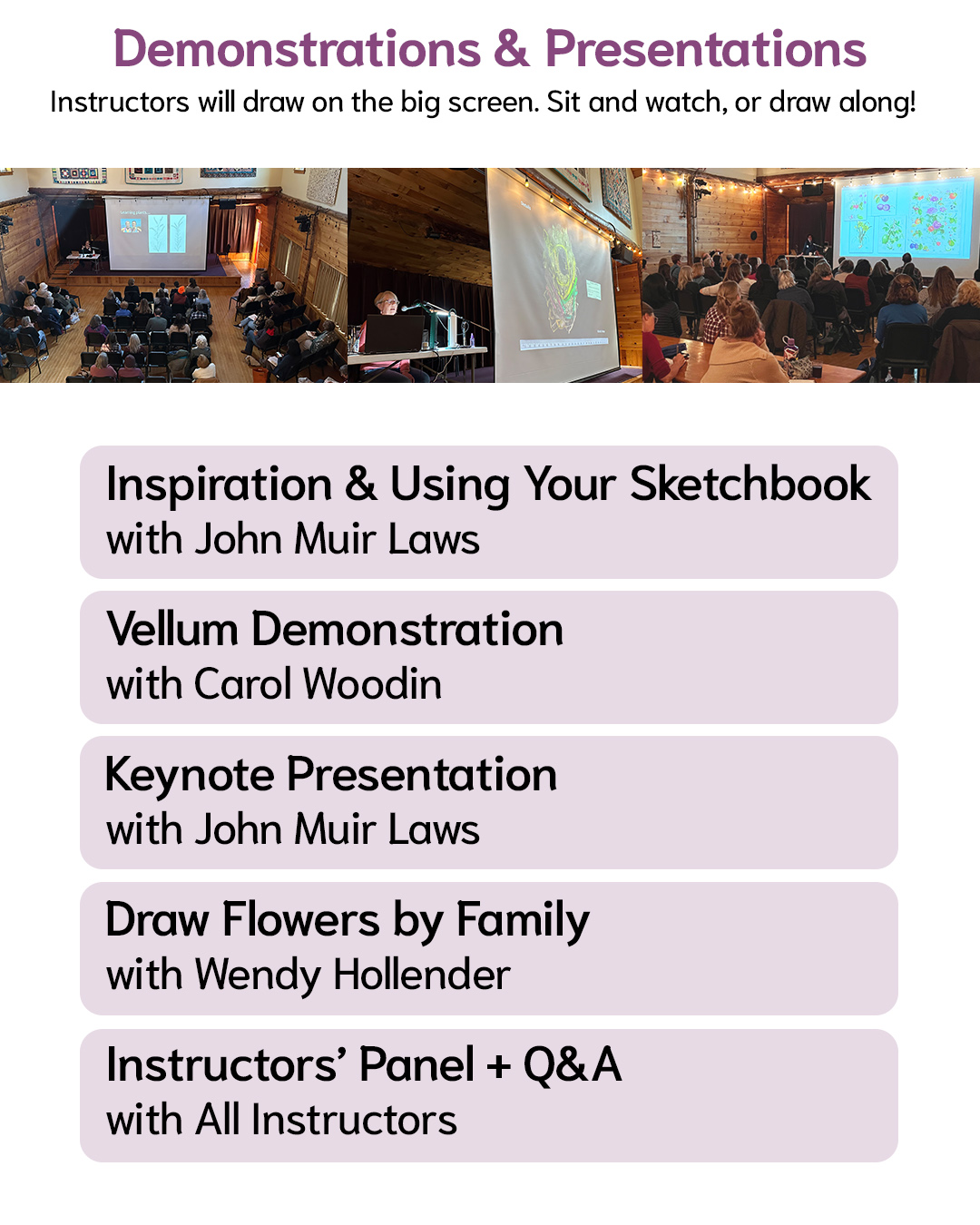
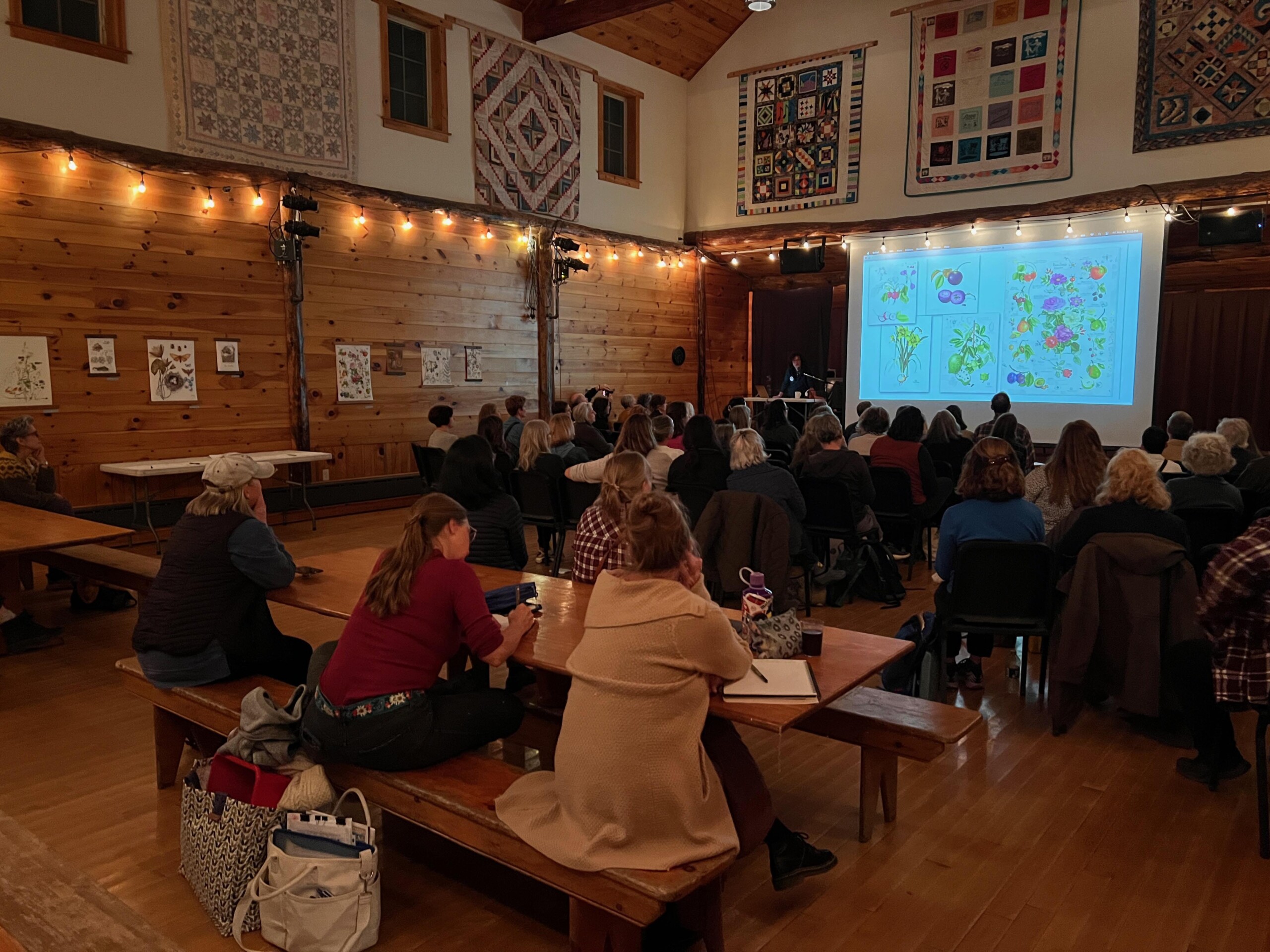
DEMO: These are live demonstrations where the instructor’s drawing will be projected on the big screen. Watch and listen, or draw along!
DRAW: In these learning sessions, instructors will teach techniques, give you time to practice those skills, and be available to answer questions and provide constructive feedback.
DOWN TIME: These periods are for food, focus, and fun! Make friends during meals, take your time drawing, share your work, ask questions, receive compliments, and enjoy your memorable moments among instructors and fellow nature and art enthusiasts.
Session topics may include:
•Intro to Observational Drawing
•Intro to Nature Journaling
•Working on Vellum
•Combining Watercolor & Colored Pencil
•Nature Journaling Walk
•Flowers by Family
•Sketch Birds in the Field
and more creative activities and drawing demonstrations
Special Highlights
Early Birds Special – Tour of Wendy’s Plant Families Exhibition
Doors at the Ashokan Center don’t open until 4pm, but here’s a special treat for early birds! Arrive in Kingston between 1pm and 3pm for a special tour of Wendy’s exhibition, displaying the 24 paintings she created with the release of the book, The Album of Plant Families. Join her at The Prince Street Gallery in Kingston, NY to celebrate.
Joyful Jam Sessions
Enjoy an intimate performance by incredible musicians and Ashokan leaders, Jay Ungar & Molly Mason.
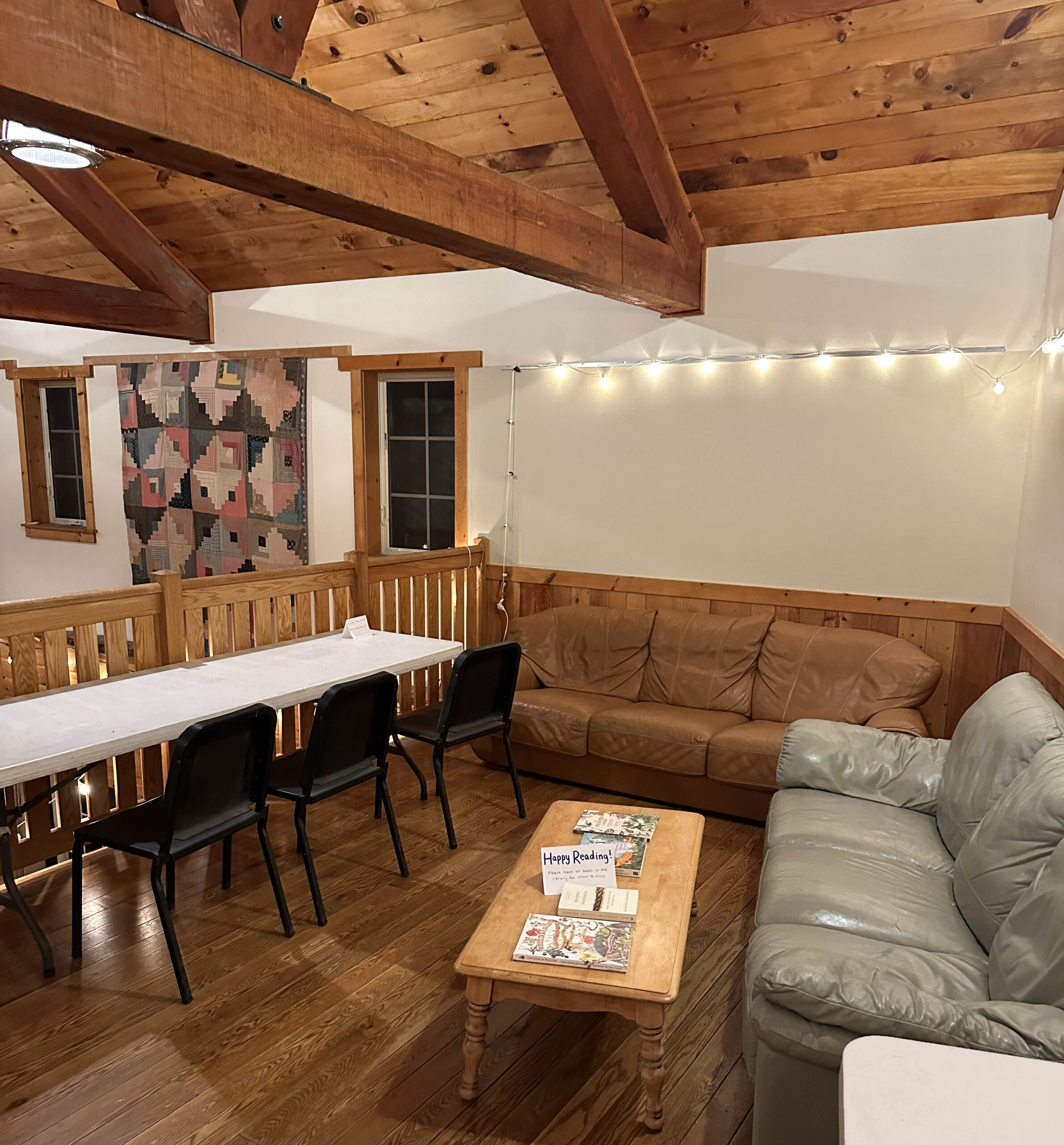
Lounge in the Library
Get comfy on the couch and peruse some of the instructors’ favorite books.
📅 Reserve Your Spot & EnJOY Botanical Art & Nature Sketching
 .
. 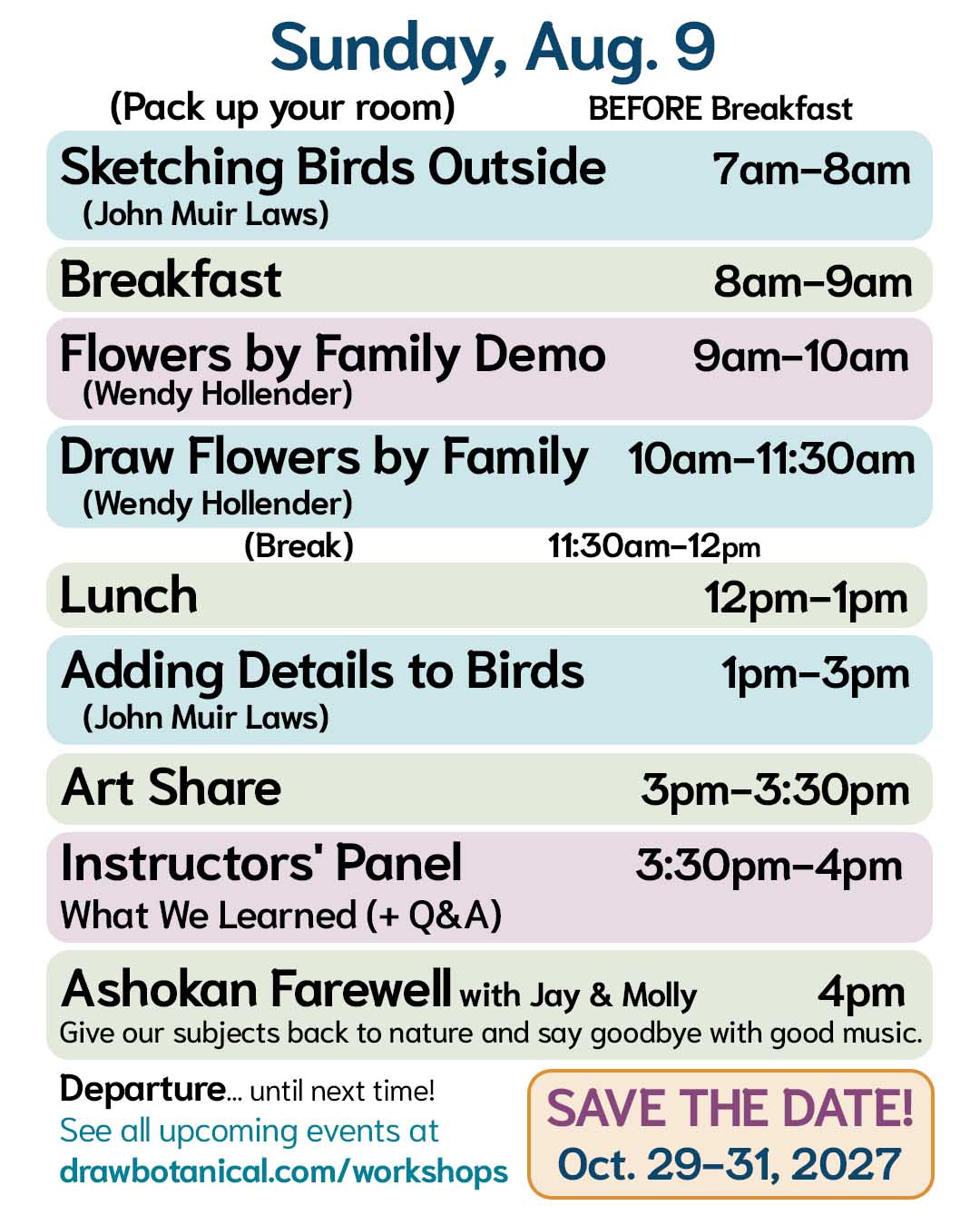
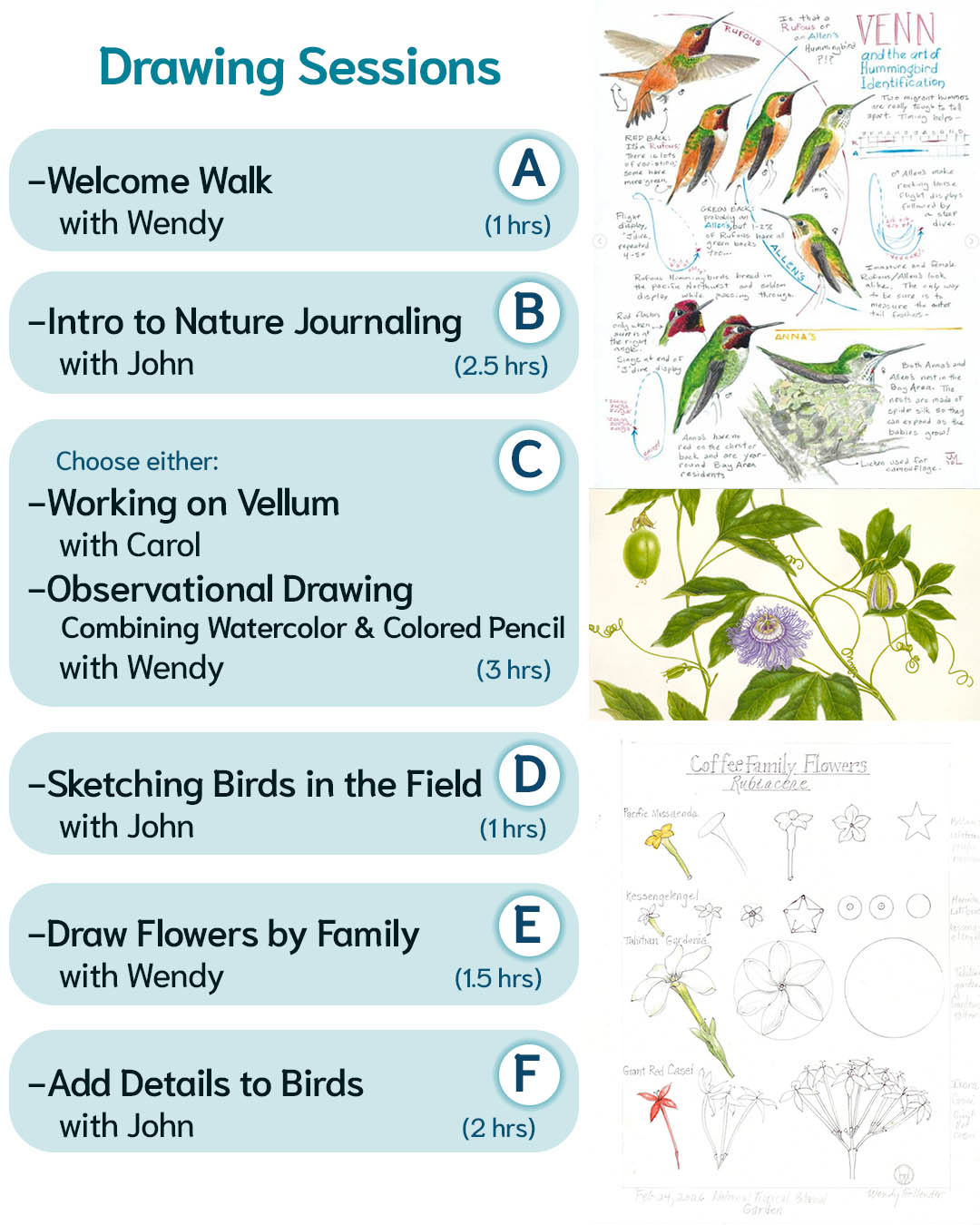
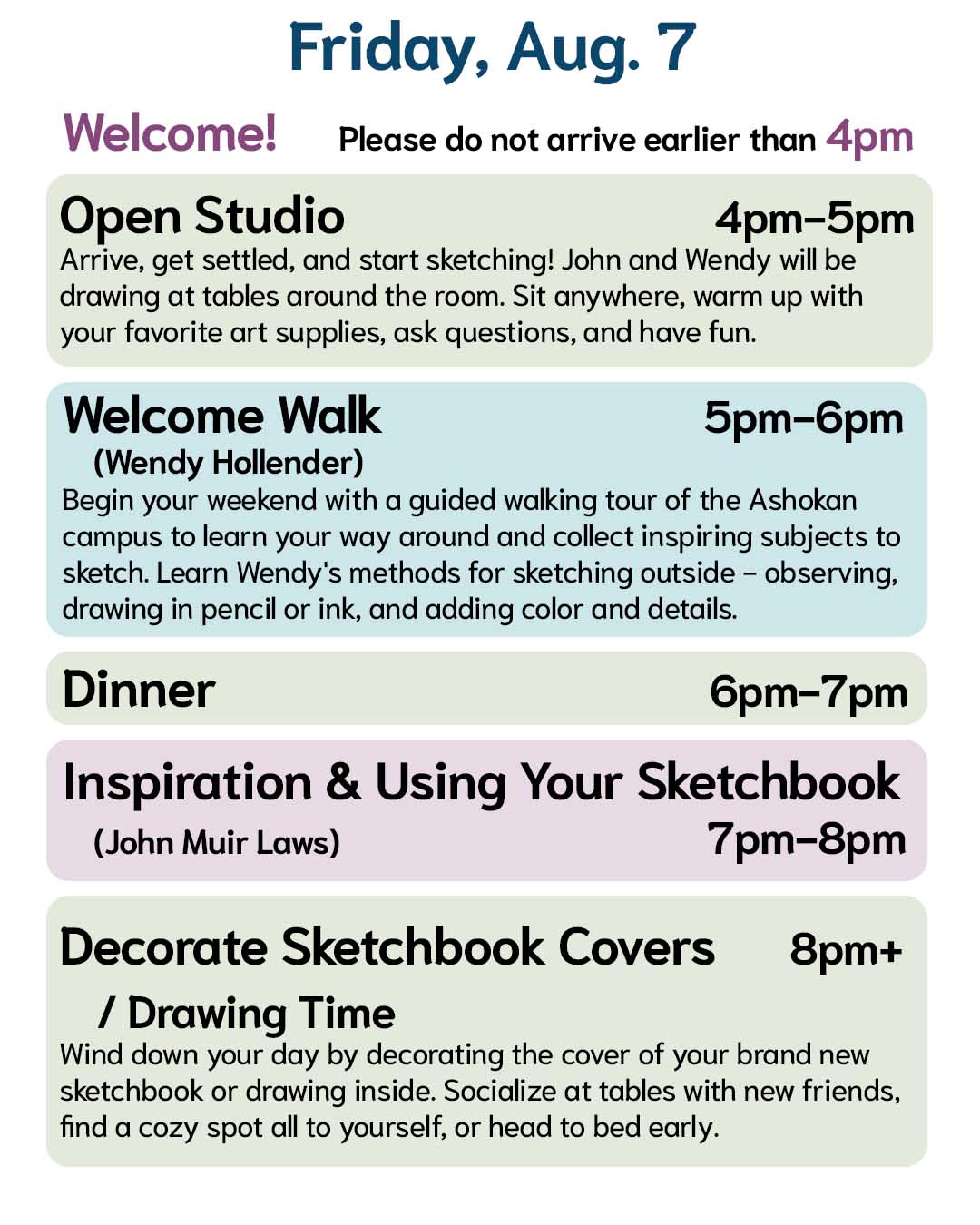
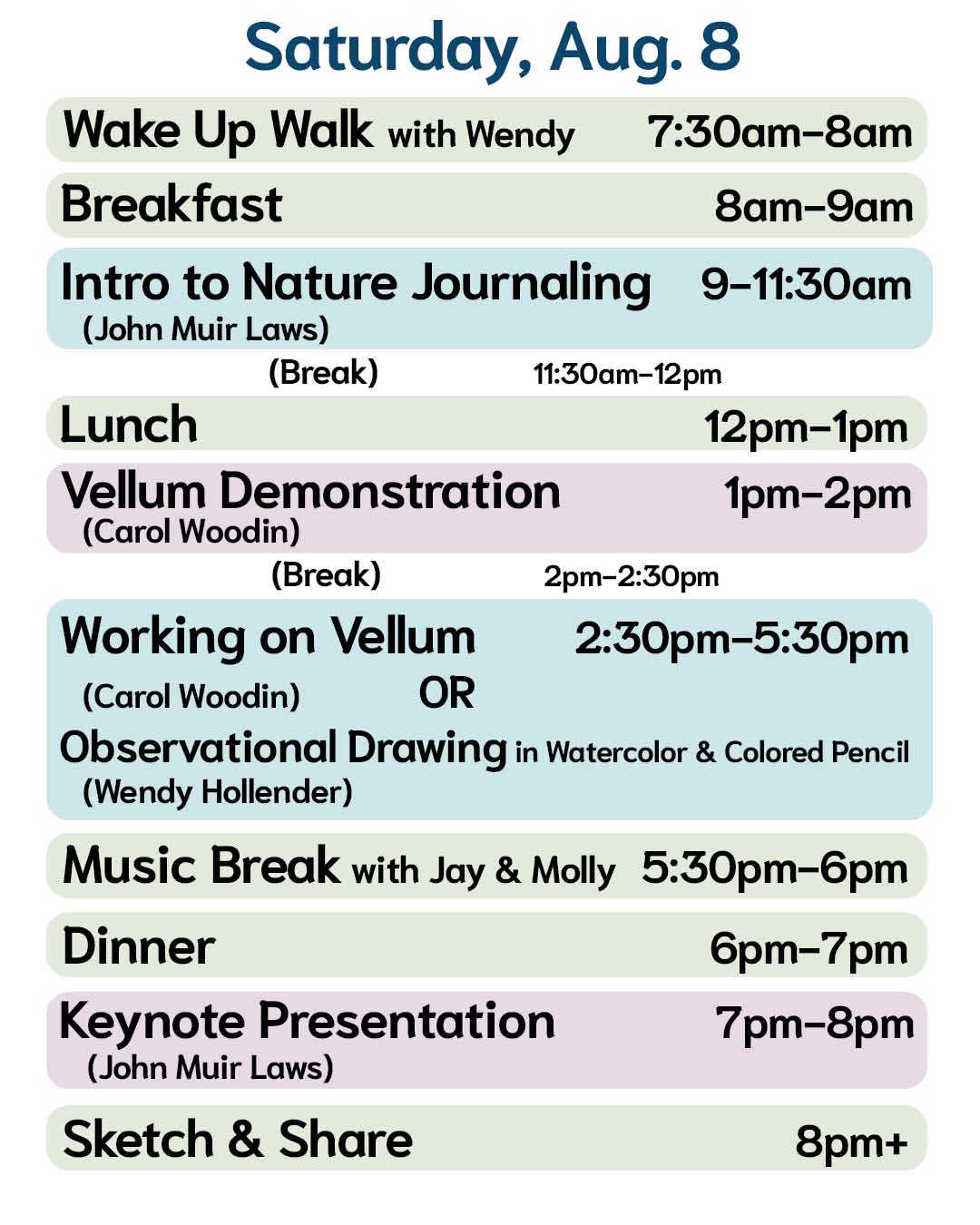
See the Daily Schedule Here
(The full itinerary is still in process and may change before being finalized.)
Fun for the whole family!
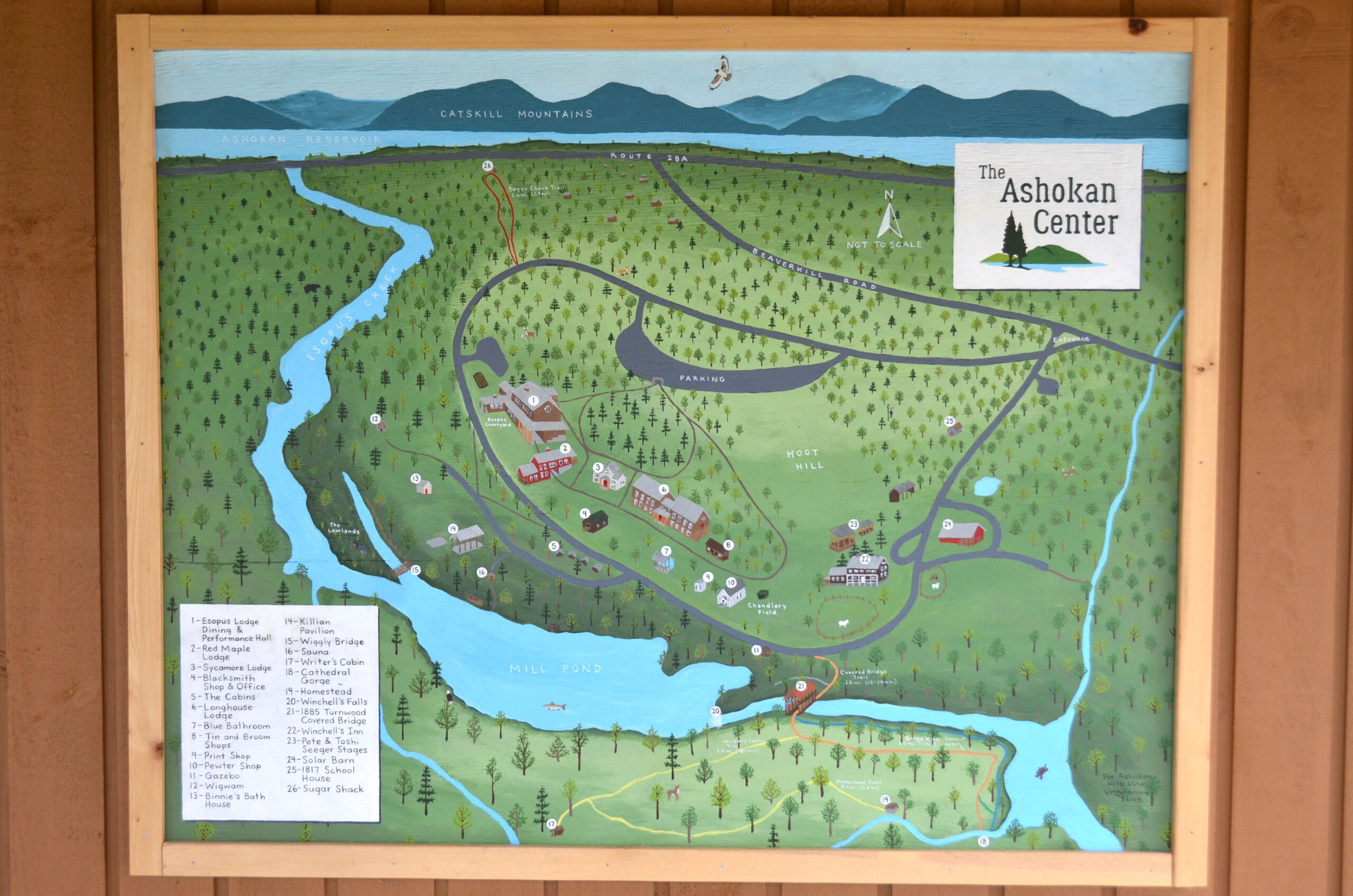
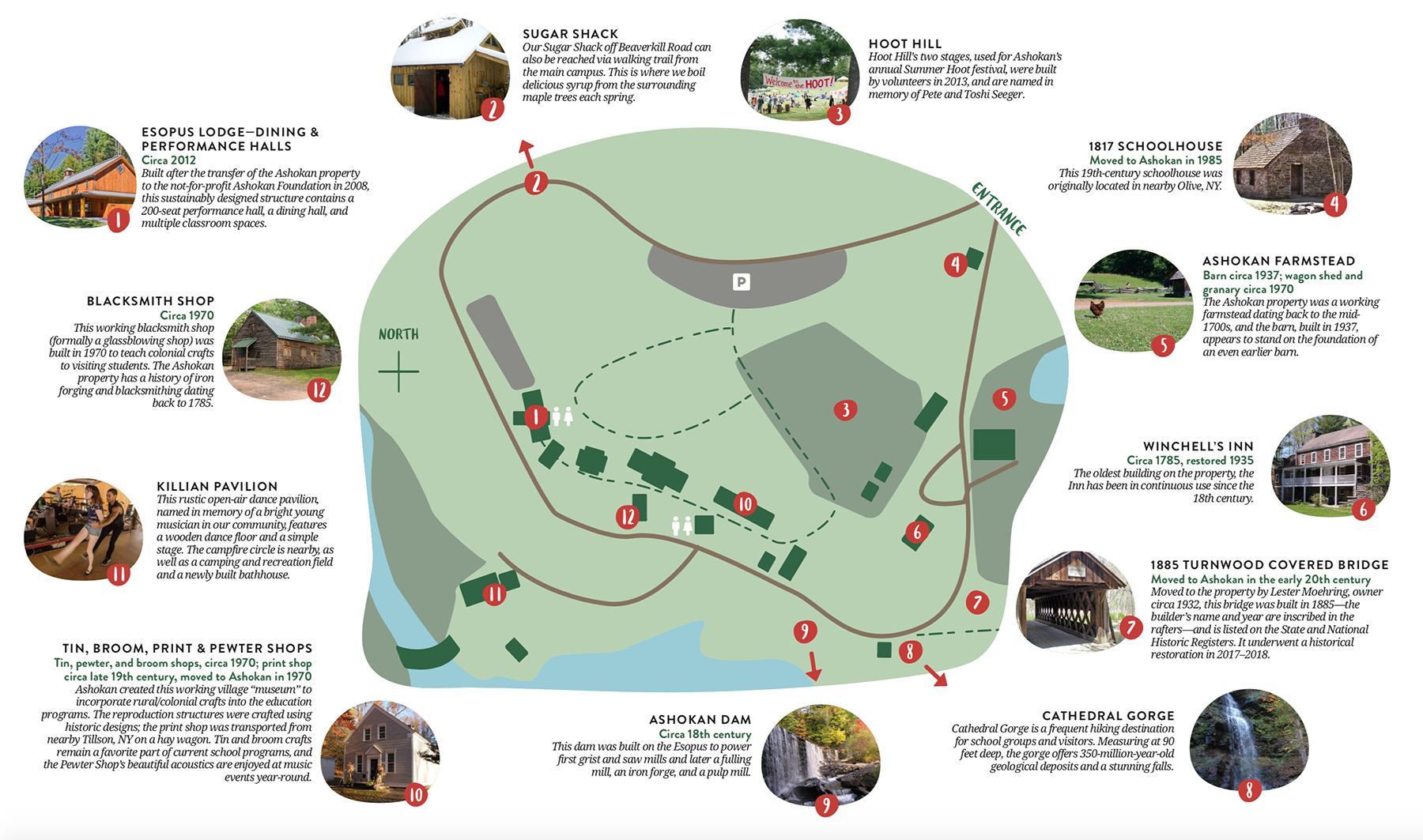
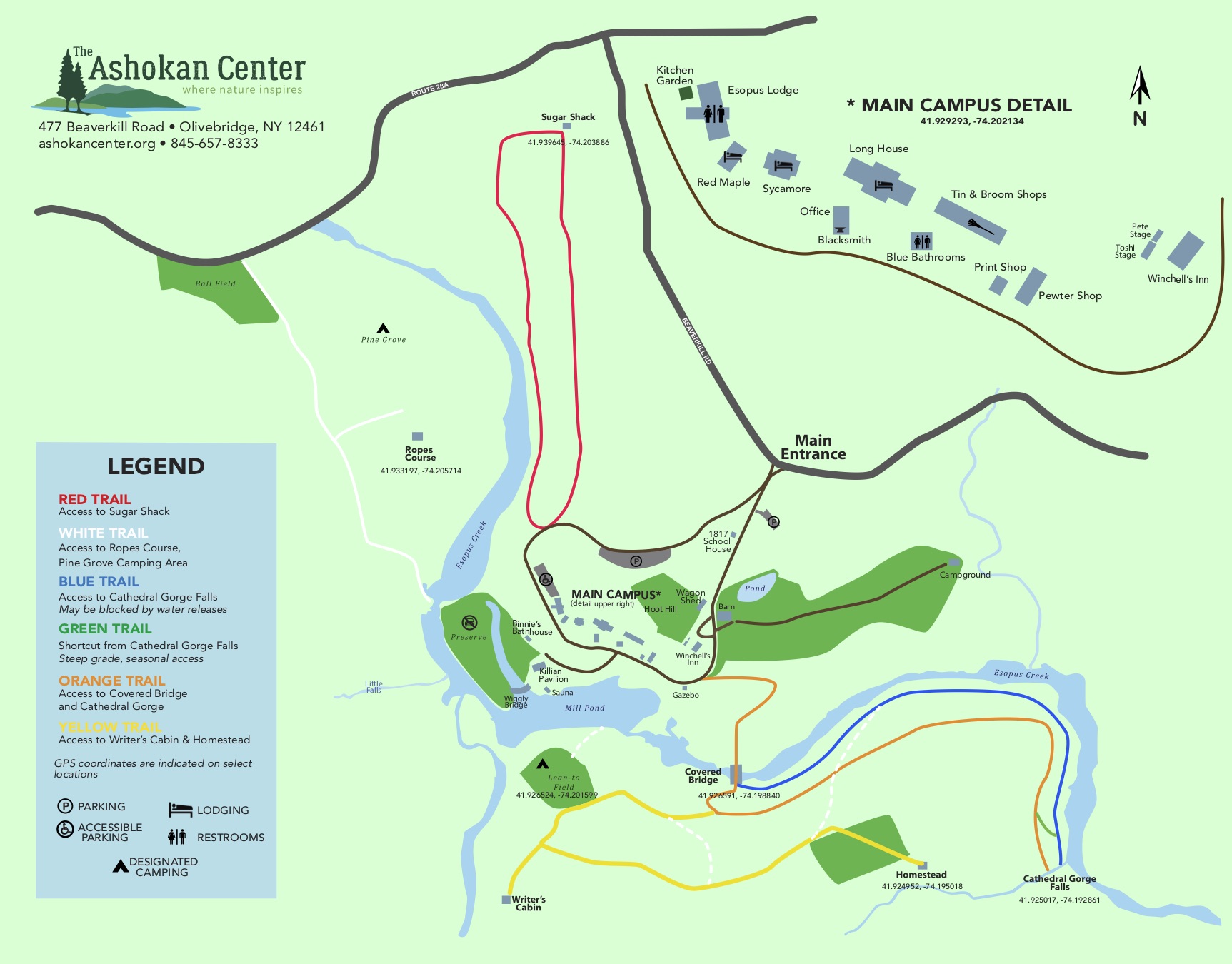
Enjoy delicious meals together and sleep soundly in beautiful wooden lodges. Children younger than 13 years old must have adult supervision at all times and can enjoy various family activities around the Ashokan Center. (Click here for a map of the main campus.)
Family activities may include:
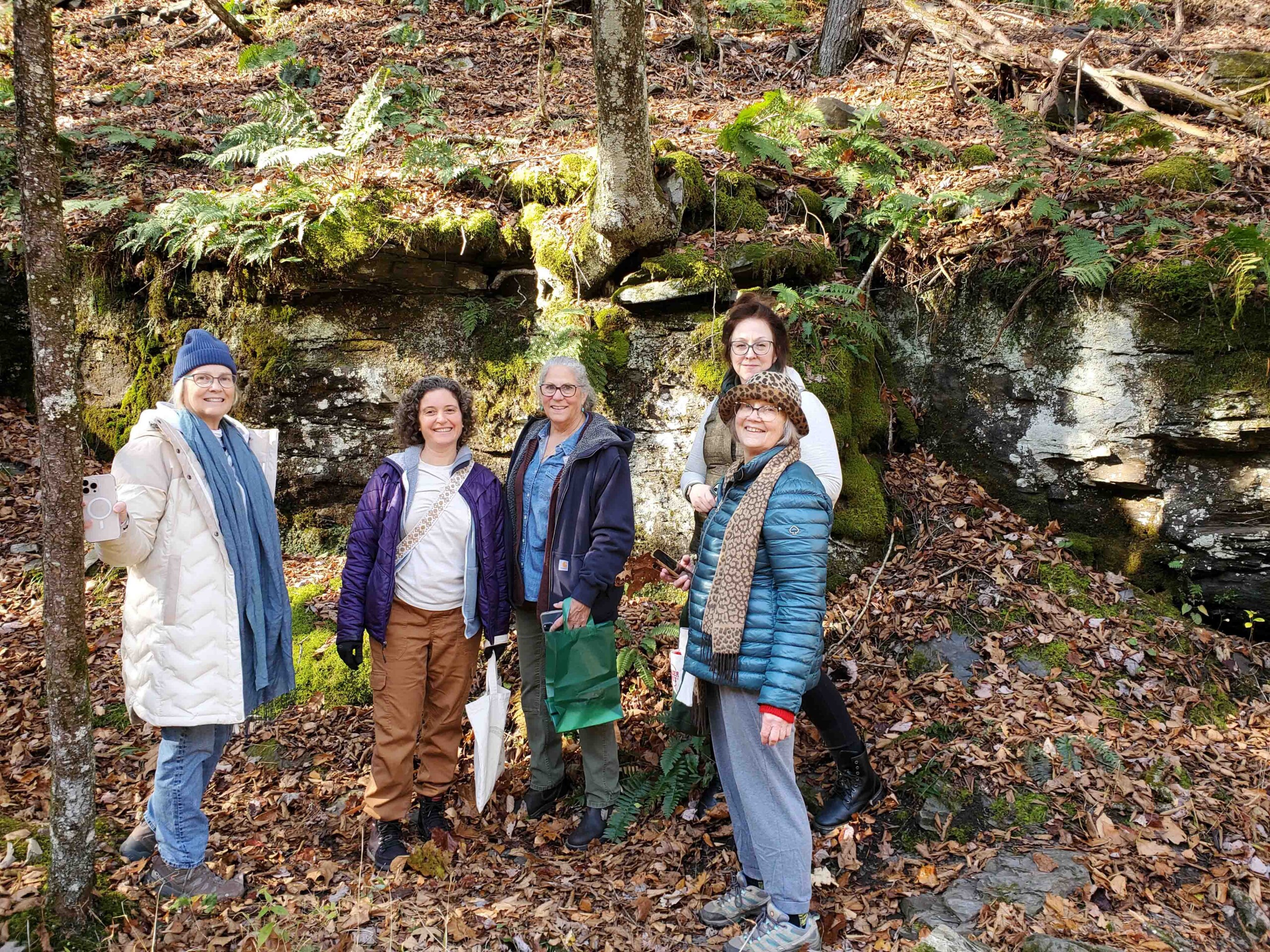
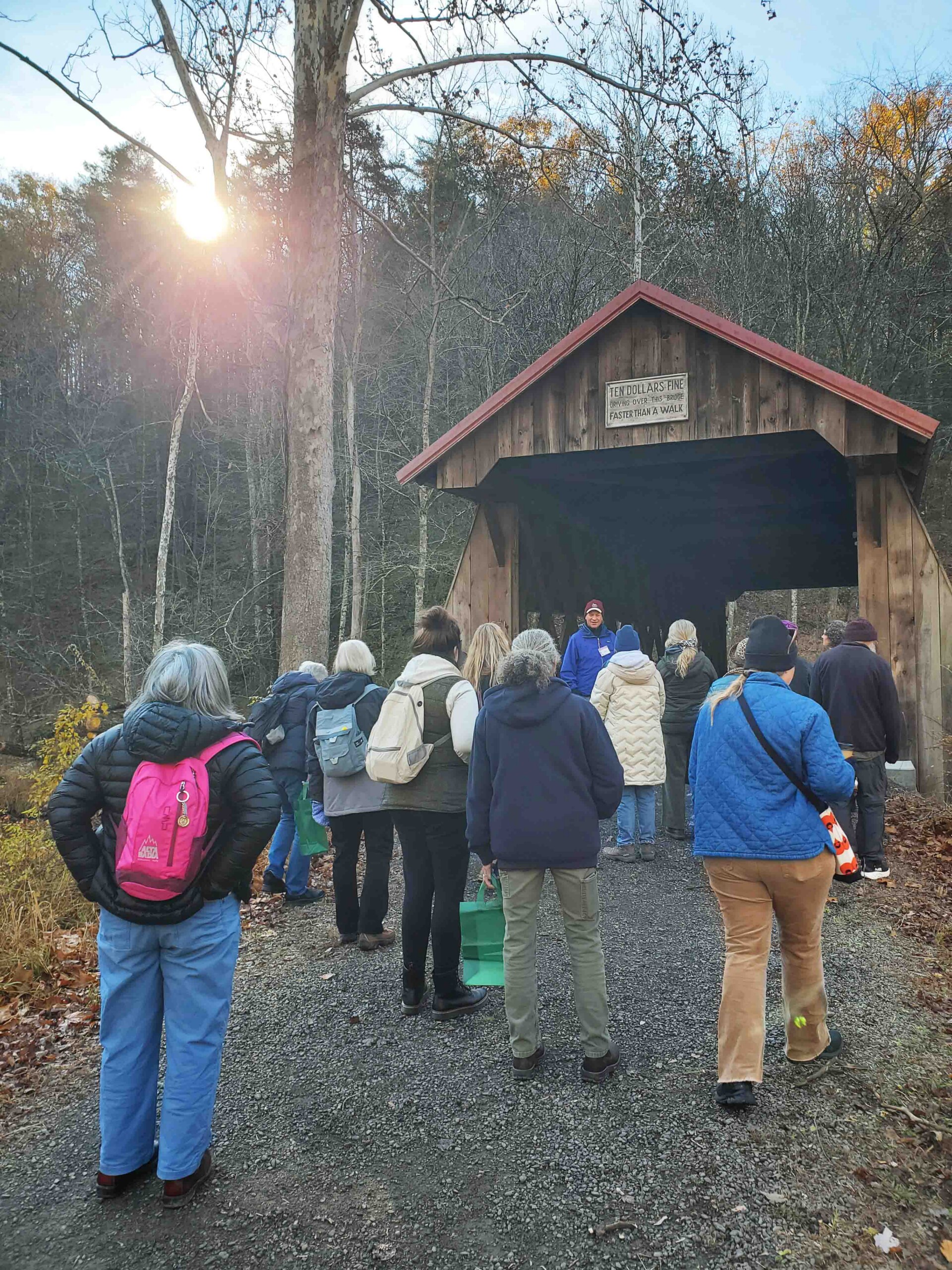
–Hiking: Explore forest and streamside trails to Historic 1885 Covered Bridge, Winchell’s Falls, Cathedral Gorge, Homestead, and Sugar Shack. (Click here for trail map.)
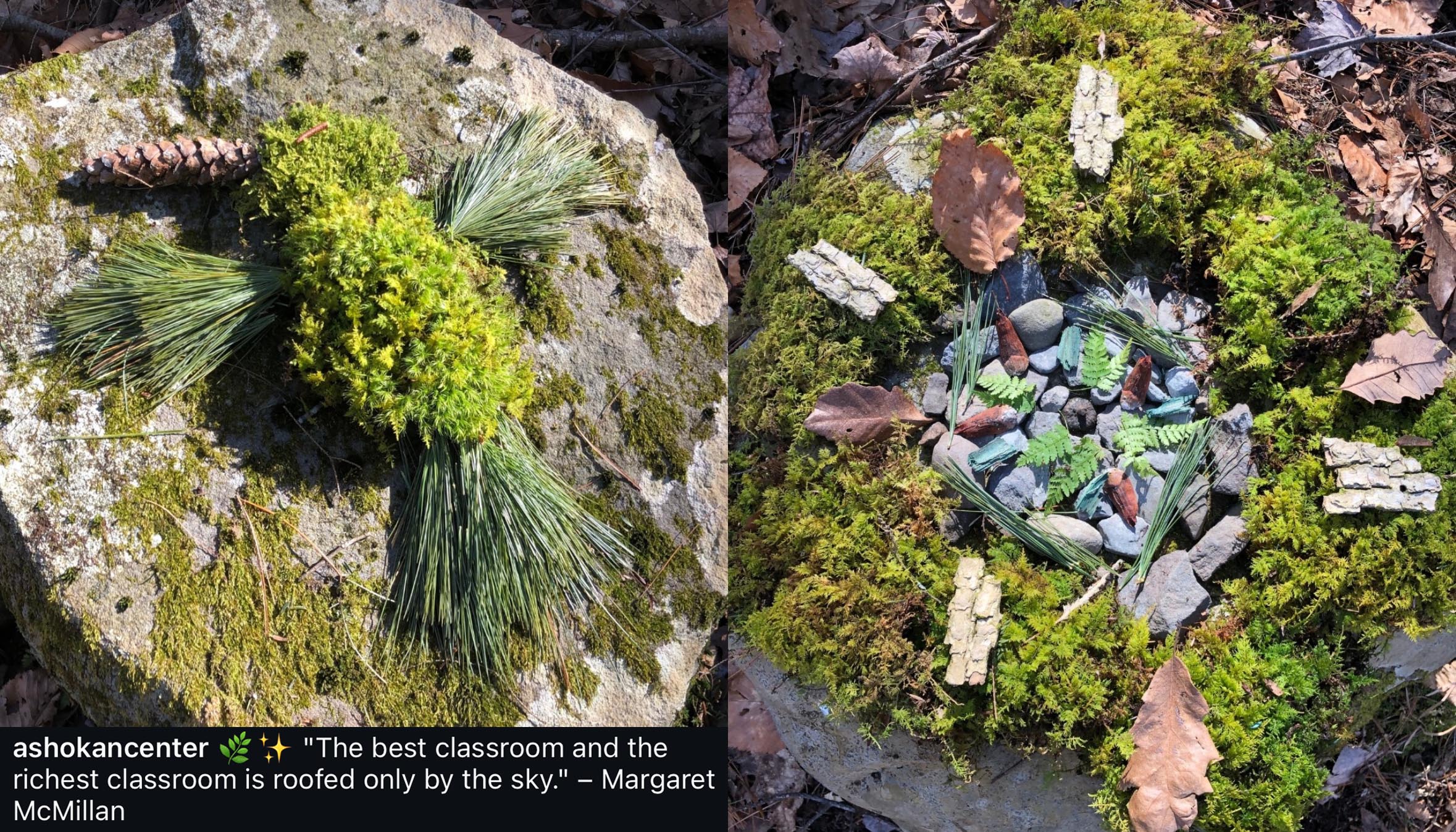
–Art: Colored pencils and watercolor supplies will be available for families to draw and paint all of the interesting botanical parts you find on your hikes. You can also take inspiration from artist Andy Goldsworthy and create temporary art installations using natural materials.
–Music: Play ukuleles, guitars, and other available instruments, or bring your own portable instrument to practice.
–Games: Whether you like running around playing sports or prefer more mental exercise, you’ll enjoy the variety of fun games we’ll have available.
–Local Attractions: Adventure around the Hudson Valley to various local attractions. (Click here for list of local sites.)
Note: Children (and their accompanying adult) may join you at no extra charge from us, but you will be responsible for arranging their lodging and dining with the Ashokan Center.
How BLOOM Began
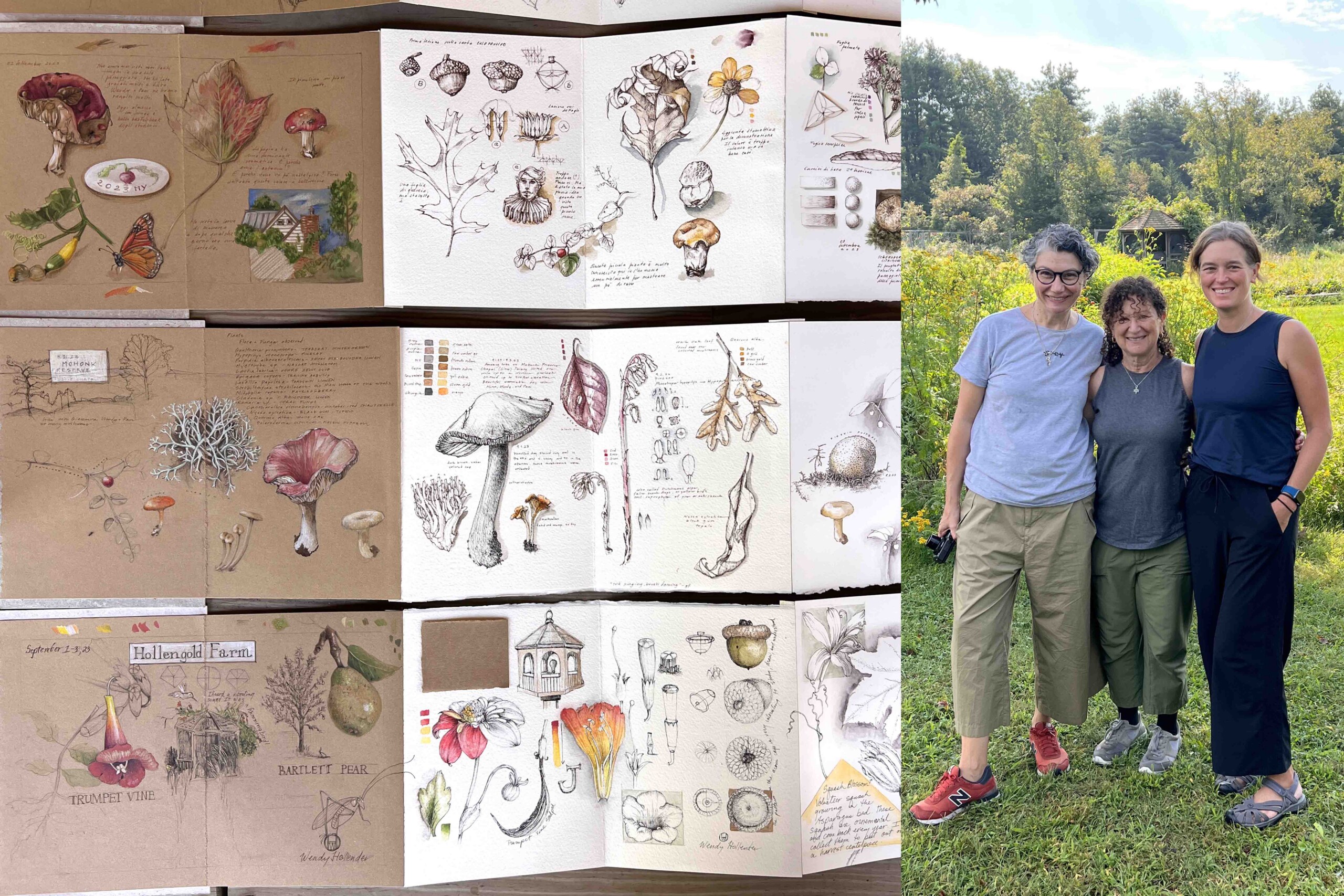
It started with a seed, an idea, a dream. Wendy found a few talented botanical artists and professional nature journaling instructors that inspired her. After taking their classes and hosting many workshops of her own at her farm, Wendy knew that inviting these artists she admired to teach with her would bring fresh flavor and learning opportunities. In 2023, Lara Call Gastinger and Giacomina Ferrillo co-taught a small nature journaling workshop with Wendy at Hollengold Farm. It was so successful, and they had so much fun together, that they decided to join forces again!
The Ashokan Center and Wendy have been working together for many years, and she knew it would be the perfect place to host a larger workshop. We were able to find an available wintery weekend in 2024 that worked for everyone, Jean Mackay joined the teaching team, and we had an amazing experience. How could we not keep this going?!

In 2025, we stepped it up another notch. We listened to participants’ feedback and made significant improvements. Vern Fannin became a fifth instructor, and our late autumn event was better than ever.
The weather will be much warmer in August this year, but the dates did not work for Lara, Giacomina, and Jean. We needed to adapt, so now the seeds of our Botanical Art & Nature Journaling Retreats are evolving into BLOOM, an annual artists’ retreat rooted in curiosity, creativity, and community. This year we are thrilled to welcome John Muir Laws, Carol Woodin, and Pam Thompson to the growing team with Wendy Hollender and Vern Fannin. That’s how BLOOM was born!
About The Ashokan Center
The Ashokan Center is an independent music & nature nonprofit established in 2008. Their mission is to inspire learning and build community through shared experiences in nature, history, music, and art. They welcome school groups for Educational Field Trips, host public community events including festivals and Music & Dance Camps, and more. The site has been declared an Historic District on the National and State Registers of Historic Places. This land was a favored hunting and fishing ground for the Munsee Indians for generations, and became home to Americans of European descent in the 1730s. The first mill and blacksmith shop in Ulster County were built here… Learn more about Ashokan
Details for Sleeping & Eating
You will make your lodging and dining selections in the registration form when you’re ready to sign up. Submit a SEPARATE FORM for EACH ATTENDEE you are registering. Do not register more than one person at a time.
 If your preferred choice is sold out: Please review our Alternative Lodging Suggestions for local off-site options.
 Staying Off-Site / Commuting? Select “Commuting/Staying Off-Site” for your lodging choice on the registration form, complete your payment with us to secure your event spot, and then independently make your lodging arrangements elsewhere.
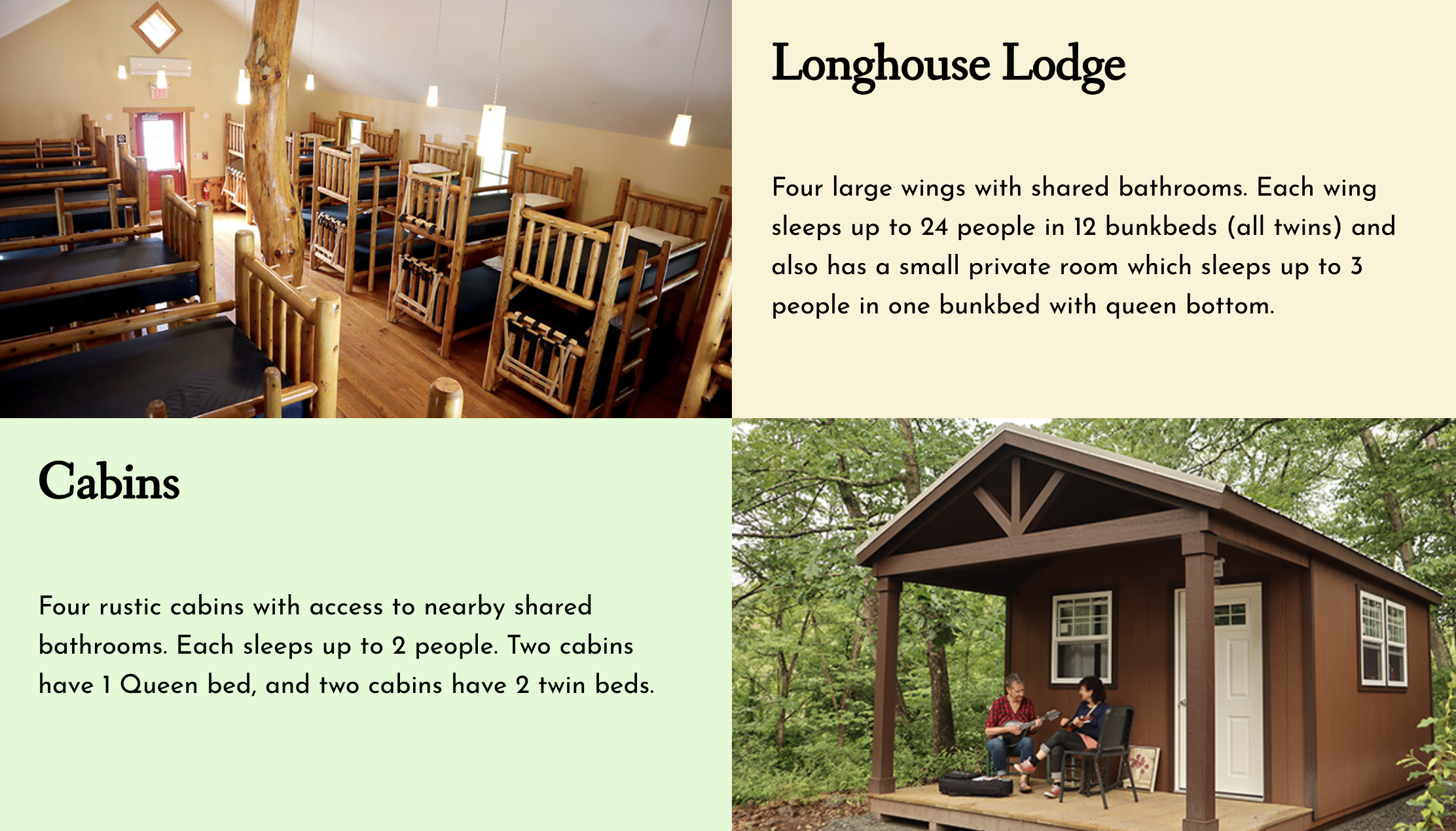
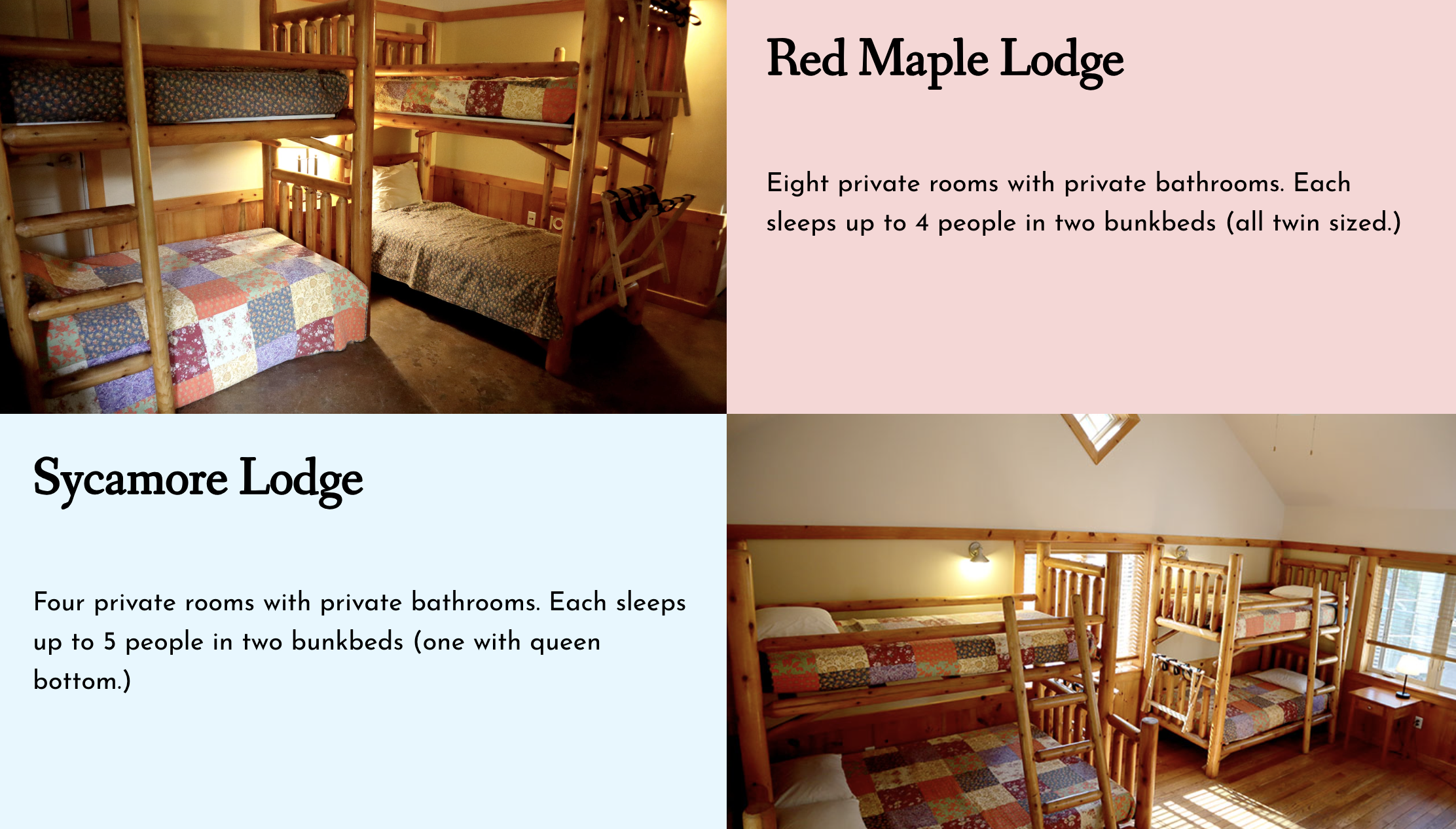
LODGING
You will make your lodging selections in the registration form when you’re ready to sign up.
Lodging Options Overview
$51.50 / person / night
$154.50 / room / night
$185.40 – $206 / room / night
$226.60 – $236.90 / room / night
$154.50 / cabin / night
$16.48 / person / night
$10.30 / person / day
$0
Twin: $26.78
Queen: $39.14
WENDY’S RECOMMENDATION: I have stayed in these bunks in the Longhouse many times and personally recommend the authentic “sleepaway camp” experience. Don’t let shared bathrooms scare you; the Longhouse is LOVELY and a great chance to meet new friends.
If your preferred lodging at the Ashokan Center is sold out, here is a list of other local places to spend the night.
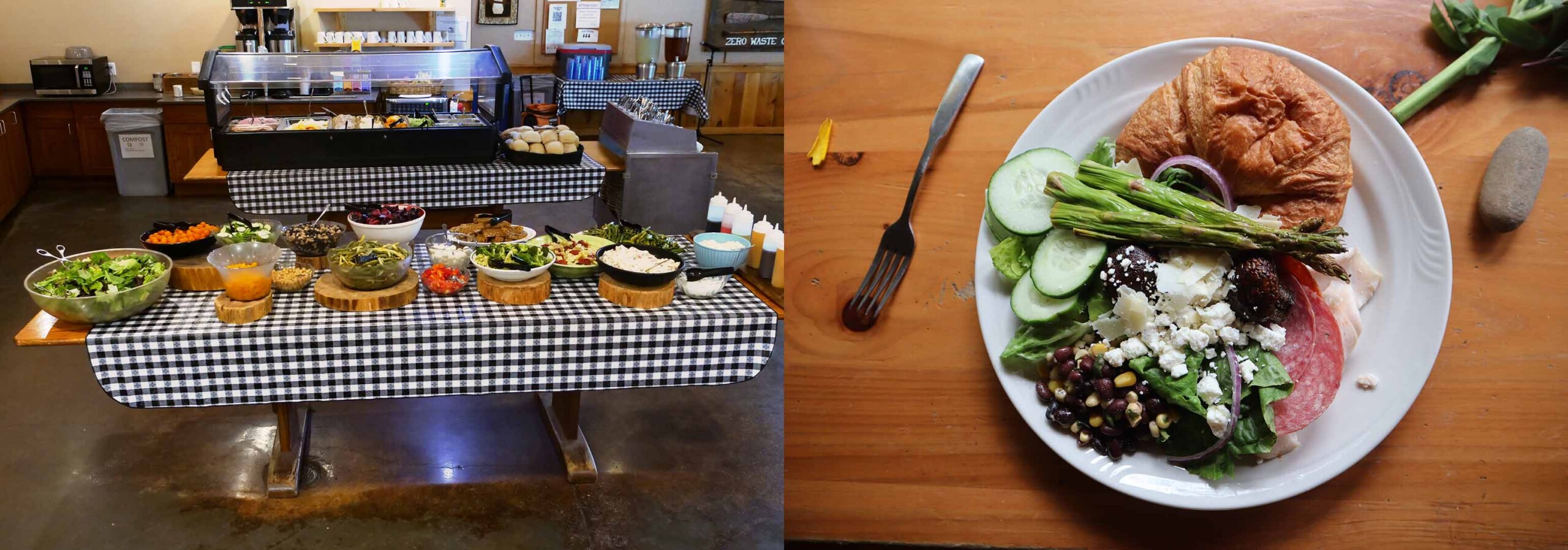
DINING
Regardless of where you sleep, dining at Ashokan is the easiest option (plus it’s delicious!). You will make your dining selections in the registration form when you’re ready to sign up. Meals are served buffet and/or family style in the Dining Hall at designated times.
All-Day Refreshments: Coffee and tea are available throughout the day. Paper cups will be provided for your convenience, but using your own travel mugs and water bottles is encouraged.
Snacks & Desserts: Fruit will be available throughout the day, and lunches and dinners almost always end with desserts. You may bring extra snacks if you need, but please always store them safely.
Select 1 option for a meal plan:
•Full-Weekend Meal Plan – $159
•Saturday Meal Plan – $88
•Sunday Meal Plan – $58
•Kids Meal Plan (Ages under 4) – $0
💡 Understanding Your Registration Fees
Your registration total combines two distinct components to cover the venue and the instruction for this retreat:
Workshop Fees
Full Weekend: $899
One Day (Sat. / Sun.): $299
Register Now
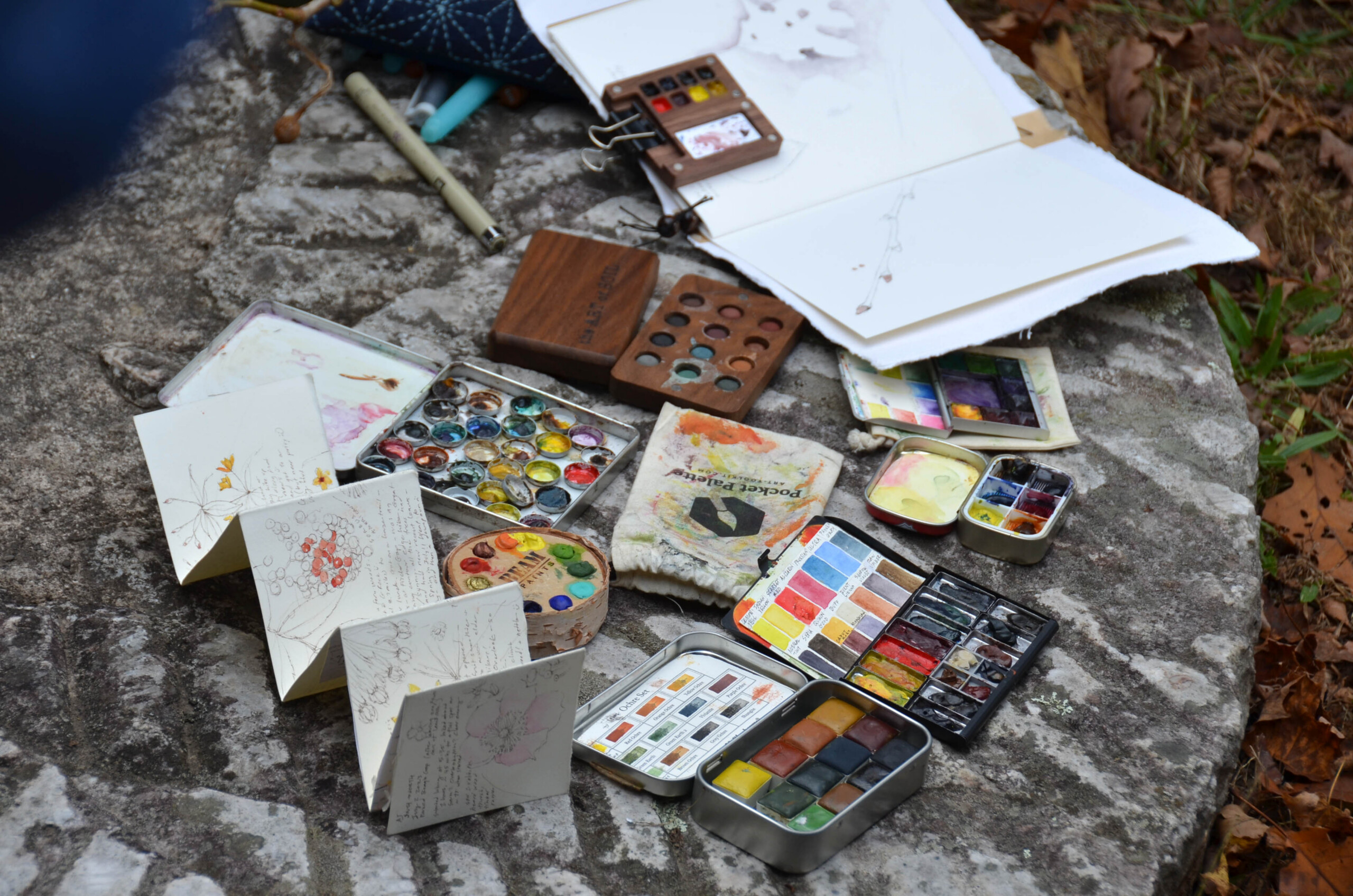
Art Supplies
Below is a list of supplies recommended for this workshop. Some brands are suggested, but you can use any supplies you prefer.
BRING YOUR OWN:
•Graphite Pencil (H or HB) – can be mechanical (003 or 005) and/or regular pencil
•Pencil Sharpener (Muji Desktop Pencil Sharpener or Faber Castell Double Hole Sharpener)
•Eraser (Tombow Mono Zero)
•Watercolor (portable watercolor travel set or watercolor pencils (Faber Castell Albrecht Durer))
•(optional) Watercolor Brushes (See suggestions, sizes 6, 2, and 3/0)
•Colored Pencils (Faber Castell Polychromos)
•Sepia Micron Pen, size 005
•Vellum (size 3”x4” or 5”x7”) – Pergamena Classic Cream / Character Cream suggested, but any kind will do
•Magnifying Glass
•Small Ruler (see-through if possible)
•Portable Lamp (battery powered is best due to limited outlets)
WE SUPPLY*:
•Sketchbook: The Laws Sketchbook for Nature Journaling
•Pencil: Prismacolor Col-erase Non-photo Blue Pencil
•Water Brush: Pentel Arts Aquash Round, Large (18mm), Fine Point Water Brush
*Full-Weekend Participants Only! If you only signed up for one day, these items will not be provided.
Meet the Instructors
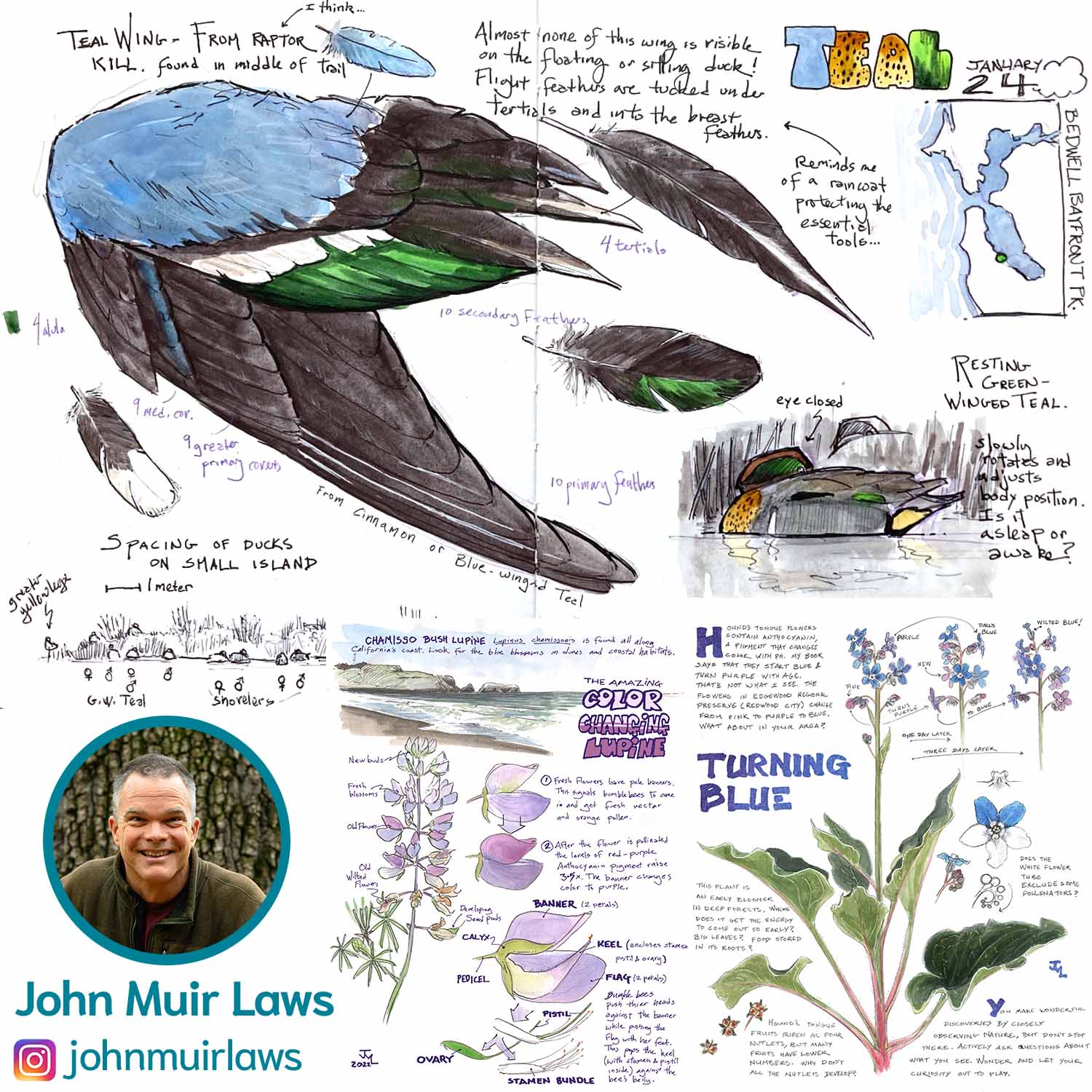
John Muir Laws
John Muir Laws, aka Jack, is a principal leader and innovator of the worldwide nature journaling movement. Jack is a scientist, educator, and author, who helps people forge a deeper and more personal connection with nature through keeping illustrated nature journals and understanding science. His work intersects science, art, and mindfulness. Trained as a wildlife biologist and an associate of the California Academy of Sciences, he observes the world with rigorous attention. He looks for mysteries, plays with ideas, and seeks connections in all he sees. Attention, observation, curiosity, and creative thinking are not gifts, but skills that grow with training and deliberate practice. As an educator and author, Jack teaches techniques and supports routines that develop these skills to make them a part of everyday life.
He is the co-founder and president of the Wild Wonder Foundation, a non-profit organization dedicated to encouraging nature connection and conservation through attention, curiosity, art, science, and community. Laws is the founder and host of the Nature Journal Club, a family-friendly, intergenerational community that connects with nature through art and field journaling. He was awarded the 2026 Conservation Hero Award by San Francisco Nature Education, the 2024 Conservationist of the Year by the John Muir Association. the 2020 Bay Nature Local Hero Award for his work in environmental education, and the 2009 Terwilliger Environmental Award for outstanding service in Environmental Education. He is a 2010 TogetherGreen Conservation Leadership Fellow with the National Audubon Society. He was the 2011 artist for International Migratory Bird Day.
He has written and illustrated books about art and natural history including How to Teach Nature Journaling (2020), The Laws Guide to Nature Drawing and Journaling (2016), The Laws Guide to Drawing Birds (2012), Sierra Birds: a Hiker’s Guide (2004), The Laws Guide to the Sierra Nevada (2007), and The Laws Pocket Guide Set to the San Francisco Bay Area (2009). He is a regular contributor to… Learn more
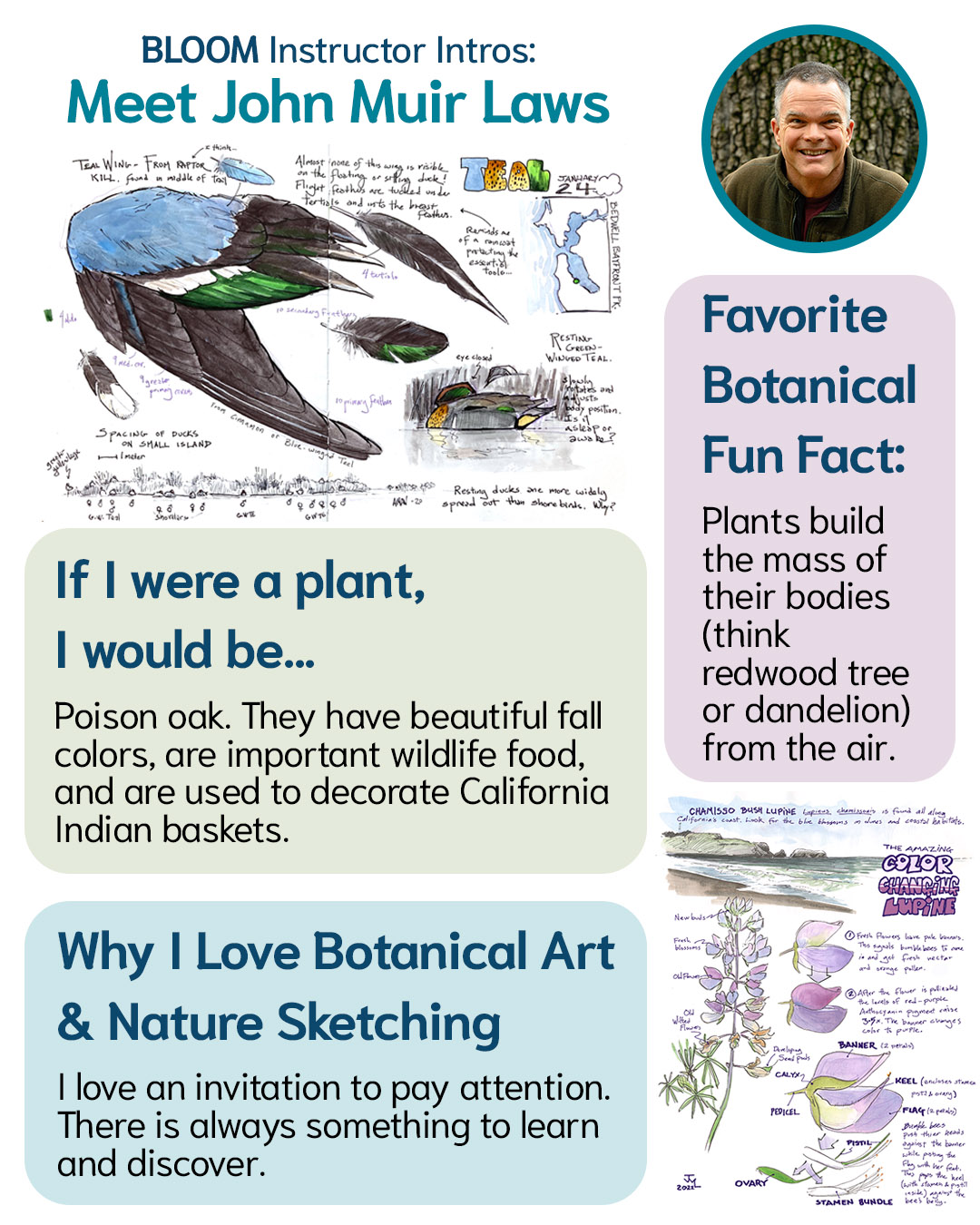
Get to know John
Q: What are your favorite art supplies to use?
A: Prismacolor Col-erase Non-photo Blue Pencil and Pentel Arts Aquash Round, Large (18mm), Fine Point Water Brush. Shop for my favorite supplies here.
Q: If you were a plant, which plant would you be and why?
A: I would be poison oak. They have beautiful fall colors, are important wildlife food, and are used to decorate California Indian baskets.
Q: What do you love most about botanical art and nature sketching?
A: I love an invitation to pay attention. There is always something to learn and discover.
Q: Who inspires you?
A: My mom inspires me with kindness, attention to people, and protection of nature. My dad inspires me with thoughtful perspectives and is willing to go deep. Carolyn inspires me with loyalty, sideways humor, emotional intelligence, and great hugs. Amelia inspires me by doing the right thing when no one is watching. Cybele inspires me by living a life of service to the community and being a mentor to vulnerable people.
Q: What is your favorite botanical fun fact?
A: Plants build the mass of their bodies (think redwood tree or dandelion) from the air.
Learn more about John Muir Laws
https://johnmuirlaws.com/
https://www.wildwonder.org/
YouTube: @JohnMuirLaws
Instagram: @johnmuirlaws
Facebook: @John Muir Laws
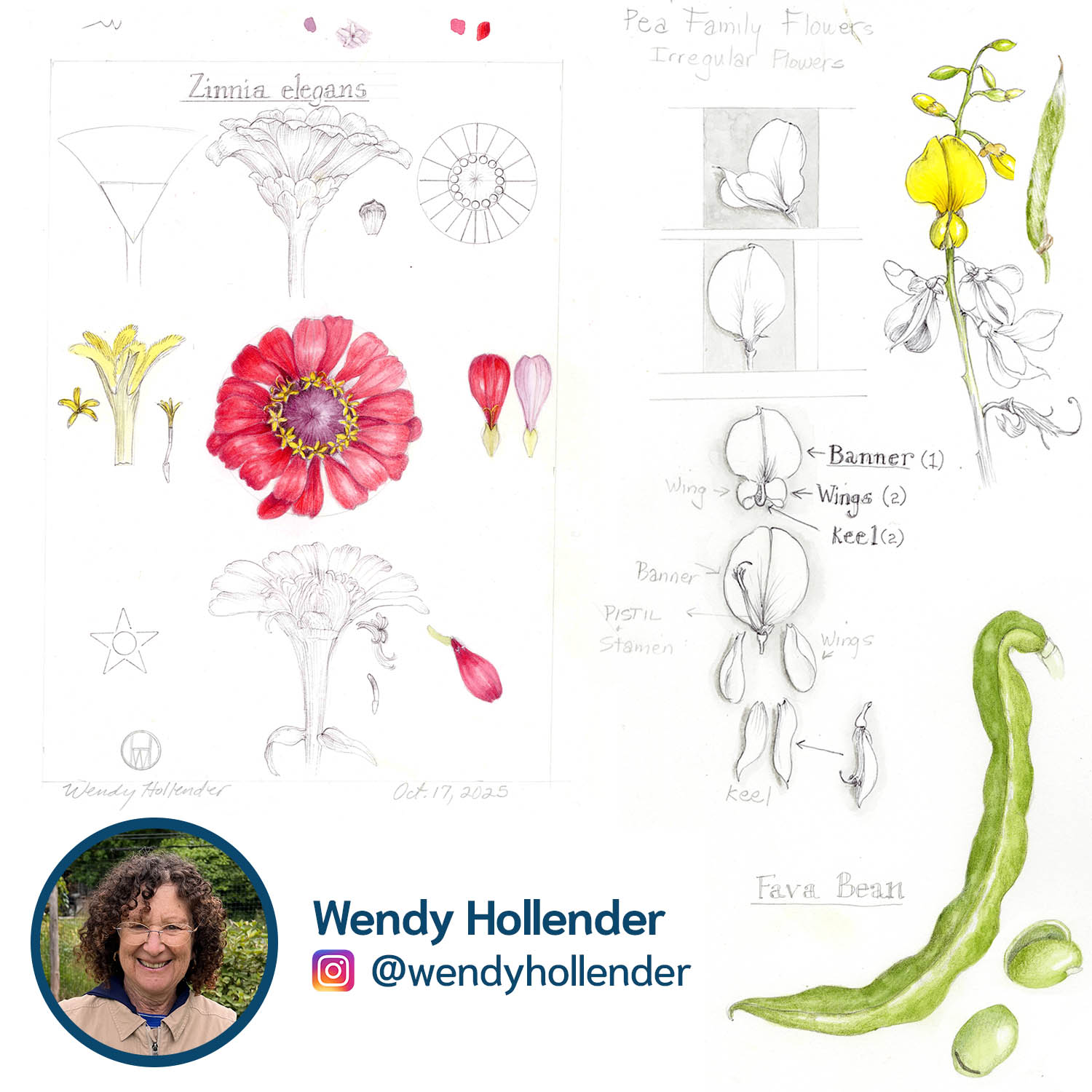
Wendy Hollender
Wendy Hollender is a botanical illustrator, author, and instructor, as well as the founder of Draw Botanical. She is a member of the American Society of Botanical Artists and the National Tropical Botanical Garden Florilegium Project
– BFA in Textile Design from the Rhode Island School of Design
– Certified by the New York Botanical Garden in Botanical Art and Illustration
– Featured in the 13th International Exhibition at Hunt Institute for Botanical Documentation
– Exhibited by Royal Botanical Gardens, Kew, the Smithsonian National Museum for Natural History and the US Botanic Garden
– Author of The Joy of Botanical Drawing, Nature Journaling in a Nutshell, The Practice of Botanical Drawing, Botanical Drawing in Color and the self-published Botanical Drawing, A Beginner’s Guide
– Illustrator of Foraging and Feasting: A Field Guide and Wild Food Cookbook by Dina Falconi
– Member of the National Tropical Botanical Garden Florilegium of Artists
– Wendy’s newest large format art book, The Album of Plant Families: An Illustrated Exploration of Nature’s Beauty & Bounty, is due to be released by Abbeville Press in May 2026… Learn more
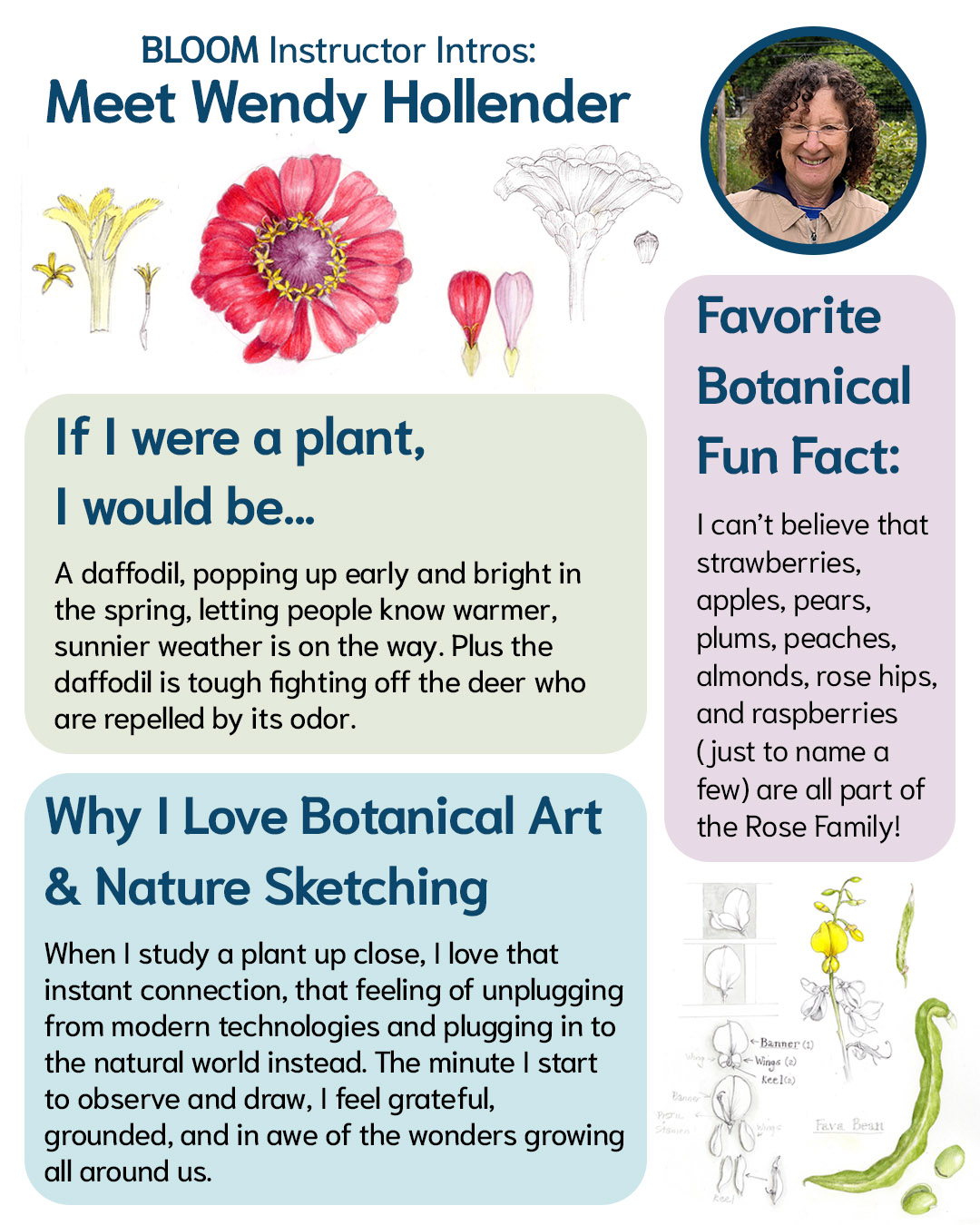
Get to know Wendy
Q: What are your favorite art supplies to use?
A: Colored pencils and watercolor pencils
Q: If you were a plant, which plant would you be and why?
A: In a way I think in the east coast I would be a daffodil popping up early and bright in the spring, letting people know warmer, sunnier weather is on the way. Plus the daffodil is tough fighting off the deer who are repelled by its odor. They last and spread out nicely but don’t take over the landscape which is considerate of their neighbors.
Q: What do you love most about botanical art and nature sketching?
A: I love the immediate feeling when I study nature close up of feeling I am plugging in to nature and eliminating the rest of the world that is man made things such as phones and computers. Nature is beautiful, quiet, gentle and incredibly smart with how it creates such amazing things for us to use in our life in all aspects and I always feel this connection the minute I start to observe and draw.
Q: Who inspires you?
A: When people appreciate the sharing of botanical drawing techniques and the positive impact it has on their lives I am inspired to continue to share my passion with others.
Q: What is your favorite botanical fun fact?
A: I can’t believe that strawberries, apples, pears, plums, peaches, almonds, rose hips, and raspberries to name a few are all part of the Rose Family
Learn more about Wendy Hollender
wendyhollender.com/
Instagram: @wendyhollender
Carol Woodin
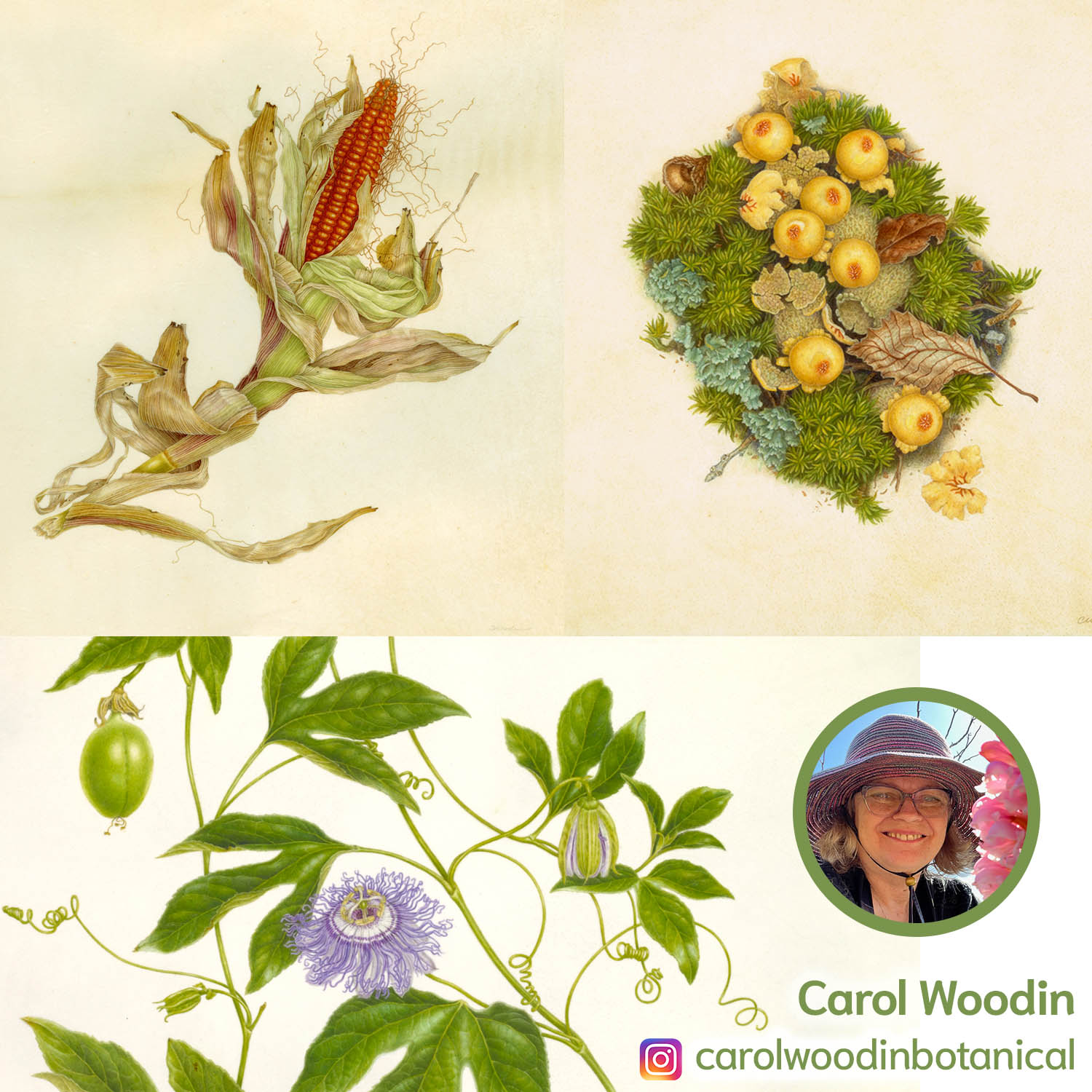
Carol Woodin enjoys spending time outdoors looking at and thinking about plants and habitats and making studies for future paintings. Plants and their diversity serve as never-ending sources of inspiration and fascination, and have led to a life-long vocation of painting them in watercolor. She was drawn into the field through an interest in wild orchids in upstate New York, and since then curiosity has led her to paint everything from heirloom food crops to threatened species. Carol has been painting on vellum for thirty years and has taught her techniques to people around the world. Some recent venues showing her work are the Shirley Sherwood Gallery, UK, Museum de Zwarte Tulp, the Netherlands, Hannarie Wenhold Gallery, Grootbos, South Africa, and UBS Gallery, New York.
Her work has appeared in Curtis’ Botanical Magazine and in three orchid monographs published by the Royal Botanic Gardens, Kew and Natural History Publications, Borneo, and authored by Phillip Cribb. An instructional book edited by Carol with Robin Jess, Botanical Art Techniques: A Comprehensive Guide received the 2020 CBHL Award for Excellence in Botanical Art and Illustration. In 2024 she became the third recipient of the Shirley Sherwood Award for ‘broad and significant contributions to botanical art’… Learn more
Get to know Carol
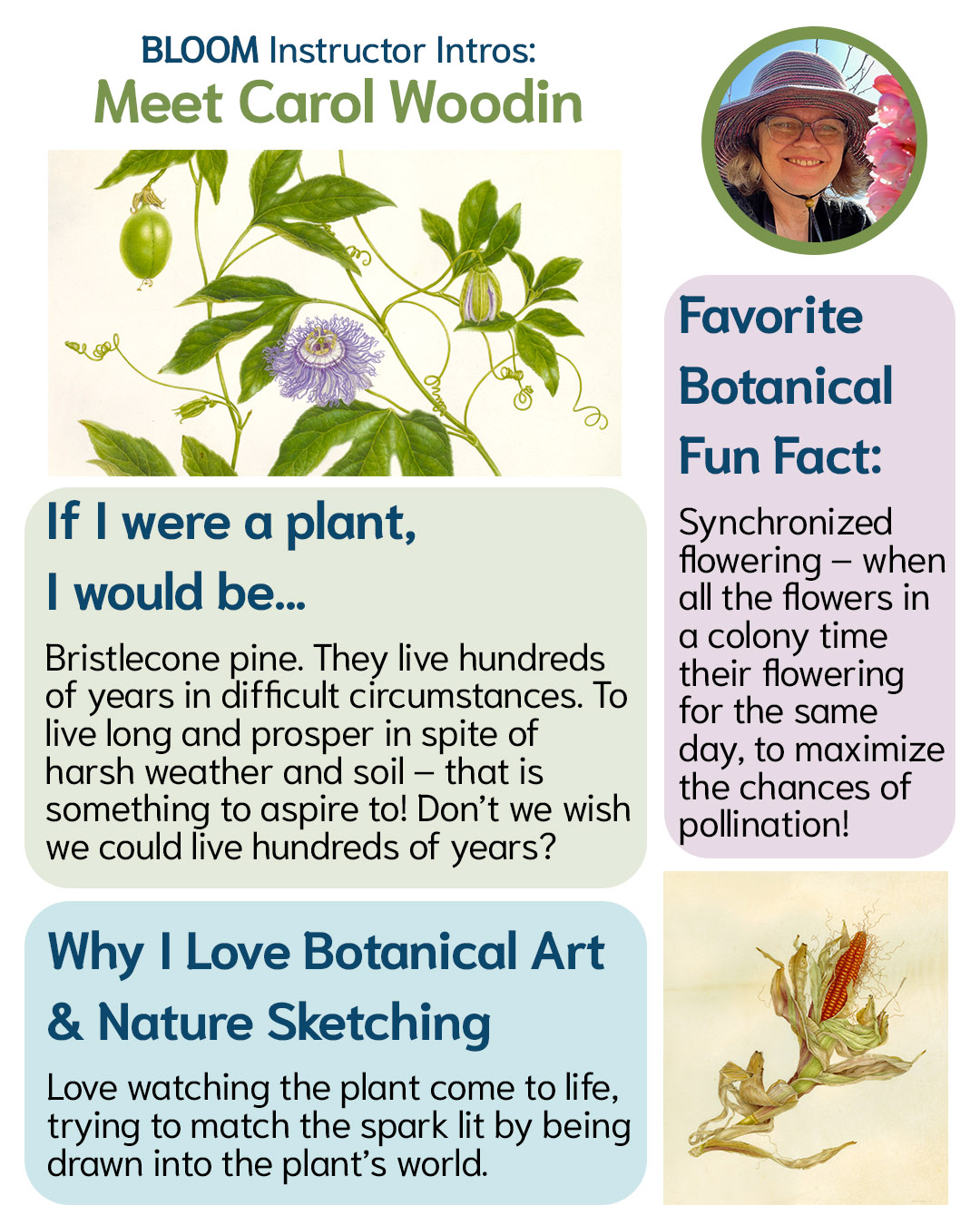
Q: What are your favorite art supplies to use?
A: I keep my supplies simple – watercolor, drafting pencils, and very good brushes. Brushes are so important. You want them to do what you want, not what they want! Of course each piece of vellum is unique, so you become attached to each, and want to make good use of it.
Q: If you were a plant, which plant would you be and why?
A: I think I’d be a bristlecone pine. They live hundreds of years in difficult circumstances. To live long and prosper in spite of harsh weather and soil – that is something to aspire to! Don’t we wish we could live hundreds of years?
Q: What do you love most about botanical art and nature sketching?
A: Love watching the plant come to life, trying to match the spark lit by being drawn into the plant’s world.
Q: Who inspires you?
A: So many artists and others, where do I start? For artists, Margaret Mee made me see that this work could be done, Rory McEwen, who took it down a completely new path, and there are so many living artists, among them those who consider themselves botanical artists, and others who don’t. I especially love to see artists bringing something new into a long-established field. For me this year’s hero is Christina Koch, Artemis II astronaut.
Q: What is your favorite botanical fun fact?
A: Synchronized flowering – when all the flowers in a colony time their flowering for the same day, to maximize the chances of pollination!
Learn more about Carol Woodin
carolwoodinart.com
Instagram: @carolwoodinbotanical
Register Now
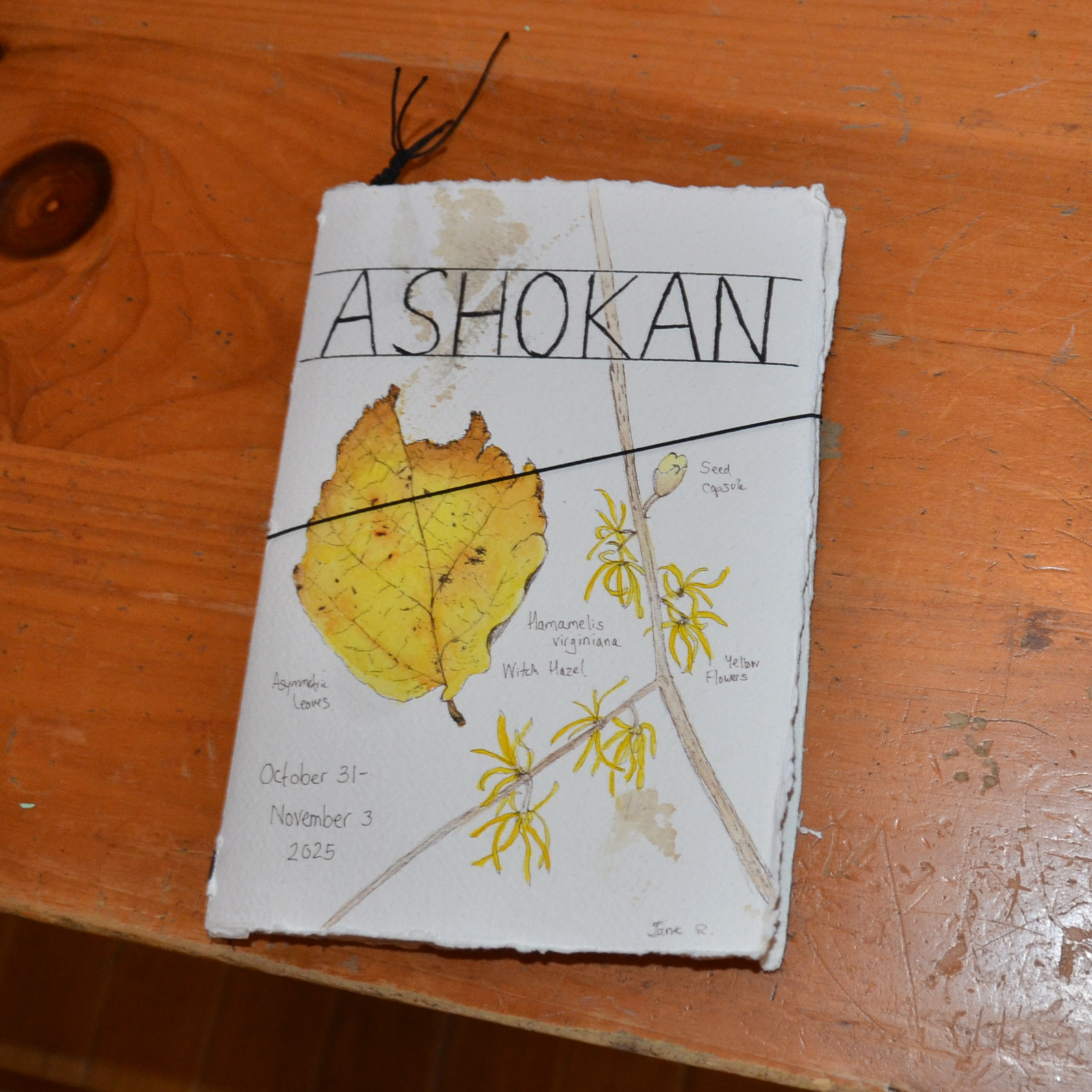
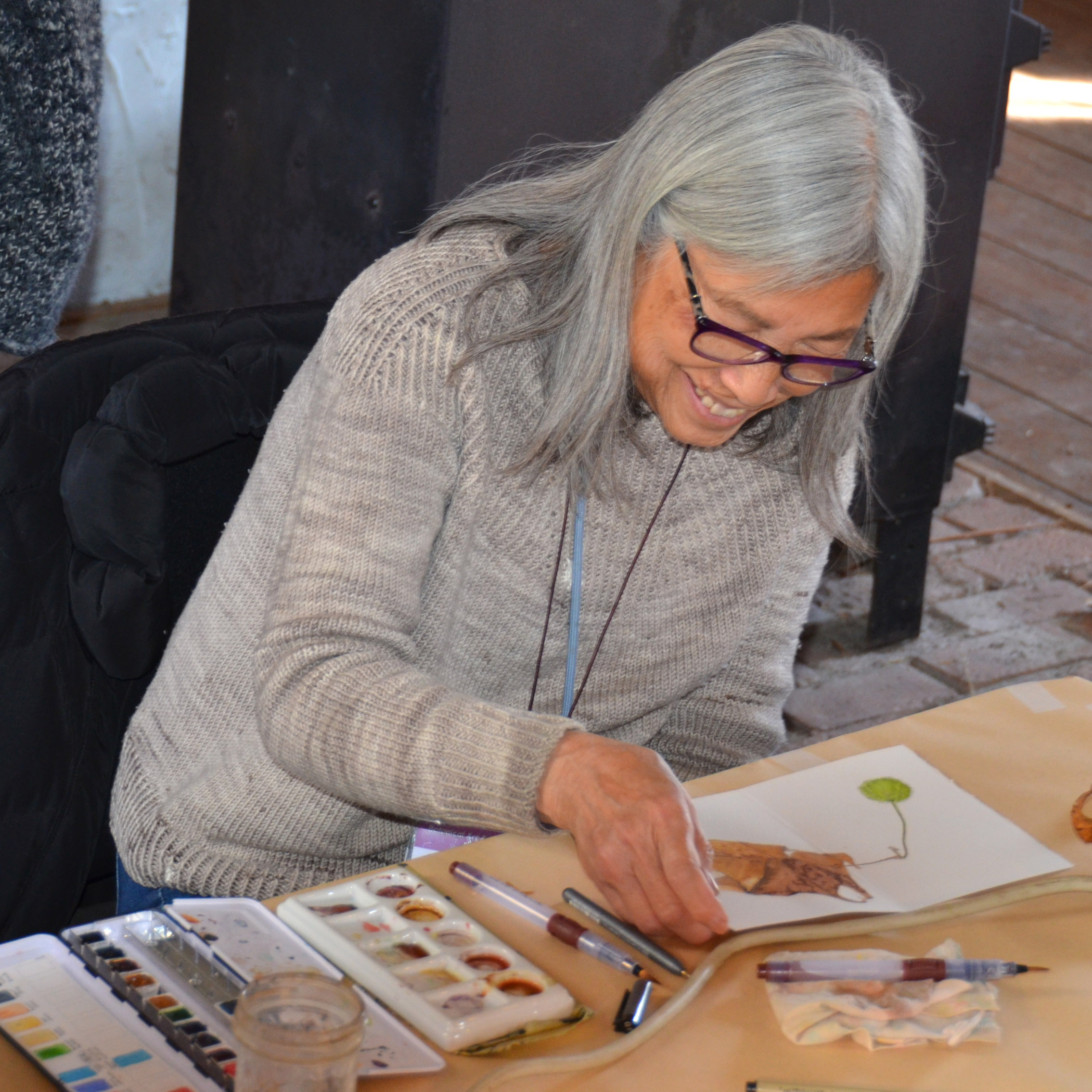
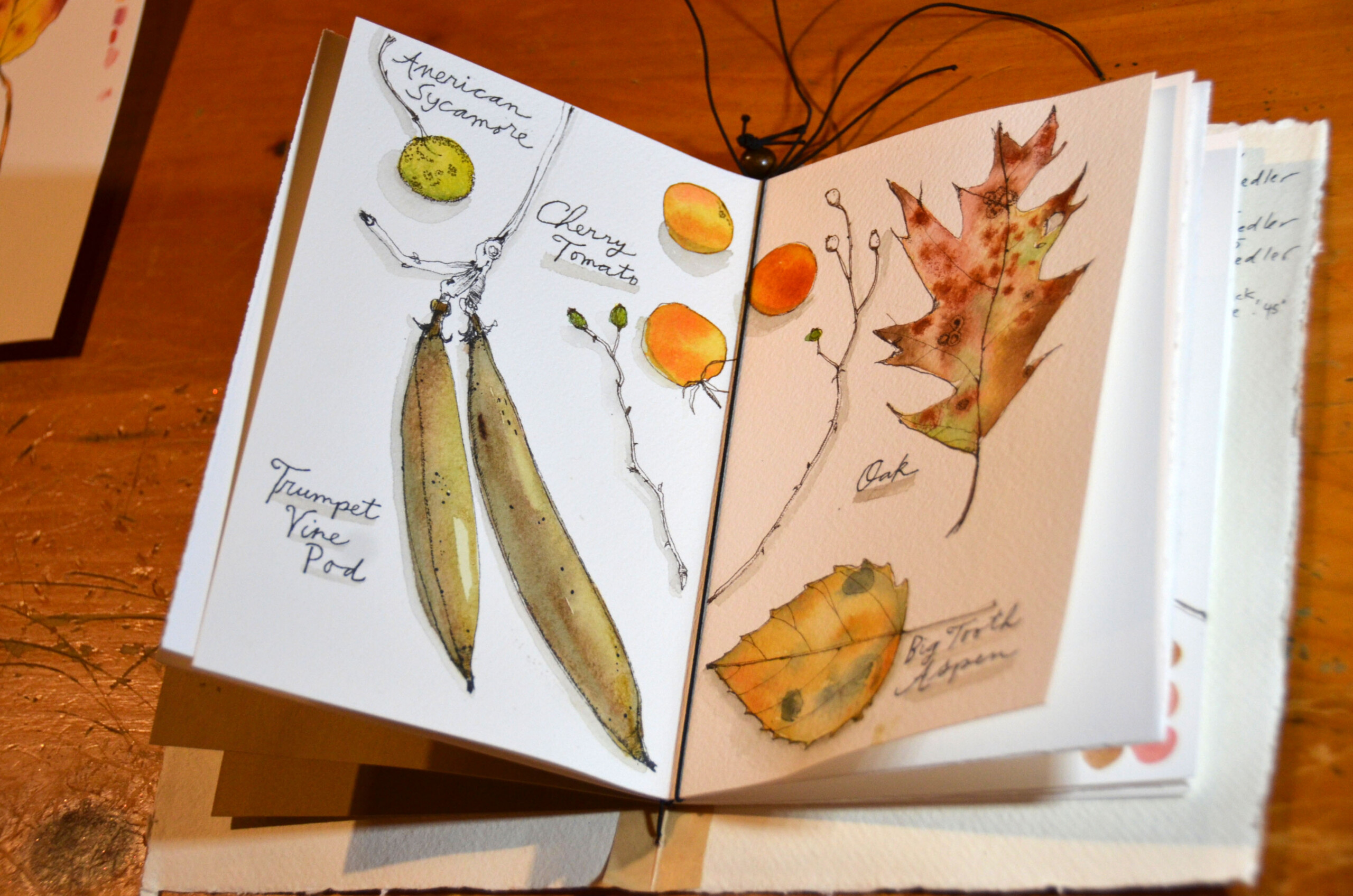
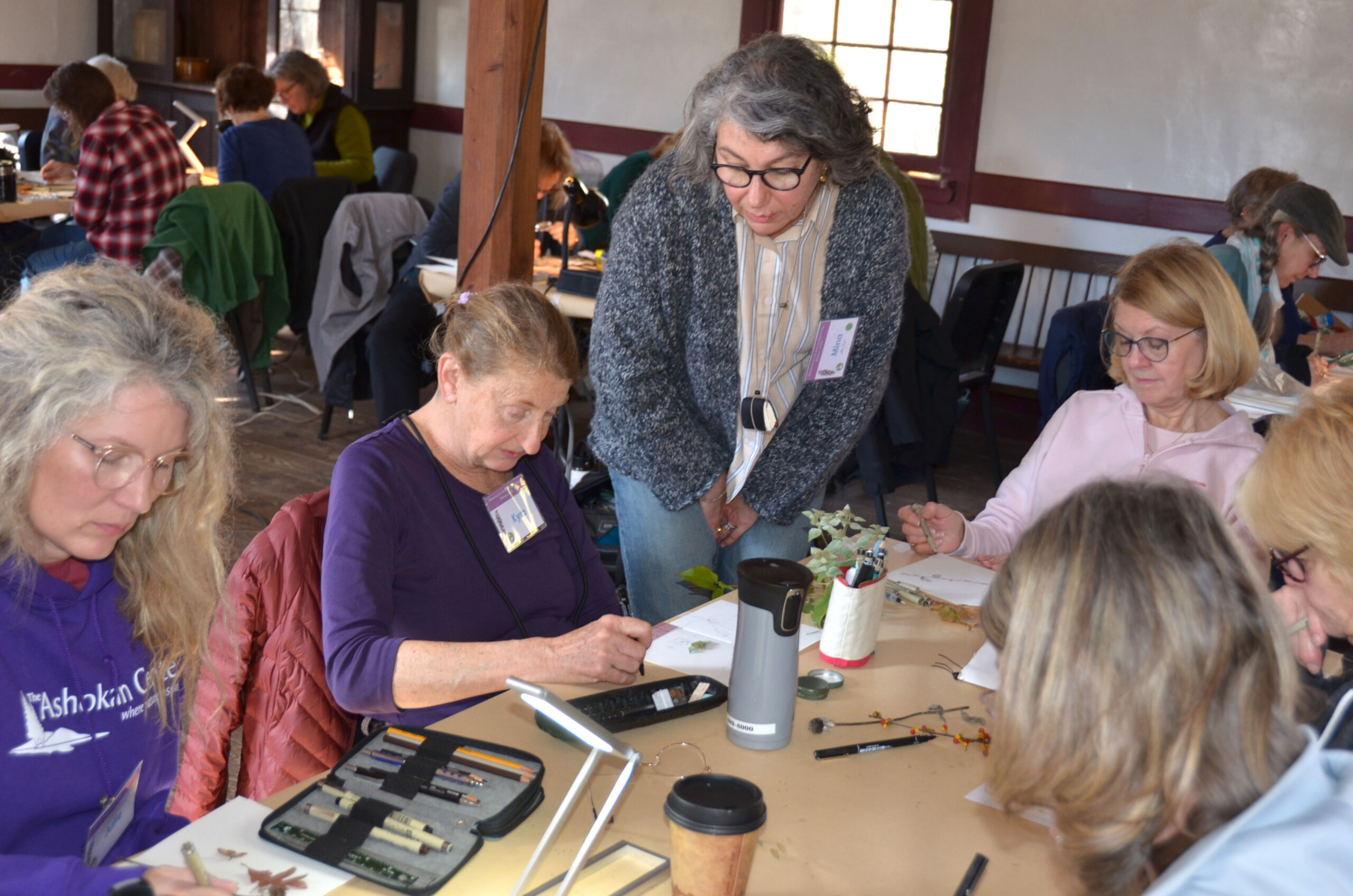
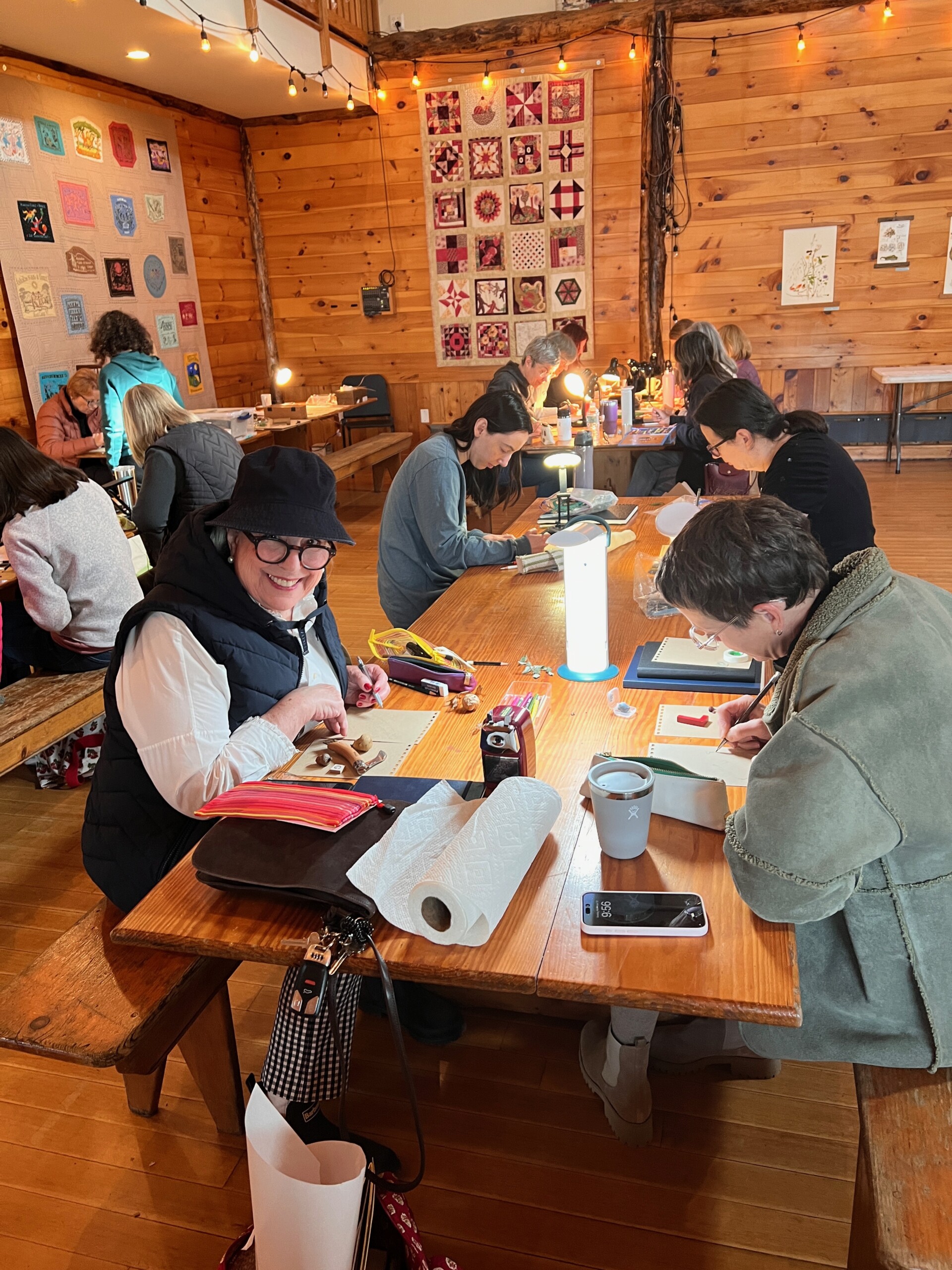
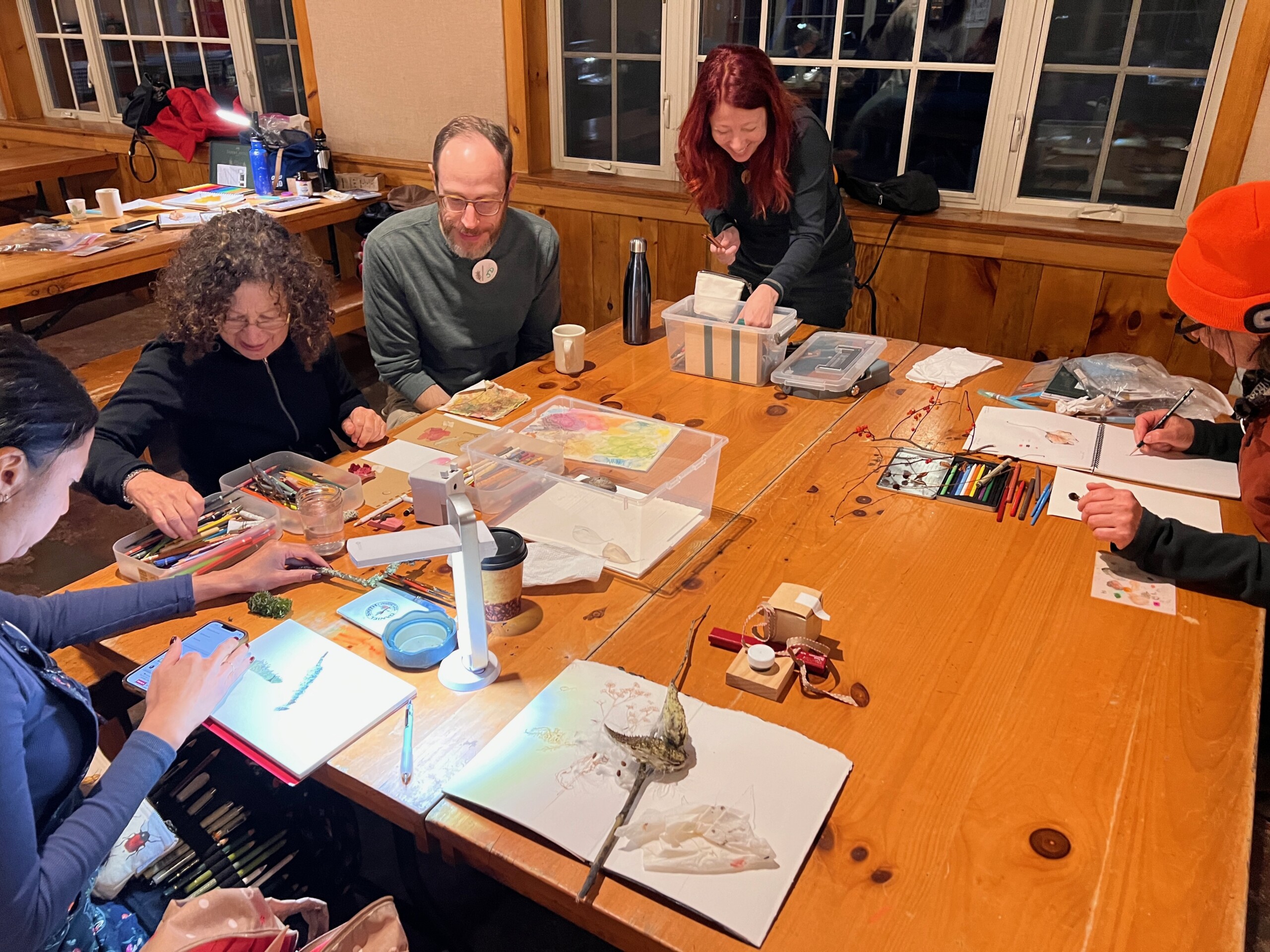
Photo Gallery from Past Retreats

Register Now
Cancellation Policy: In the event you cancel over 6 weeks before, a partial refund of 70% will be given if we are able to fill your spot. If we are unable to fill your spot or if you cancel less than 6 weeks before, we cannot issue a refund. We reserve the right to cancel a workshop at any time. If we cancel a workshop, you will receive a full refund.
If you’re ready to register, fill out the form below.
Can’t wait to BLOOM with you!