Learn the Language of Illustration: Botanical Terms and Definitions
A Growing Glossary of Botany & Drawing Definitions Essential for Artists & Nature Lovers
Your Go-To Guide for Garden Terminology & Creative Vocabulary
Written with care, curiosity, and a deep love of the natural world by the Draw Botanical Team
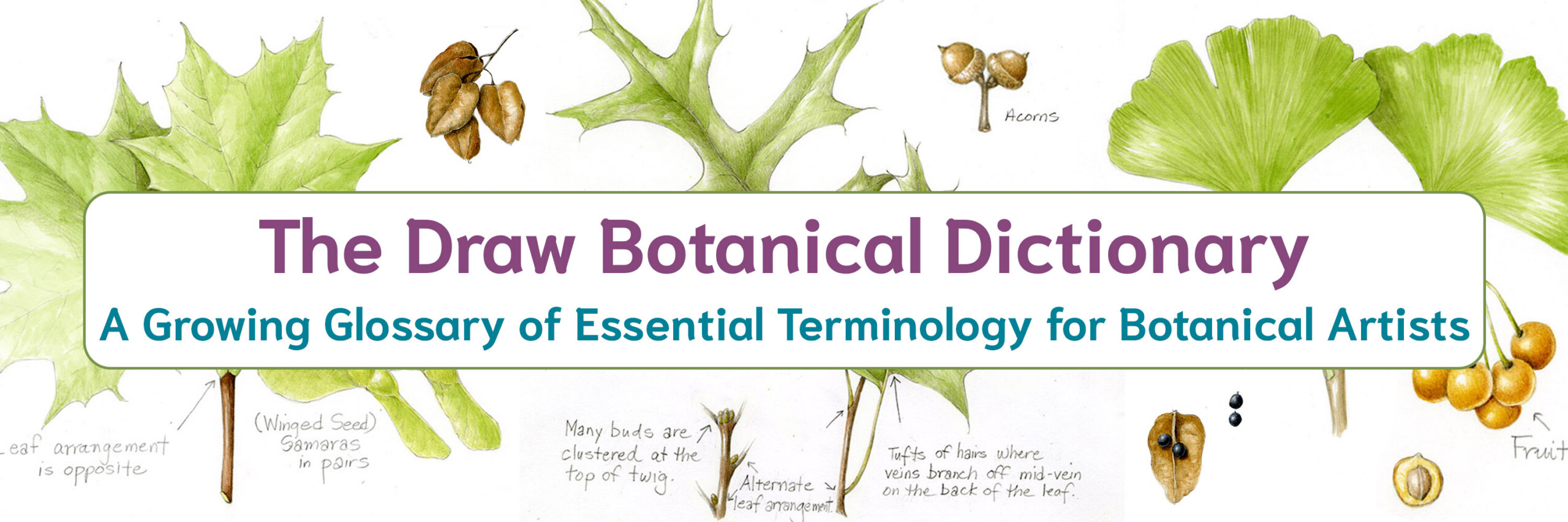
When you sit down with a rose and realize that the swollen green bump at the base of the petals is the ovary (AKA the future fruit, full of seeds), you stop seeing a vague shape and start seeing a story. When you recognize that those leaves are arranged, not randomly, but purposefully in an opposite pattern, your eyes begin to read the logic of the plant. When you understand that a core shadow falls at the turning point of a curved form, you stop guessing where to put your darkest pencil strokes and start toning with quiet confidence.
Language does that. The right words unlock understanding and true observation. And sharper observation is everything in botanical illustration!
We’ve seen it happen in our students countless times: the moment someone learns what a pistil is, they begin to look at it with loving attention, and suddenly the center of every flower becomes fascinating rather than confusing. The moment an artist understands the concept of contrast, their drawings stop looking flat, just like that! Vocabulary isn’t just academic trivia. It is the lens through which you begin to see your subject clearly enough to draw it.
That’s why we built this dictionary. It covers the anatomy of flowers, leaves, fruit, and plant structures alongside the drawing and illustration techniques we teach every day. At Draw Botanical, our courses focus primarily on colored pencil and watercolor, two of the most luminous and detail-friendly mediums in botanical art. However, the vast majority of concepts here travel beautifully across any medium: graphite, pen and ink, watercolor, or gouache.
Now set yourself up for success, place a live plant in front of you, quiet your inner critic, and let’s learn the language of botanical illustration together. Scroll through this post of dictionary definitions, or click below to jump to a specific section.
📖 Table of Contents
•Flowers
•Leaves
•Fruit, Seeds & Pods
•Plant Structures & General Botany
•Drawing & Illustration Techniques
•Frequently Asked Questions
•Ready to Grow? Let’s Draw Together
•References & Further Reading
🌸 Fancy Flowers
Everyone wants to draw beautiful blooms, and those who take the time to understand their intricacies can truly capture these stunning showstoppers on paper. Find a few free tips on drawing flowers here.
Anther — The pollen-producing tip of a stamen, often plump, textured, and absolutely beautiful to render up close. This is where all the golden, dusty drama happens!
Bract — A modified leaf found near a flower or inflorescence that can look remarkably petal-like. (Fun fact: the elegant “petals” of calla lilies and other plants with spathes are actually bracts! Learn to draw spectacular spathes here.)
Calyx — The collective name for all the sepals of a flower. The calyx is the flower’s first coat of armor, protecting the bud before it opens its petals to the world.
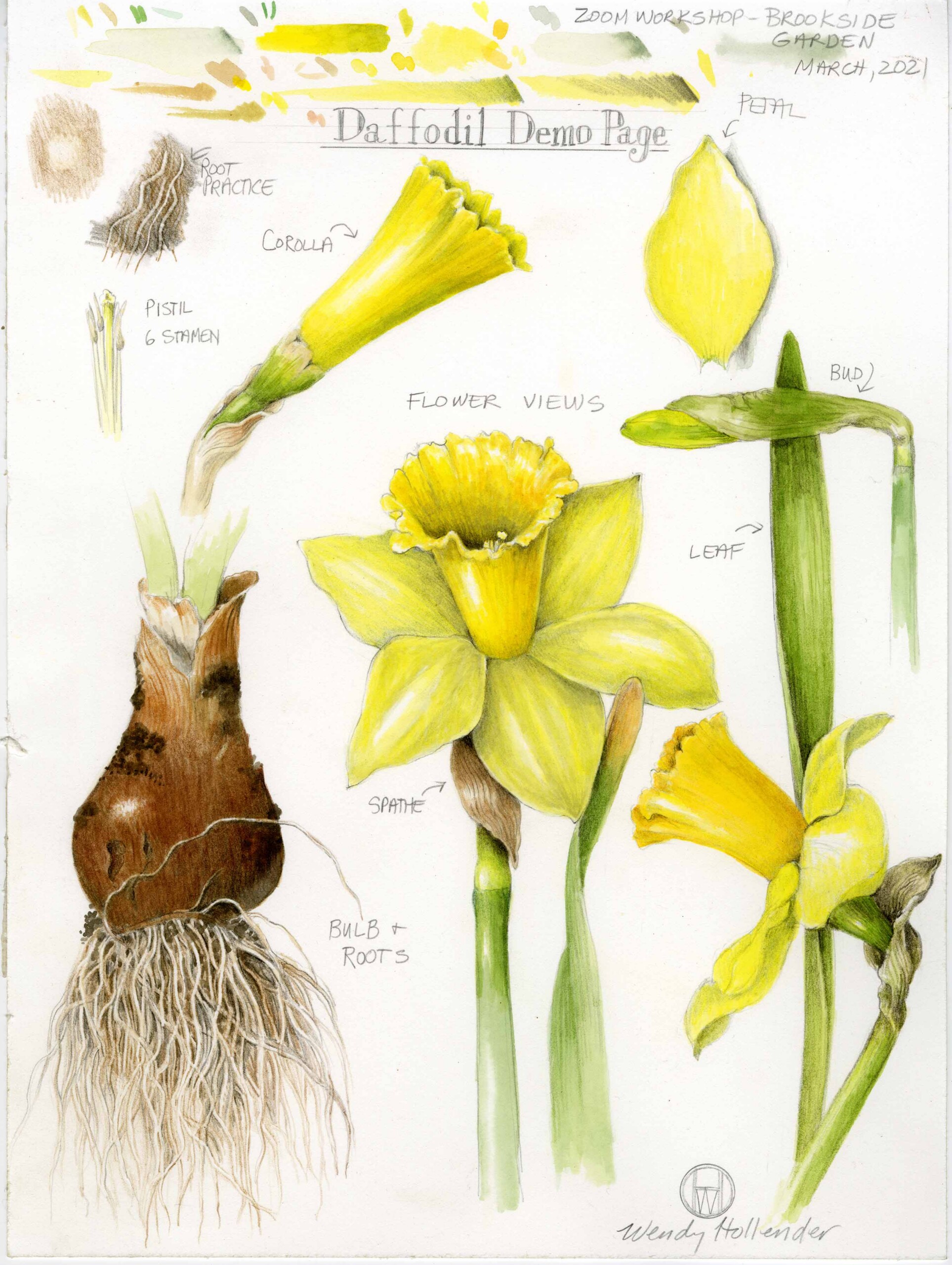
Corolla — The collective name for all the petals of a flower. When you draw those silky, layered petals, you’re drawing the corolla.
Filament — The slender, thread-like stalk that holds the anther up into the light. Delicate and often translucent, a light pencil touch is all you need to capture this darling detail.
Floret — A small, individual flower that forms part of a larger flower head or cluster. The hundreds of tiny flowers packed into a sunflower center? Each one is a floret!
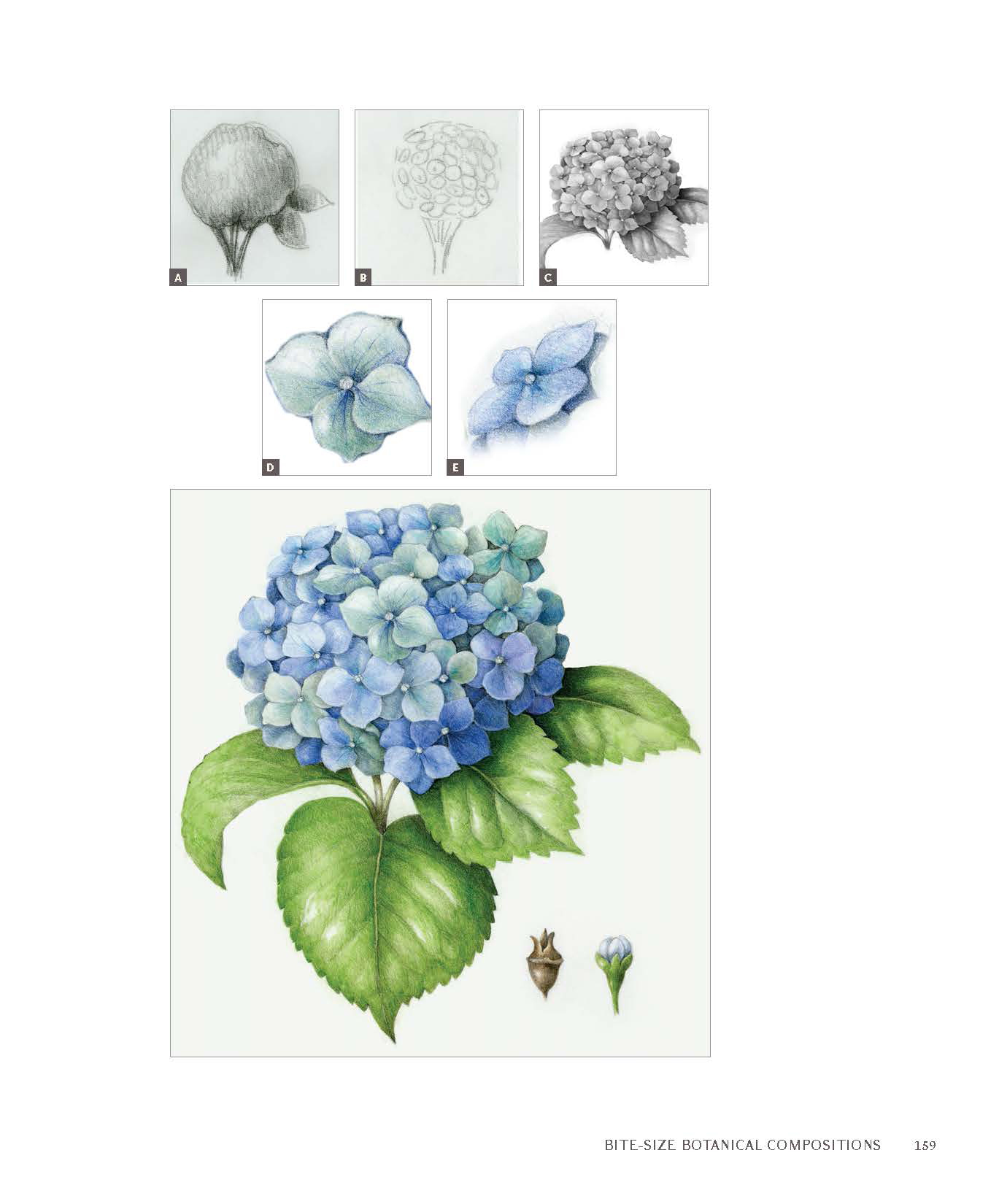
Inflorescence — The arrangement or cluster of flowers on a single stem or branching structure. A lilac’s gorgeous spray, a hydrangea’s big pom-pom, and composite flowers like zinnias are all inflorescences.
Ovary / Ovules — The ovary contains eggs which reside in ovules. After an egg is fertilized, the ovule develops into a seed and the ovary matures into a fruit. What a transformation story!
Pedicel — The individual stalk of a single flower within a cluster. Each bloom in a bunch of lilacs has its own little pedicel holding it up to the sun.
Peduncle — The main stalk that supports an entire flower or flower cluster. The peduncle is the proud backbone of the floral arrangement.
Perianth — A collective term for the outermost parts of a flower, petals and sepals together. When petals and sepals look nearly identical (as in tulips and lilies), botanists often use “perianth” to describe them all at once.
Petal — A modified leaf, often colorful and fragrant, that forms part of the corolla. Petals attract pollinators — and botanical artists! They are perhaps the element we love to draw most.
Pistil — The female reproductive organ of a flower, made up of the stigma, style, and ovary. Think of it as the flower’s very own little tower of potential.
Pollen — The fine, often golden powder produced by the anther, containing the male reproductive cells. In illustrations, capturing the dusty texture of pollen adds incredible life and authenticity.
Receptacle — The enlarged, fleshy tip of the stem from which all the flower parts arise. It all grows from here!
Sepal — A leaf-like structure that forms part of the calyx that wraps around and protects the bud. Sepals are often overlooked, but drawing them accurately gives your illustration botanical credibility.
Spadix — A type of inflorescence where tiny flowers are densely packed and arranged around a thick, fleshy central stem; often paired with a spathe.
Spathe — A large, modified bract that surrounds or encloses a flower cluster. It wraps around the central spadix and protects immature flowers. Calla lilies, jack in the pulpits, and anthuriums are all popular plants with spathes.
Stamen — The male reproductive organ of a flower, made up of the filament and anther. A ring of stamens around the pistil is one of the most elegant and satisfying things to draw.
Stigma — The sticky tip at the top of the pistil that receives pollen. The stigma can be feathery, knobby, lobed, or glossy — always worth a close look through a magnifying glass!
Style — The slender tube connecting the stigma down to the ovary. It’s the elegant “neck” of the pistil, and it varies wonderfully in length and shape from flower to flower.
Want practical tips for painting beautiful blooms? Learn how to draw flowers that feel real.
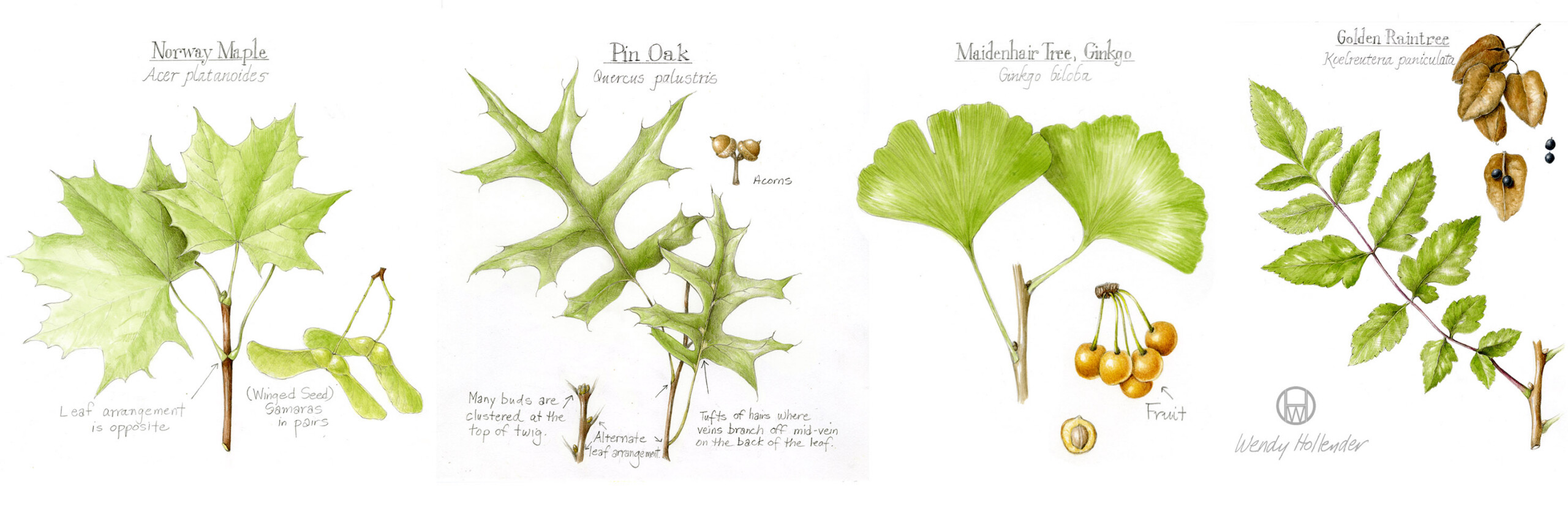
🍃 Lovely Leaves
When you create a botanical illustration showcasing a plant’s important parts, it’s difficult to avoid the challenge of drawing a realistic leaf. From the way they attach to a stem to the shape of their edges, every detail is a drawing opportunity.
Alternate — A leaf arrangement where leaves appear one at a time, alternating sides as they travel up the stem. This spiraling pattern is very common and creates wonderful rhythm in a composition.
Apex — The tip or pointed end of a leaf. The apex can be sharp and needle-like, softly rounded, notched, or even deeply forked — always worth observing closely.
Axil — The angle formed between a leaf (or branch) and the stem it grows from. Flower buds often nestle in axils, making them delightful details to include in your complete composition.
Basal — Leaves that grow at the very base of a plant, low to the ground, rising from the root crown. Think of dandelions or violets whose leaves form a rosette at ground level.
Bipinnate — A compound leaf in which the leaflets are themselves divided into smaller leaflets, like a fern gone doubly complex. Drawing one is a wonderful meditative challenge and the perfect way to practice the art of patience.
Blade — The flat, expanded surface portion of a leaf. It’s the main “face” that catches the light and does the work of photosynthesis. When we draw a leaf, most of what we draw is its blade.
Compound leaf — A leaf divided into two or more distinct leaflets on a single petiole. Roses, ash trees, and wisteria all have compound leaves. They’re easy to mistake for multiple leaves if you don’t know what to look for.
Dicots / Dicotyledons — A broad category of leaves that display a branching vein pattern, creating a network across the leaf surface. Common examples include oak, rose, and hibiscus leaves. (Check out this video on drawing a basic leaf with net veining.)
Entire — A leaf margin that is perfectly smooth with no teeth, lobes, or indentations. “Entire” leaves have a clean, elegant edge that’s satisfying to contour-draw.
Lanceolate — A leaf shape that is long, narrow, and tapering to a point at both ends, like a lance. Willow leaves are a classic example.
Leaflet — An individual unit of a compound leaf. Each leaflet looks like a small simple leaf but is attached to the main leaf’s central stalk, not directly to the stem.
Lobed — A leaf with rounded or pointed projections separated by curved or angular indentations. Oak leaves and maple leaves are beautifully lobed and endlessly fun to draw (especially in the fall!).
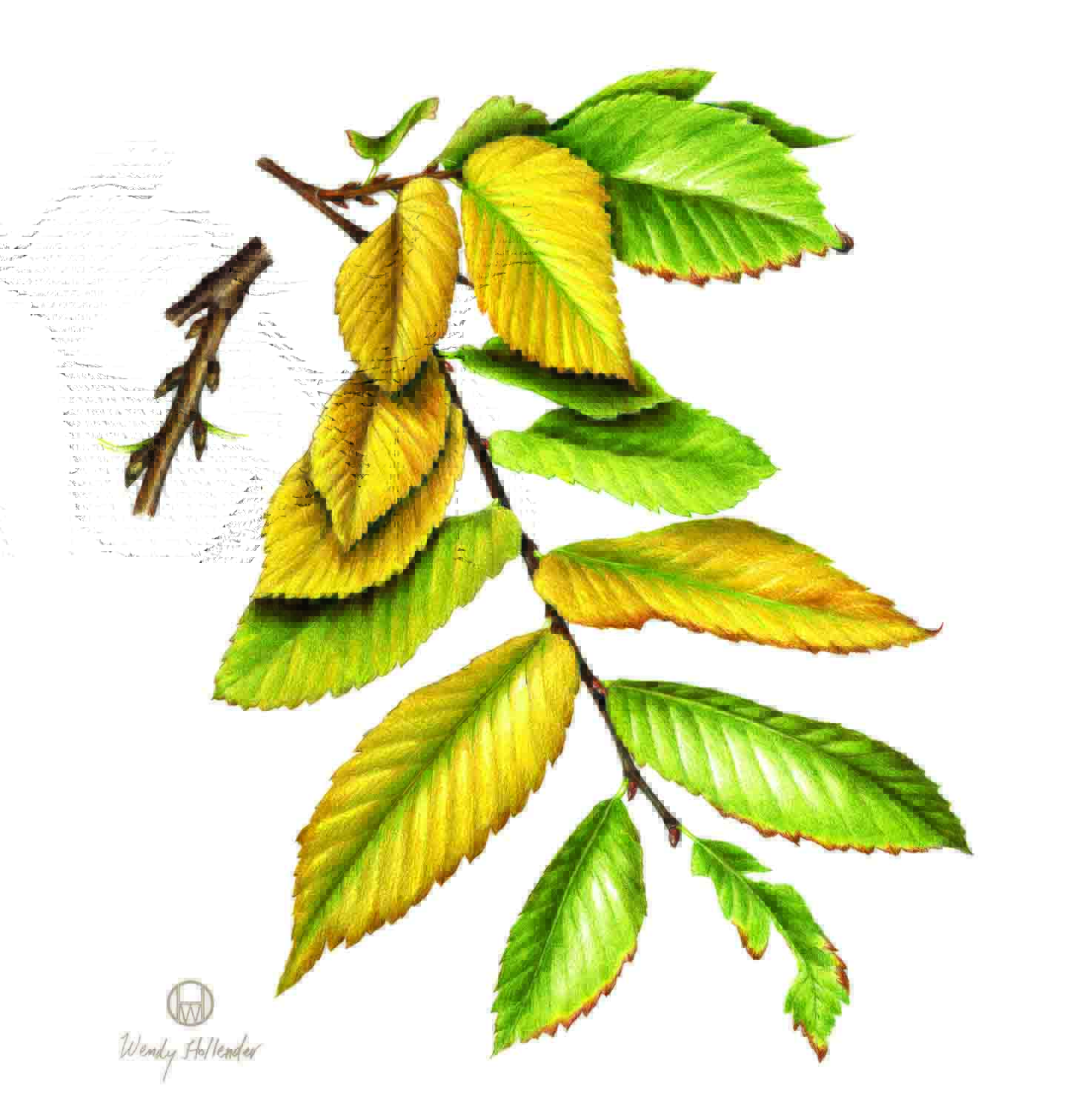
Margin — The edge of a leaf blade. The margin can be entire (smooth), serrated (toothed), lobed, wavy, or fringed. It’s an important factor to consider when identifying plants.
Midrib — The central, main vein running from the base of the leaf blade to the apex. The midrib is the leaf’s backbone and the origin of the whole vein network.
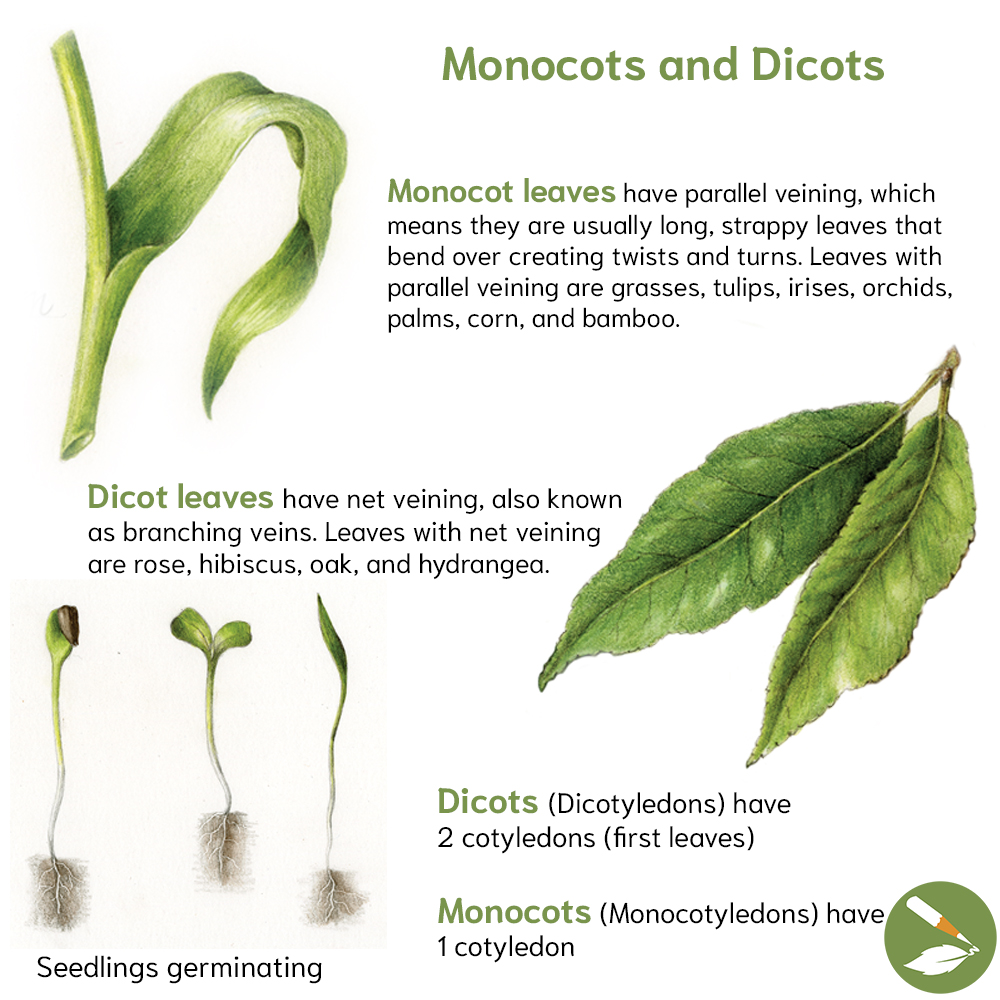
Monocots / Monocotyledons — A broad category of leaves that have parallel veins and are typically long and narrow, like those of grasses, tulips, and lilies. They often exhibit graceful curves and twists.
Node — The point on a stem where a leaf, bud, or branch is attached. Nodes are important structural landmarks when drawing stems accurately.
Opposite — A leaf arrangement where two leaves arise from exactly the same node on opposite sides of the stem, like a matching pair. Mint, lilac, and olives all have opposite leaves.
Ovate — An egg-shaped leaf outline, broader near the base and tapering toward the tip. Many common garden plants have ovate leaves.
Palmate — A leaf shape or venation pattern with lobes or veins radiating outward from a central point, like the fingers of an open hand. Maple leaves are the perfect example.
Palmate compound — A compound leaf where all leaflets arise from a single central point at the top of the petiole, like a hand opening its fingers. Horse chestnut leaves are a classic example.
Petiole — The stalk that attaches the leaf blade to the stem. Petioles vary enormously in length and thickness, so it’s important to measure and draw accurately.
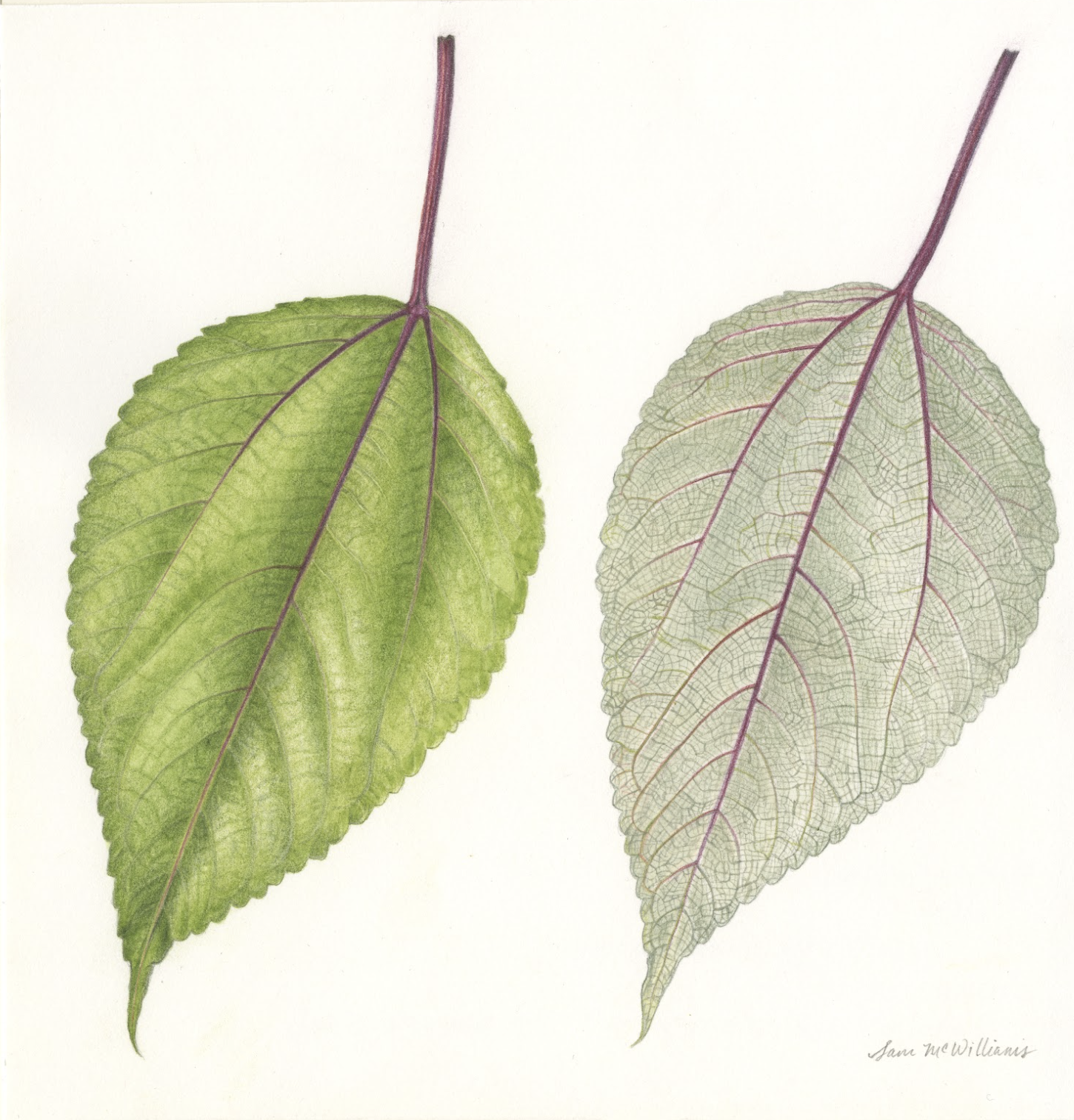
Pinnate — A compound leaf with leaflets arranged in pairs along a central stalk, like a feather. Rose leaves are pinnately compound.
Pinnate venation — A feather-like pattern of veins branching off from a single central midrib. Most broad-leaved plants have pinnate venation, the vein network you see in an average leaf with net veining. Here are 9 simple steps to draw a basic leaf.
Pubescent — Covered with fine, soft hairs. Some leaves and stems are wonderfully fuzzy, a detail that’s tricky but deeply satisfying to capture.
Serrate — A leaf margin with sharp, forward-pointing teeth, like the edge of a saw blade. Strawberry and elm leaves are serrate; the teeth give them so much character.
Sessile — Attached directly to the stem without a petiole or stalk, as if the leaf just decided to hold on directly. Some sessile leaves even clasp or wrap around the stem entirely.
Stipule — A small, leaf-like or scale-like appendage at the base of a petiole. Not all plants have them, but when present, they’re a lovely authentic detail to include.
Venation / Veining — The arrangement or pattern of veins in a leaf. Veins carry water and nutrients, but for us they are a gorgeous structural map that brings a leaf to life in a drawing.
Whorled — A leaf arrangement where three or more leaves arise from the very same node, encircling the stem like a green pinwheel. Whorled arrangements create beautiful, rhythmic compositions.
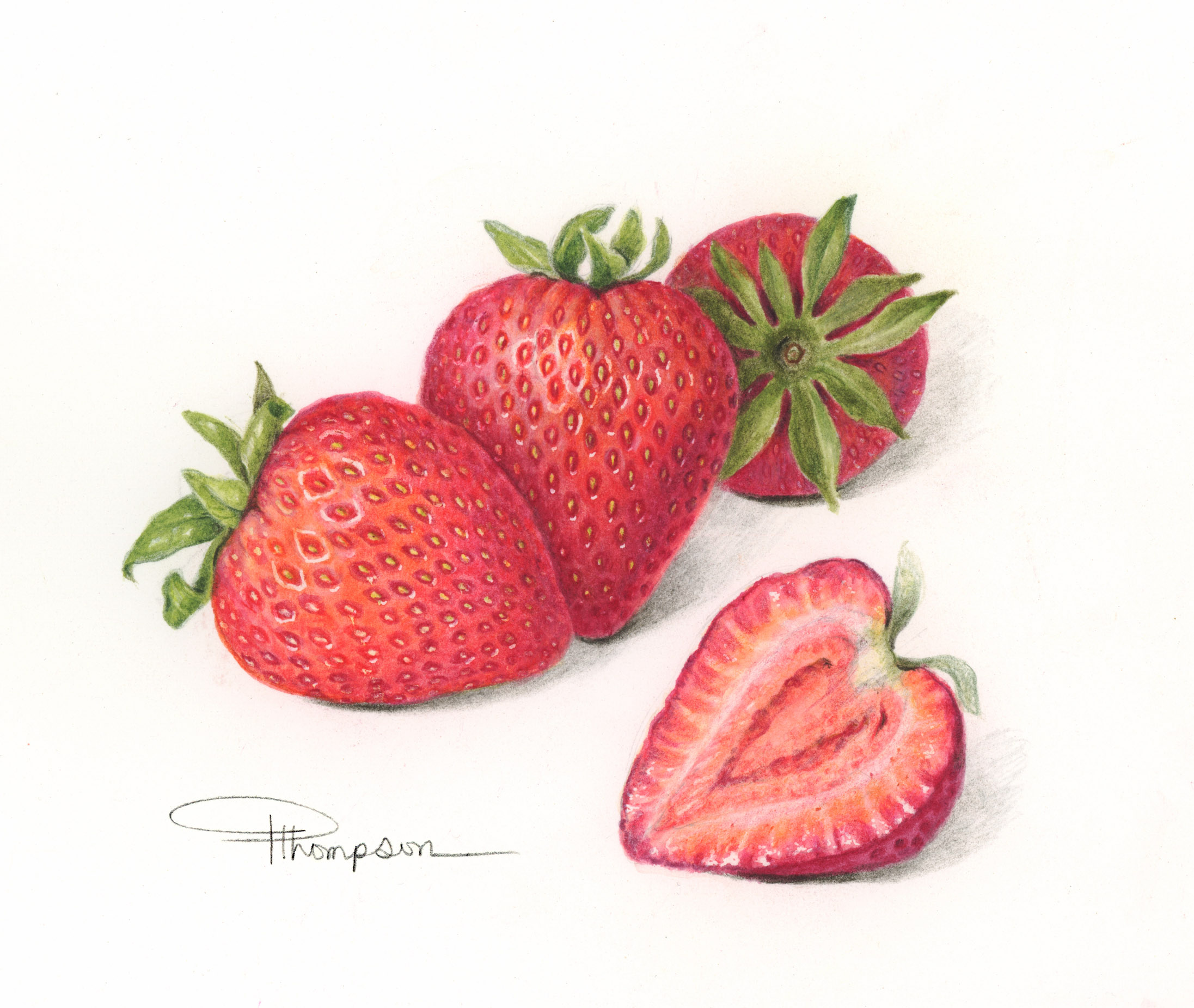
🍎 Fun Fruits, Seeds, & Pods
Fruit in the botanical sense includes everything from juicy berries to rattling seed pods to spinning maple keys… And they can all be magnificent and fascinating drawing subjects!
Achene — A dry, one-seeded fruit that does not open at maturity. The individual “seeds” on a strawberry’s surface and each seed in a sunflower head are achenes.
Berry — If you ask a botanist, a berry is a fleshy fruit developed from a single ovary with seeds embedded in the flesh. Fun fact: Tomatoes, grapes, and cucumbers are technically berries, even though strawberries are not!
Capsule — A dry fruit that splits open at maturity to release its seeds. Poppy heads, iris pods, and cotton bolls are all capsules, and their split-open forms make dramatic illustrations.
Caryopsis — A dry, one-seeded fruit typical of grasses, where the seed coat is permanently fused to the fruit wall. Every grain of wheat and rice is a caryopsis!
Cotyledon — The seed leaf; the very first leaf (or leaves) to emerge from a germinating seed. Bean seeds show their two fat cotyledons beautifully when you split them open.
Dehiscent — A fruit or seed pod that opens naturally at maturity to release its seeds. The word comes from the Latin for “to gape,” which is exactly what a ripe pea pod does!
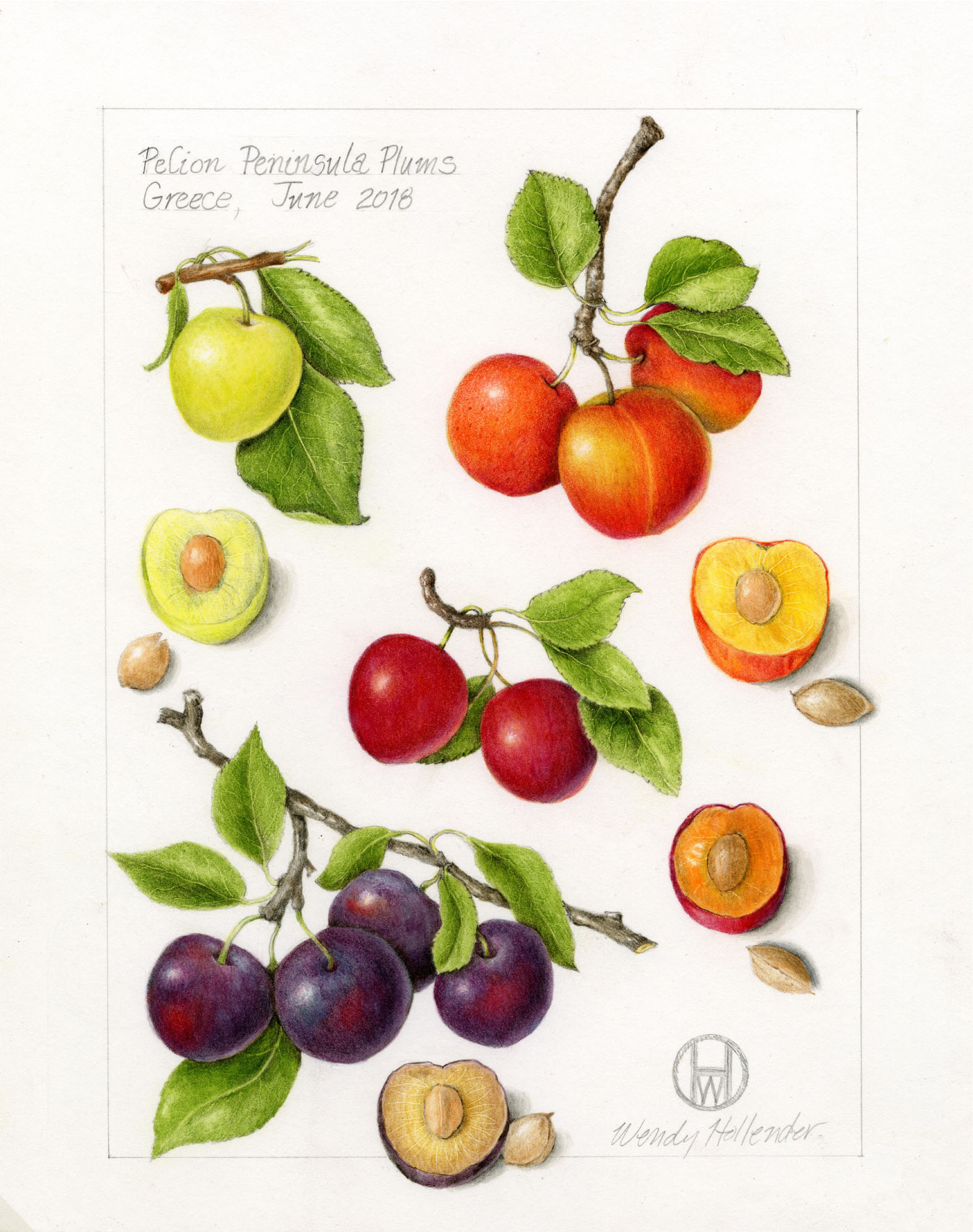
Drupe — A fleshy fruit with a hard inner stone enclosing a single seed. Cherries, plums, peaches, and mangoes are all drupes. Balance your stone fruit composition with a cross-section featuring the textured pit inside.
Follicle — A dry fruit that splits along one side only to release seeds. Milkweed pods and columbine seed heads are follicles, and when they burst open, the silk-tufted seeds inside are pure magic to draw.
Fruit — In botanical terms, a fruit is the mature ovary of a flowering plant containing one or more seeds, whether fleshy or dry, huge or tiny. This is a much broader category than the grocery store would have you believe!
Hip — The fleshy, accessory fruit of a rose plant, enclosing the seeds inside. Rosehips are a beloved autumn drawing subject; their warm reds and oranges glow beautifully in colored pencil.
Indehiscent — A fruit or pod that does not open naturally; the seeds are dispersed only when the wall decays or an animal eats it. Nuts and achenes are indehiscent.
Legume — A dry, elongated pod that splits along both seams to release seeds. Think classic pea pod shape. Legumes are wonderfully architectural and satisfying to draw in cross-section.
Nut — A hard, dry, indehiscent one-seeded fruit. Acorns, hazelnuts, and chestnuts are true nuts, and their textures and caps offer some of the most tactile and enjoyable drawing challenges. Draw along with this recording from our Mixed Nuts workshop.
Pericarp — The wall of a mature fruit, developed from the ovary wall. In fleshy fruits the pericarp is what we eat; in dry fruits it forms the hard outer coating.
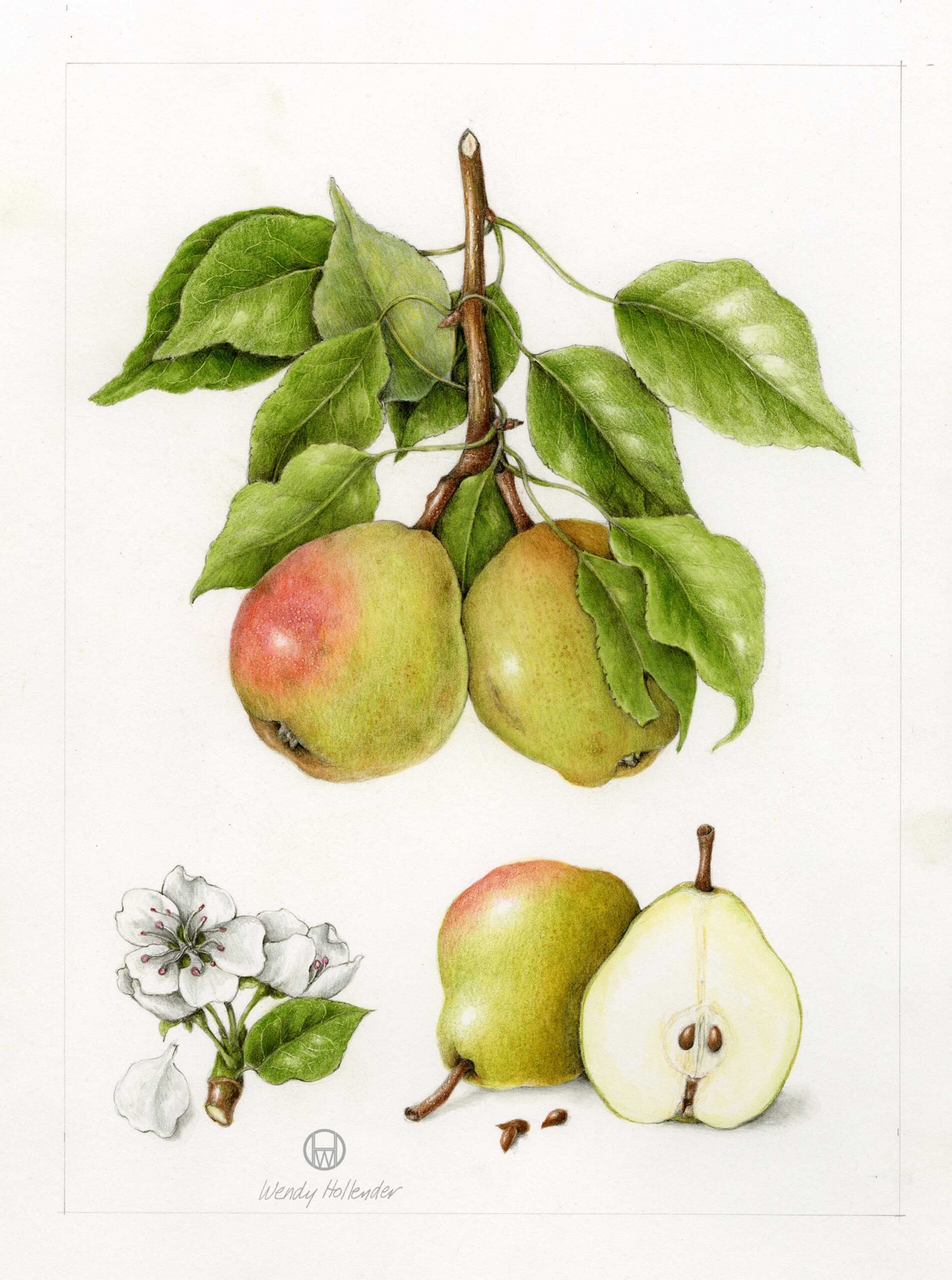
Pome — An accessory fruit where the fleshy, edible part develops from the enlarged receptacle rather than the ovary itself. Apples and pears are pomes, and their cross-sections, revealing seeds in their core, are iconic additions to complex botanical compositions.
Samara — A dry, winged fruit designed to spin and glide on the wind as it falls. Maple “helicopters” and ash keys are samaras, one of autumn’s most joyful gifts to draw.
Seed — The mature, fertilized ovule containing a plant embryo, ready to germinate into a new plant. Seeds come in extraordinary varieties (feathery, spiny, hard, papery, etc.), and every one is a tiny portrait waiting to be drawn.
Seed Pod — A type of dry dehiscent fruit (often a legume, follicle, or silique) that matures from the ovary of a flower. Find the recording from our Sensational Seed Pods drawing workshop here.
Silique — The long, narrow seedpod typical of plants in the mustard family, like honesty or wallflower. When ripe and papery, the translucent siliques of honesty are breathtaking in illustration.
Testa — The hard outer coat of a seed; its first layer of protection against the world. The testa’s texture, color, and markings are fascinating details to render closely.
Vegetable — NOT a botanical term! You may be surprised to learn that “vegetable” is a culinary category broadly referring to the edible parts of plants.
🌿 Plant Structures & General Botany Terminology
Plants prove that there’s no such thing as “normal,” so some terms don’t fit into the categories above, but since scientific illustrators capture plants in their entirety, there are a few more definitions you may want to know.
Annual — A plant that completes its full life cycle from germination to seed production within a single year. Zinnias and sunflowers are beloved annuals that need to be replanted each year.
Biennial — A plant that takes two full years to complete its life cycle, typically growing leaves in year one and flowering in year two. Foxgloves are classic biennials.
Bud — An undeveloped shoot, flower, or leaf enclosed in protective scales. Drawing a bud alongside an open flower tells a beautiful story of time and growth in a single composition.
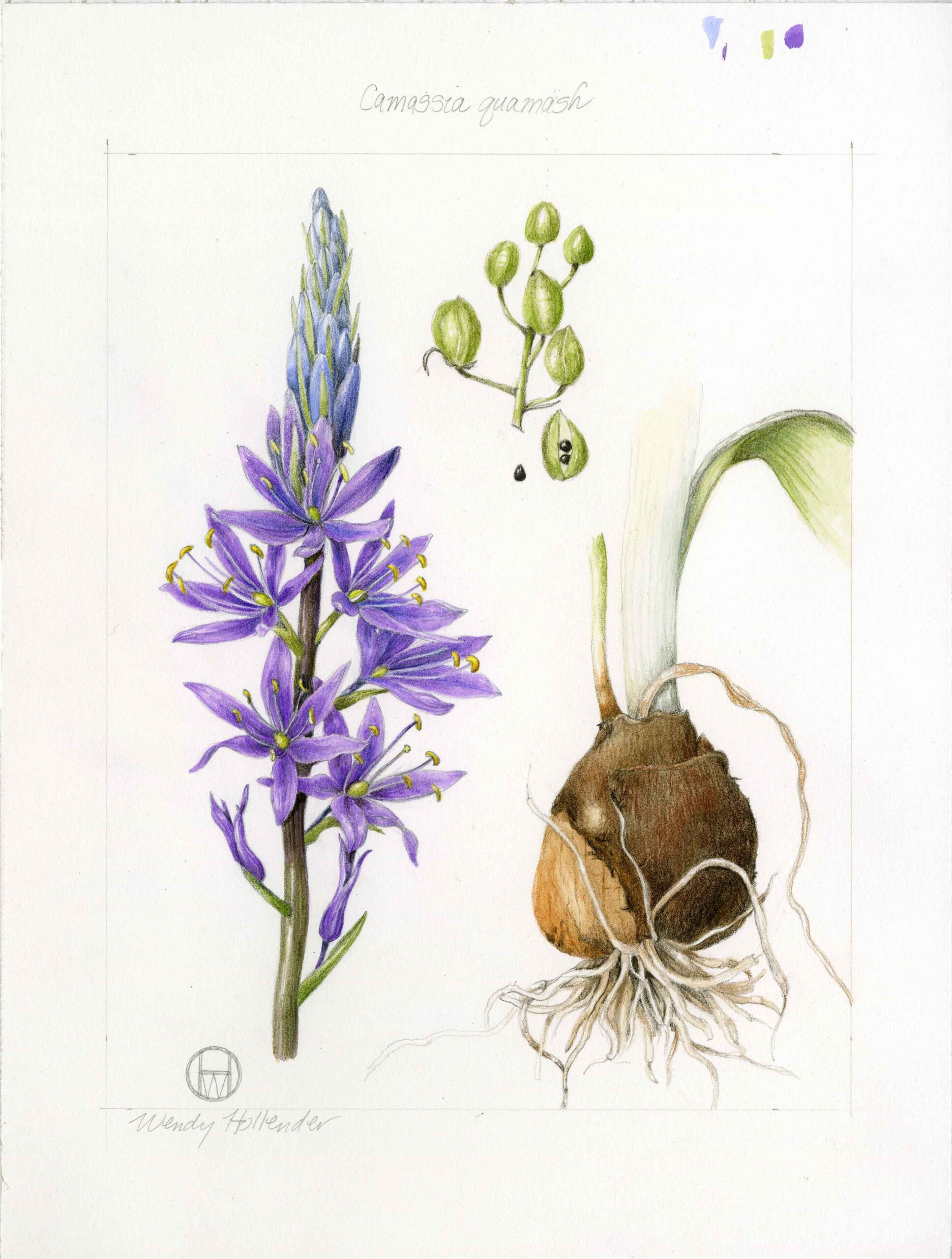
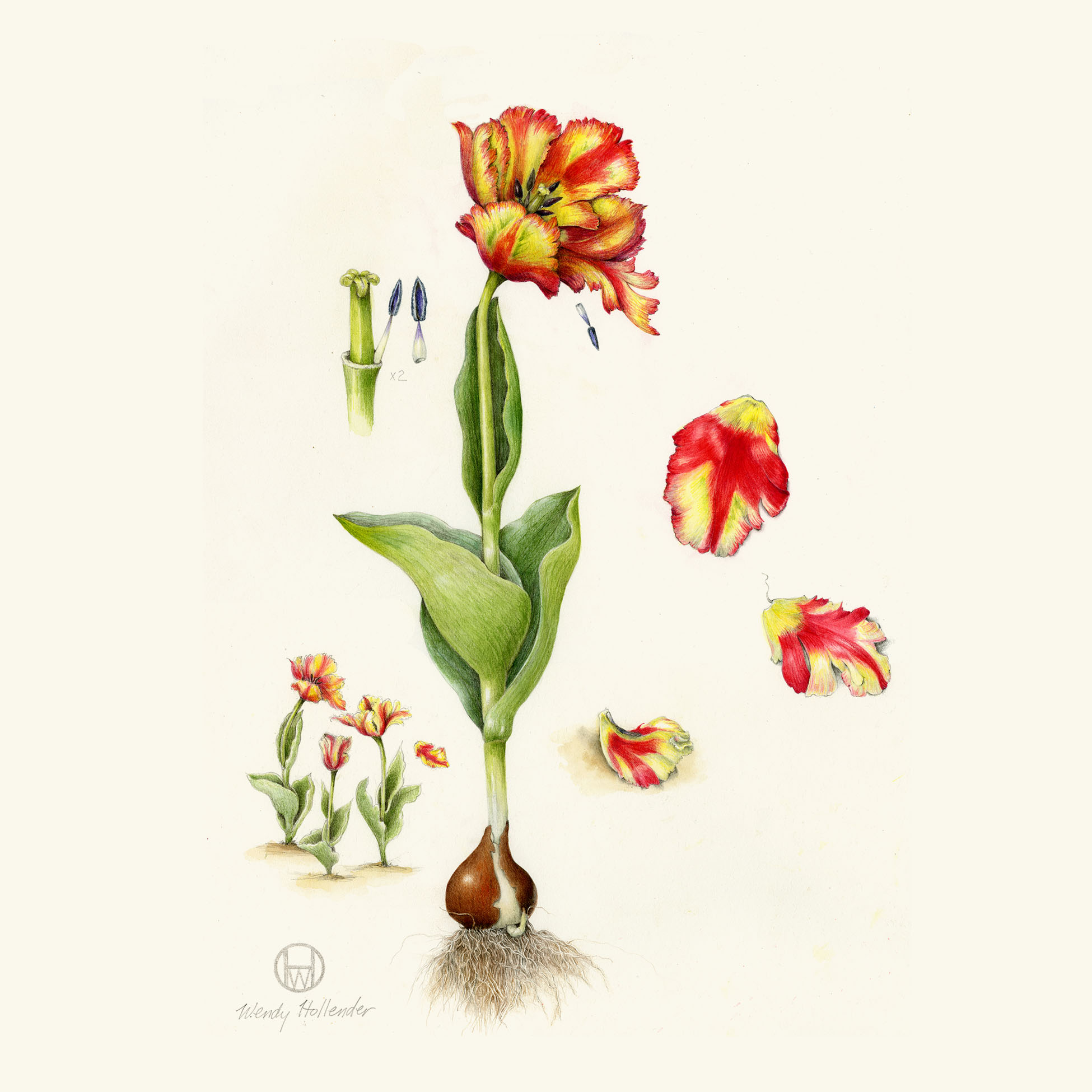
Bulb — An underground storage organ made of fleshy, layered scales, like nature’s own pantry. Tulips, daffodils, and onions grow from bulbs, which are perfect for practicing round forms and realistic roots, and they are excellent additions to complex compositions.
Cambium — A thin layer of actively dividing tissue between the bark and the wood of a stem. The cambium is where a plant’s girth grows. It’s responsible for annual rings in trees.
Corm — A solid, swollen underground stem used for food storage. Crocus and gladiolus grow from corms, similar to a bulb but solid all the way through.

Cross-section — A cut made across the width of a plant part to reveal its internal structure. Cross-sections of fruits, stems, and pods are one of botanical illustration’s most revealing and beautiful compositional elements.
Epidermis — The outermost layer of cells covering a plant organ, essentially a plant’s skin. The epidermis is what gives a leaf its surface texture and what you’re drawing when you render that waxy sheen.
Evergreen — A plant that retains its leaves throughout the year, never going fully bare. Hollies, pines, and bay laurel are evergreens. Great for winter drawing sessions because they’re always available!
Herbaceous — A plant with non-woody, soft-stemmed growth that typically dies back to the ground in winter. Most garden flowers are herbaceous. Their stems are wonderfully translucent in light.
Internode — The section of stem running between two nodes. The internode’s length varies dramatically between species and gives each plant its distinctive rhythm.
Lenticel — A small, slightly raised pore on bark or young stems that allows gas exchange with the atmosphere. For example, lenticels on cherry bark appear as horizontal dashes, which are a beautiful surface detail to include for texture.

Perennial — A plant that lives for more than two years, often dying back to the roots each winter and resprouting each spring. Peonies, hostas, and black-eyed Susans are beloved perennials that reappear once the weather warms up.
Phloem — The vascular tissue that transports sugars and nutrients produced by photosynthesis from the leaves down to the rest of the plant. The phloem is the plant’s delivery system, working hard just beneath the surface.
Rhizome — A horizontal underground stem that sends out both roots downward and new shoots upward from its nodes. Irises, ginger, and lily of the valley spread via rhizomes.
Stolon — A horizontal stem that grows along the surface of the soil, rooting at intervals where it touches ground. Strawberry runners are the most familiar example.
Taproot — A single large central root that grows straight downward, with smaller roots branching from it. Carrots and dandelions are classic examples, and a taproot cross-section makes a wonderful illustration subject.
Terminal bud — The bud at the very tip of a stem, responsible for primary upward growth. The terminal bud is the plant’s ambition, its motivation, its intention to keep growing skyward.
Xylem — The vascular tissue that transports water and dissolved minerals upward from the roots to the leaves. In woody plants, xylem forms the wood. The annual rings you see in a cross-cut trunk are layers of xylem.
🎨 Defining Drawing & Illustration Techniques
Now it’s time to dive deeper into our artistic vocabulary words! These are the tools, concepts, and techniques we use to transform a blank page into a living, breathing botanical portrait. While we primarily work in colored pencil and watercolor at Draw Botanical (see our suggested supplies list here), most of these principles travel beautifully across any medium, graphite, pen and ink, gouache, or otherwise.
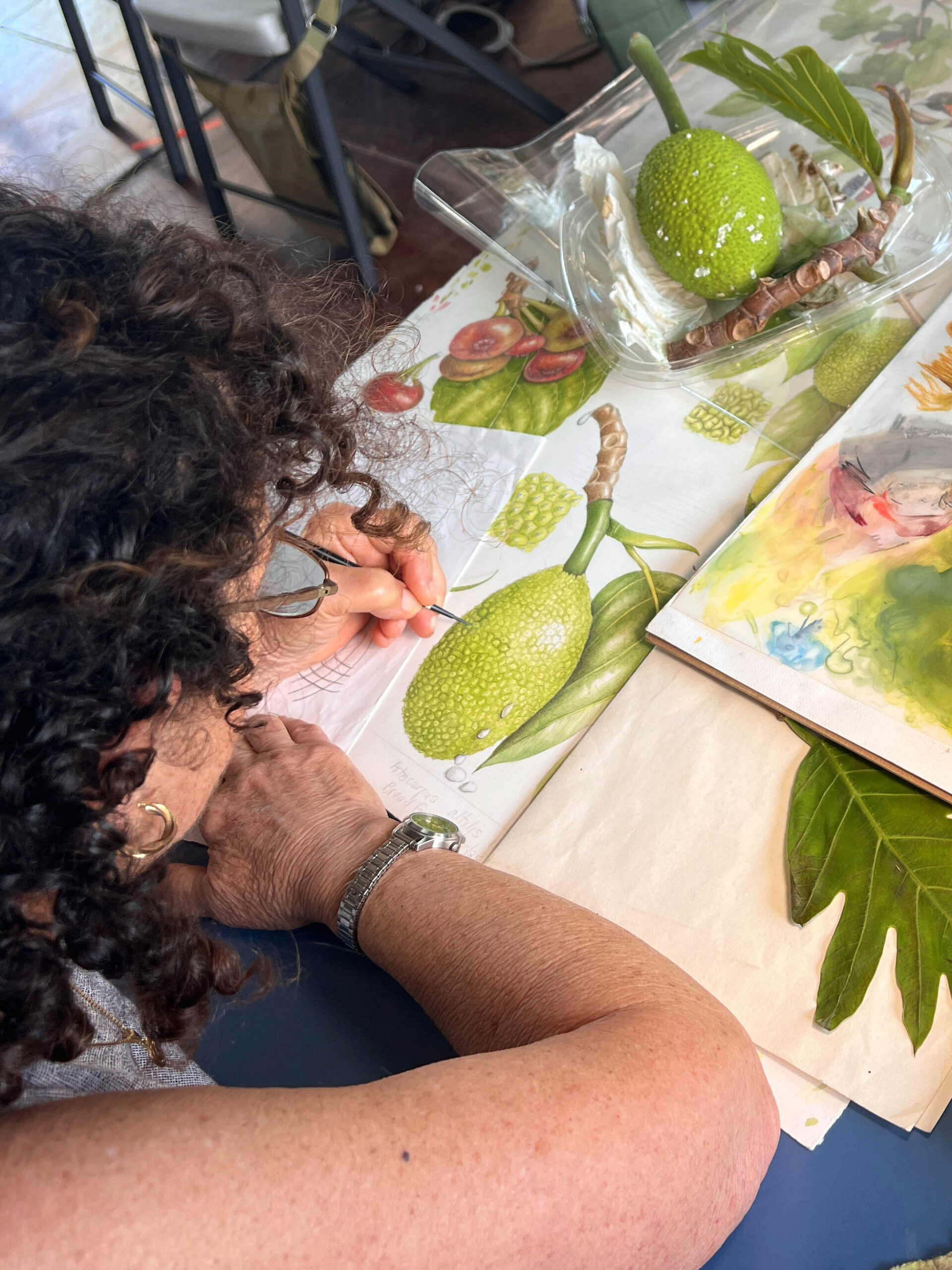
Botanical portrait — A highly detailed, scientifically accurate, and aesthetically compelling illustration of a plant or plant part. Unlike a floral still life, a botanical portrait aims to document and celebrate the subject with both accuracy and artistry.
Burnishing — A colored pencil technique where pressure is applied with a light-colored or colorless pencil to blend underlying layers into a smooth, polished, luminous surface; the magical moment a matte layer transforms into smooth silk.
Cast shadow — The shadow thrown by an object onto an adjacent or nearby surface, revealing the direction and quality of the light source. A well-observed cast shadow grounds your subject and makes it feel like it genuinely belongs in space. Learn more about cast shadows here.
Color temperature — The relative warmth (reds, oranges, yellows) or coolness (blues, violets, greens) of a color. Warmer colors appear closer, and cooler shadows push further back, adding depth to your illustrations.
Composition — The deliberate arrangement of your subject, negative space, stems, leaves, and details within the picture plane. Composition is the first decision you make and one of the most important. A good thumbnail sketch is where this magic begins. Here are 4 tips to elevate your composition.
Contour line — A line that follows and defines the outer edges and inner forms of a subject. The topography of the surface, drawn as if your pencil is traveling across the object itself. Contour drawing is a wonderful way to truly feel a plant’s form. Learn more about contour and cross-contour here.
Contrast — The degree of difference between light and dark values in a drawing. Use a full range of values (from the white of the paper to as dark as possible) to bring lighter parts forward and push darker parts back. Maximize contrast by darkening the shadows behind overlapping parts.
Core shadow — The darkest band of shadow that falls just past the turning point of a curved form, where the surface curves away from the light source but before reflected light bounces back in. Nailing the core shadow is the key to making a rounded form look fully three-dimensional.
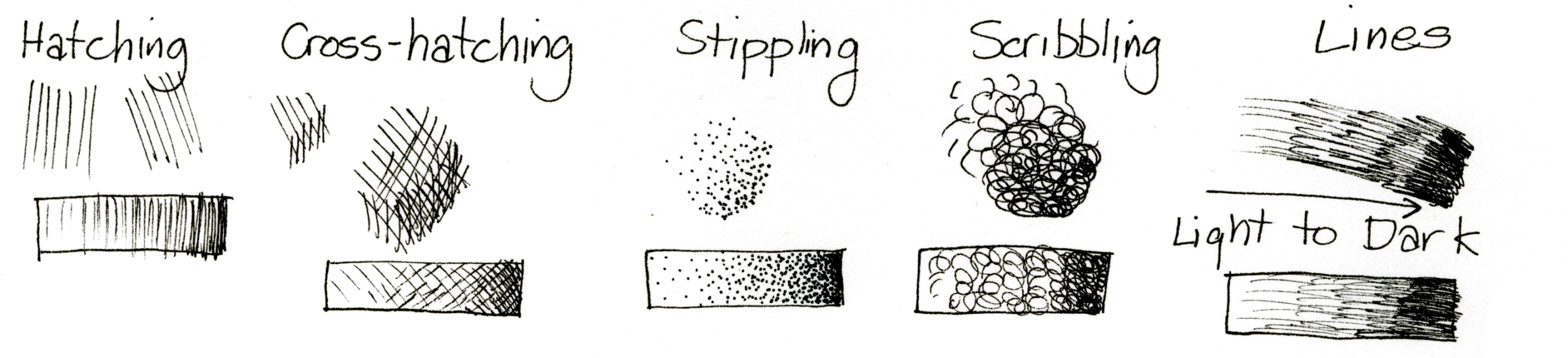
Cross-hatching — A shading technique using two or more overlapping sets of parallel lines to build up tone and texture. More commonly used in graphite and pen and ink, but the principle of building tone through layered marks applies to all media, and can be useful in quick nature journal sketches.
Depth — The convincing illusion of three-dimensional space on a two-dimensional surface. Depth is achieved through value contrast, overlapping forms, detail variation, and perspective.The central pursuit of realistic botanical illustration is to achieve three-dimensional depth on a two-dimensional surface.
Form — The three-dimensional quality of a subject, its sense of solid volume and mass. When we talk about a subject’s “form,” we mean the roundness of an orange or the cup shape of a tulip. Form is revealed by properly placing light and shadow.
Foreshortening — When a petal or leaf points toward the viewer and appears compressed. Try this cup exercise to see for yourself!
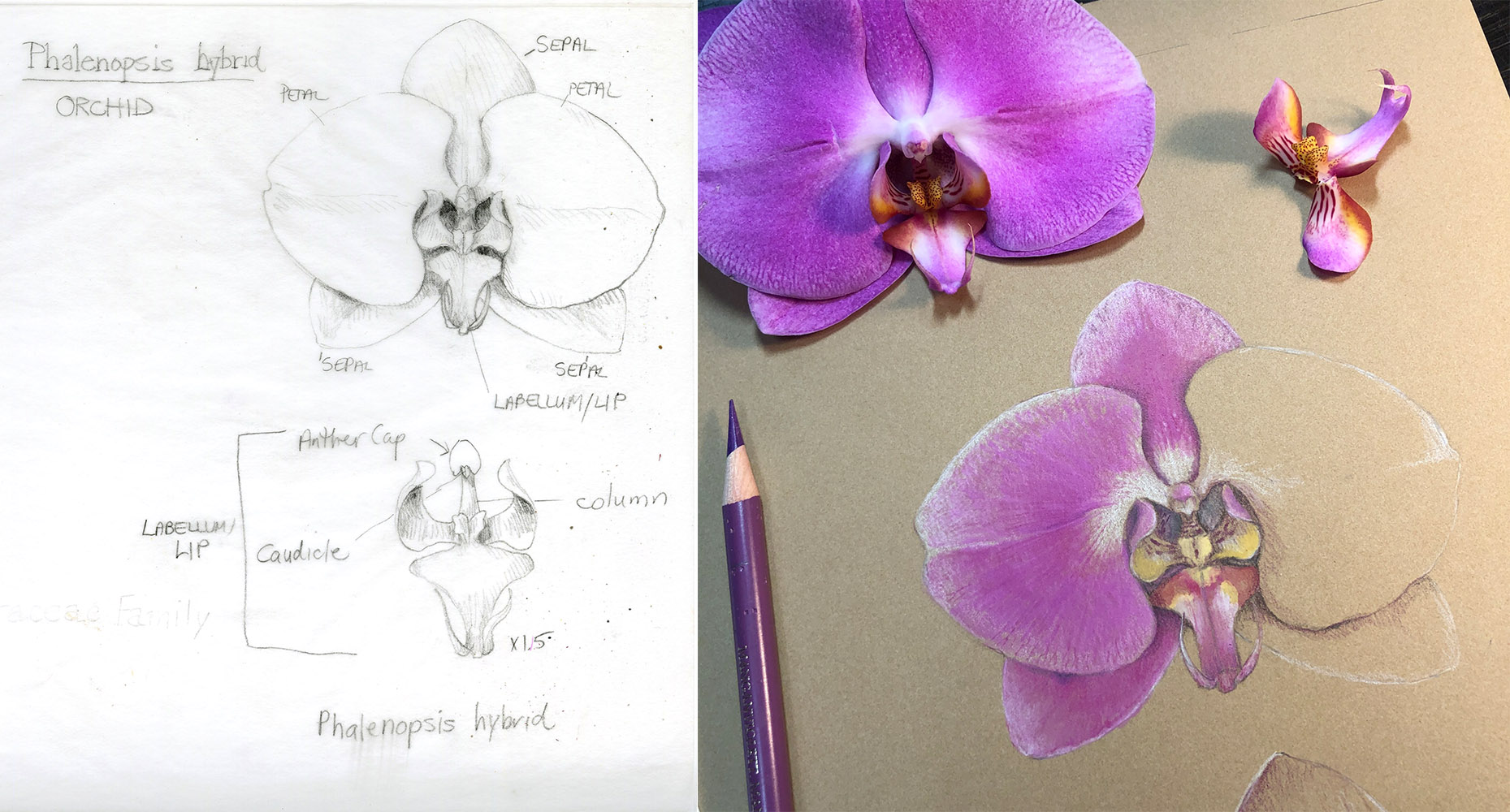
Grisaille — A complete drawing or underpainting executed entirely in shades of grey or neutral tones, used to establish a strong value structure before introducing color. Grisaille is a beautiful, meditative technique and an excellent exercise for students learning to see value independently of color.
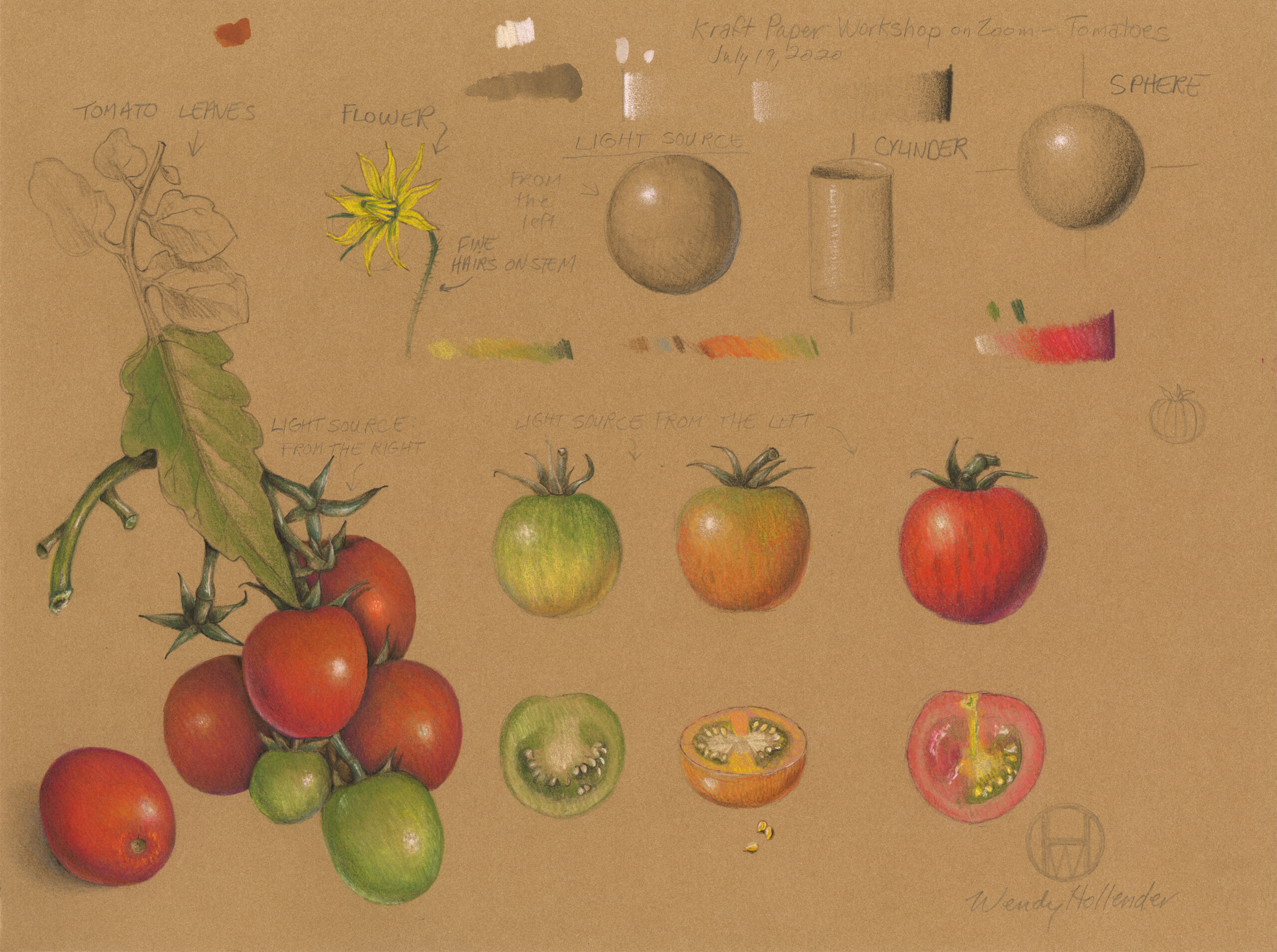
Ground — The prepared drawing surface on which you work. A “toned ground” refers to a surface that has been pre-colored or tinted. Working on a mid-toned paper allows you to work both lighter and darker from the start. Here’s what we love most about working on tan kraft paper.
Hatching — A shading technique using sets of parallel lines to build up tone, with lines placed closer together to create darker values. Hatching is the foundation of tonal drawing in pen and ink, and the principle applies in colored pencil, too.
Highlight — The brightest point on a subject where light strikes most directly; they should shimmer, not appear as a hole of empty space. Highlights on shiny surfaces will appear much brighter than on dull surfaces. Helpful hint: Start with the darkest areas, and slowly move closer to the highlight as you add layers.
Hue — The pure spectral name of a color (red, blue, yellow, violet, etc.), independent of how light or dark, or how vivid or muted, it is. Hue is just the color’s “name” in the rainbow, so hue and local color are often used interchangeably.
Layering — The technique of building up multiple translucent applications of colored pencil or watercolor to achieve depth, richness, and nuance of tone and color. Botanical illustration in colored pencil and watercolor is almost entirely about the art of layering.
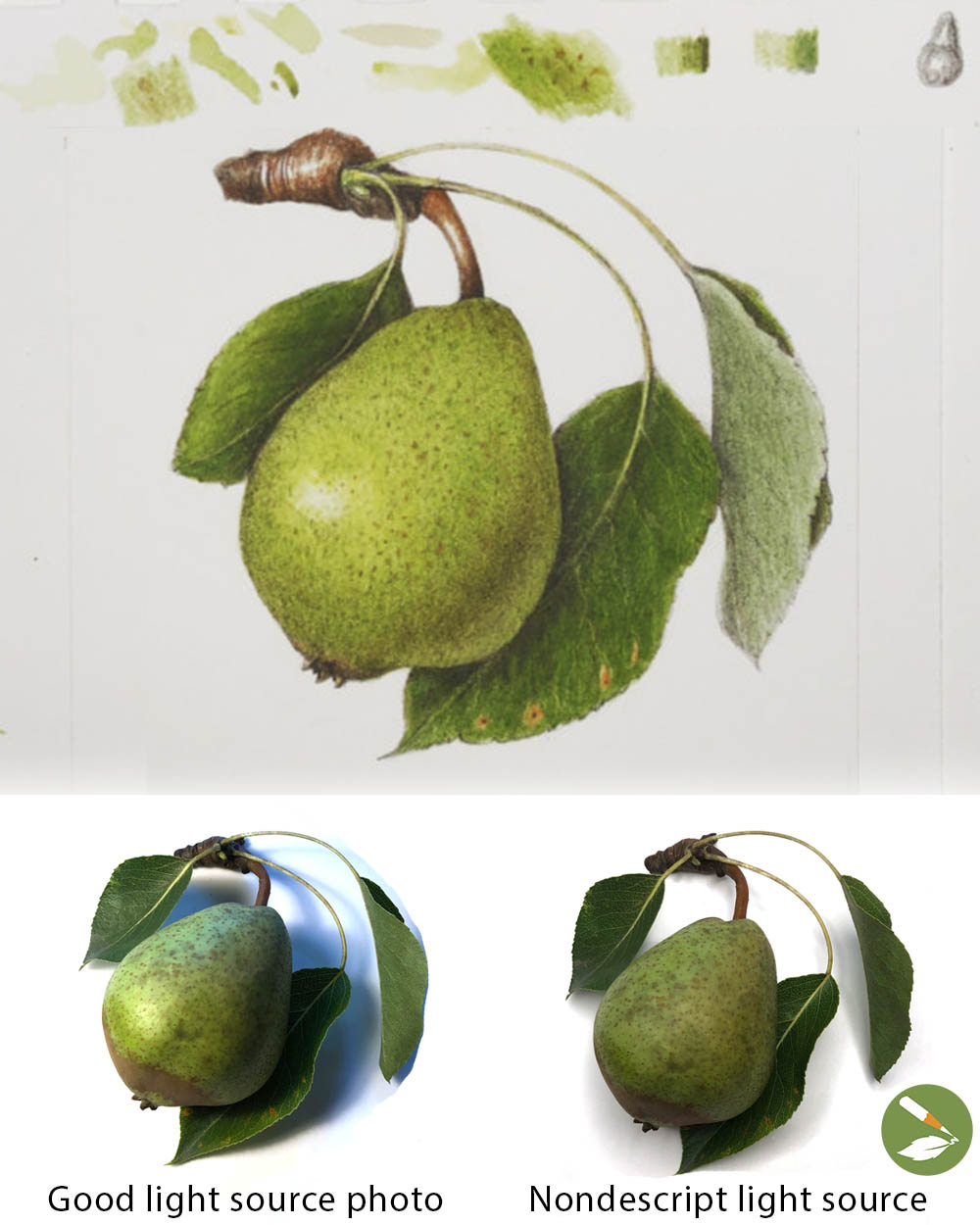
Light source — Where your light is coming from. We depict our subjects with a single light source coming from the upper left, hitting your subject at about a 45 degree angle. Find out more about light source here.
Local color — The actual, inherent color of an object as seen in neutral, even light without the influence of colored shadows or reflected light. A red apple’s local color is red, even though its shadow may appear violet and its highlight nearly white.
Negative space — The empty or background area surrounding and between the elements of your drawing. Paying attention to the shapes created by negative space is one of the most powerful techniques for improving proportion and composition.
Perspective — The technique of representing three-dimensional forms on a flat surface so they appear to recede accurately in space. In botanical illustration this is most relevant in foreshortening. Learn more about perspective here.
Picture plane — The flat, imaginary “window” of your drawing surface through which you’re viewing and depicting your subject. If we measure the height, width, and depth this way, we will have a view of the subject in perspective.
Proportion — The accurate size relationship between different parts of a subject, and between the subject and the page. Precise proportion is what separates a convincing botanical illustration from one that feels “off.” It’s always worth measuring carefully.
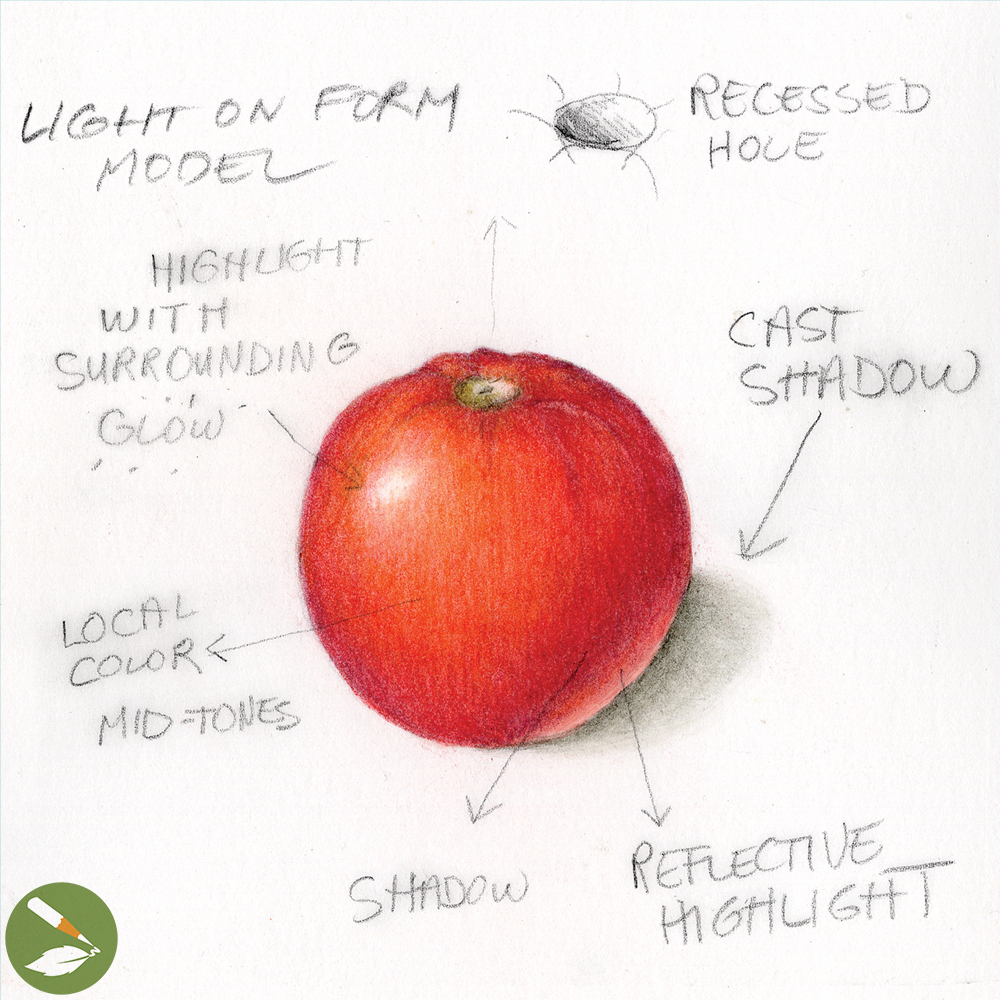
Reflective highlight — Light that bounces off a nearby surface (a table, another petal, a leaf below) and illuminates the shadow side of your subject. Reflected light can help add contrast to your drawing, but it is very subtle and is not always necessary. Here are tips to achieve a glowing reflective highlight.
Rendering (v.) — The full process of applying tone, texture, color, and detail to a drawing to create the illusion of three-dimensional reality. (ie. Rendering a botanical subject is a fun, focused act of observation.)
Rendering (n.) — An illustration or depiction. (ie. Wow, your rendering of that subject is so realistic!)
Saturation — The intensity or purity of a color, how vivid or muted it appears. A fully saturated color is as bright as it can be; a desaturated color appears dull, washed out, or greyish.
Stippling — A drawing technique using tiny dots to build up tone and texture. Stippling creates beautiful, organic textures.
Texture — The physical feel or appearance of a surface. Draw the basic foundation of a subject gets you halfway there, but adding texture elevates your illustration so it will look like it’s ready to leap off the page. Transform a basic, red sphere into a juicy, ripe tomato, almost like magic! Here are some easy techniques to help you portray realistic texture.
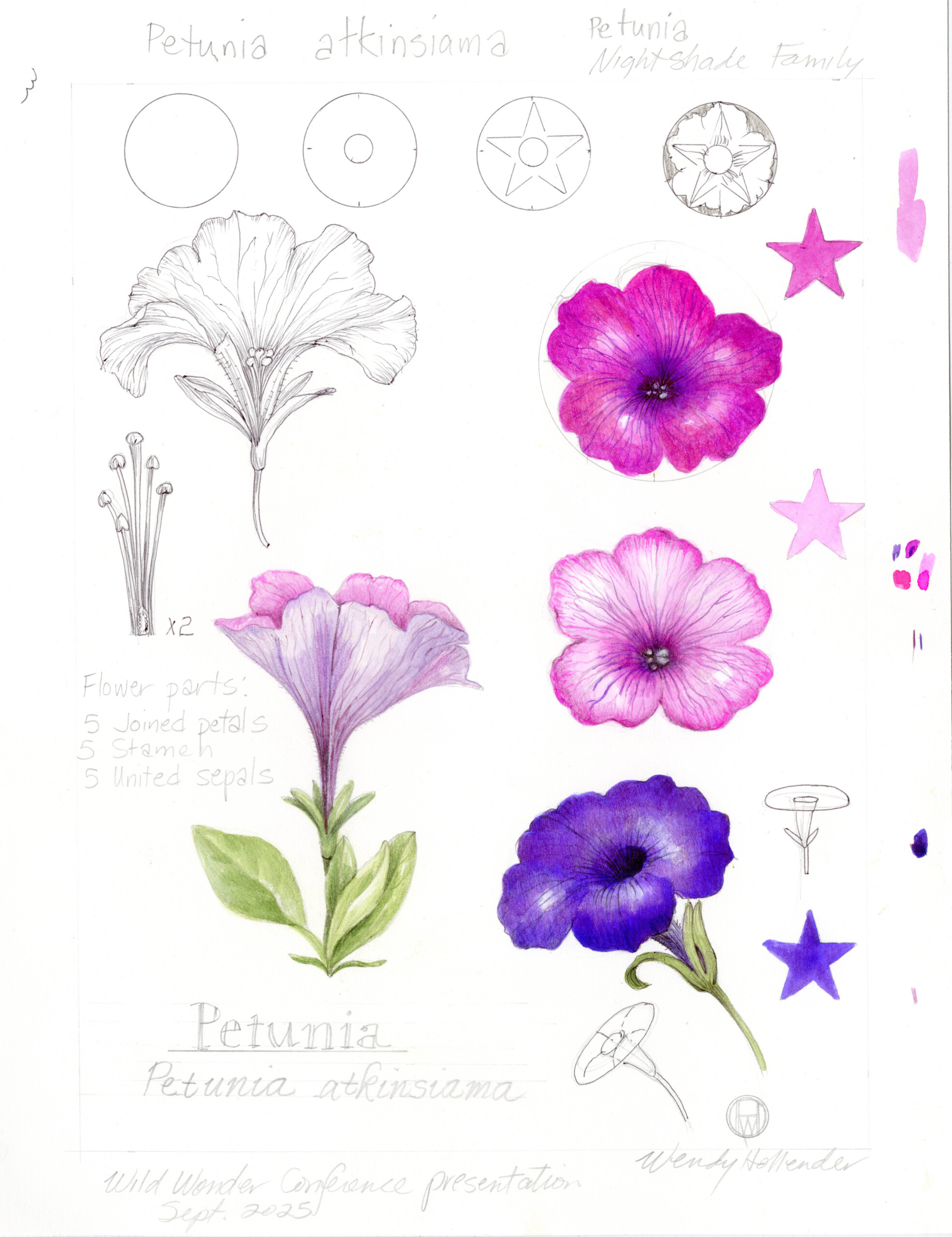
Thumbnail sketch — A small, quick, rough sketch used to plan composition, value distribution, and the placement of elements before beginning a finished illustration. Never skip your thumbnails! They save enormous time and energy later.
Tone / Toning — The process of applying graduated values (from light to midtones to deep shadow) to a drawing to suggest form, volume, and the direction of light source. Slow, continuous toning is the heart of all realistic rendering work.
Underpainting — An initial layer of paint or medium applied as a foundation for subsequent layers. In watercolor botanical illustration, a soft wash establishes the value and color structure before detailed layers are added. We often begin with grisaille to help us avoid being seduced by color in the beginning and unintentionally creating flat-looking drawings.
Value — The relative lightness or darkness of a tone on a scale from pure white to absolute black. When we seamlessly blend together a full range of values, we create the illusion of form, depth, and light more powerfully than anything else.
Value scale — A reference tool showing a gradual range from pure white through graduated grey tones to deep black. Keeping a value scale nearby while you work helps you check whether your shadows are dark enough and your lights are light enough. Try warming up with these value scale tone bars.
💡 Frequently Asked Questions
Do I need to know all of these terms to start drawing botanically?
Absolutely not! Please don’t let a long list intimidate you. You can start drawing right now with just a pencil and a real plant in front of you. But over time, as your skills and curiosity grow, understanding these terms will deepen your observation and make your illustrations richer and more satisfying. Think of this dictionary as a resource to return to again and again, not a test to pass before you begin.
What’s the difference between a botanical illustration and a floral painting?
A botanical illustration aims to document a plant accurately and completely, often showing multiple stages of growth, cross-sections, and specific anatomical details, while a floral painting prioritizes aesthetic impression. Botanical illustration requires both artistic skill and botanical knowledge, which is what makes it such a uniquely rewarding art form. Learn more about their differences here.
Does it matter what medium I use for botanical illustration?
Here is our growing list of potential materials so you can see each medium’s pros, cons, and personality and decide which is right for your next project. Historically, botanical illustration was dominated by graphite and watercolor. Today, colored pencil, watercolor pencil, pen and ink, gouache, and oil are all used by practicing botanical illustrators. At Draw Botanical we specialize in colored pencil and watercolor because of their accessibility, control, and incredible capacity for fine detail, but the artistic principles in this dictionary apply across all media.
Where can I learn more about botanical illustration technique?
Right here with us! At Draw Botanical, our team of expert instructors offers courses, books, and video lessons for all experience levels. From absolute beginners to advanced students developing their signature style, from intensive workshops to free lessons, we offer options for every step on your botanical drawing journey.
Explore our full range of classes and start drawing today!
How do I identify plant parts on a real specimen before I draw it?
The best way is to spend time with the plant before you even pick up a pencil! Rotate it, look at it from all angles, feel its textures, count its petals and stamens, observe how the leaves are arranged on the stem. A good hand lens or magnifying glass is a valuable tool in a botanical illustrator’s kit. Here’s our guide to identifying plants, spotting plant patterns and drawing what you see.
What’s the best paper for colored pencil botanical illustration?
For us, it’s smooth, hot-press watercolor paper, which is great for fine detail work. This is why it’s our favorite! Some artists prefer the texture of cold-press paper; it all depends on personal preference and how small you want to be able to make your tiniest details. Your paper is your ground, and the right choice makes every layer more enjoyable.
🌱 Ready to Grow? Let’s Draw Together.
The best thing about botanical illustration is that every single drawing is a conversation between you, your pencil, and a living, breathing plant. The more vocabulary you carry into that conversation (whether it’s knowing the difference between a pedicel and a peduncle, or understanding why a burnished layer glows), the richer that conversation becomes.
Just as you prepare your kitchen before you jump into the art of cooking, you must prepare your knowledge before you jump into the art of botanical illustration. And now? You’re more prepared than ever.
We’d love to be your guides on this journey. At Draw Botanical, our collective team of instructors brings decades of experience, a deep love of the natural world, and a genuine joy in teaching to every lesson we create.
Anyone can draw! Let’s learn together. 🌿 → Explore All Classes & Video Lessons at Draw Botanical
📚 References & Further Reading
- Wikipedia: Glossary of Botanical Terms — A comprehensive, free reference for botanical terminology
- The American Society of Botanical Artists (ASBA) — The leading professional organization for botanical artists in the United States, with extensive resources for students and practitioners
- Hunt Institute for Botanical Documentation, Carnegie Mellon University — A world-class archive of botanical art and illustration history. The Institute acquires and maintains authoritative collections of books, plant images, manuscripts, portraits and data files, and provides publications and other modes of information service.
- Illinois Wildflowers: Definitions and Line Drawings of Botanical Terminology — Clear botanical term definitions with some helpful line drawings
- The Cambridge Illustrated Glossary of Botanical Terms by Hickey & King (Cambridge University Press) — A beautifully illustrated reference with over 2,400 definitions; an essential bookshelf companion for serious botanical illustrators
- Botanical Art Techniques by the American Society of Botanical Artists (Timber Press) — The definitive guide to materials and methods across all media